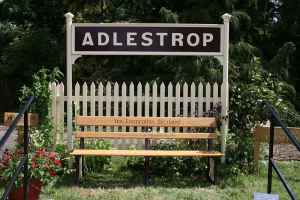
Yes, I remember Adlestrop –
The name, because one afternoon
Of heat the express-train drew up there
Unwontedly. It was late June.
The steam hissed. Someone cleared his throat.
No one left and no one came
On the bare platform. What I saw
Was Adlestrop – only the name
And willows, willow-herb, and grass,
And meadowsweet, and haycocks dry,
No whit less still and lonely fair
Than the high cloudlets in the sky.
And for that minute a blackbird sang
Close by, and round him, mistier,
Farther and farther, all the birds
Of Oxfordshire and Gloucestershire. 🌹🌹 — Edward Thomas : :🌹🌹🌹🌹🌹🌹🌹🌹🌹🌹🌹🌹🌹🌹🌹🌹🌹🌹🌹🌹🌹🌹🌹🌹🌹🌹🌹 અર્થ નિર્દેશ આસ્વાદ કાવ્યાર્થ વિચાર સંકલન વિ જયરાજ :: ‘Adlestrop’. The setting for this poem is the railway station serving the small village of Adlestrop in Gloucestershire; the moment is a day in ‘late June’ – specifically, late June 1914, when Thomas, on his Summer day lakeway to visit Robert Frost, noted the summery sounds and sights while the train stopped at the station. The poem captures a moment of English summer tranquillity in a few vivid, evocative images and sounds. : : : : The wonderful sixteen-line poem, which was once ranked Britain’s 20th favourite poem : : : : The origins of the poem lie in an event that took place on 24 June 1914, while English poet Edward Thomas (1878-1917) was on the Oxford to Worcester express train. The train made an unscheduled stop at Adlestrop (formerly Titlestrop) in Gloucestershire, a tiny village in the Cotswolds with a population of just over 100. (Jane Austen visited Adlestropthe former rectory at Adlestrop three times – her mother’s cousin lived there – and Mansfield Park in her novel of that name may have been partly inspired by her visits to Adlestrop House.) : : : : Detailed Poem Analysis : Pending : : : : Presented by V Jayaraj Pune India : : May 9 , 2022 : : : :
 MADHU MALTI