December : Matthew Zapruder : : December Poems : : Months Poems : :

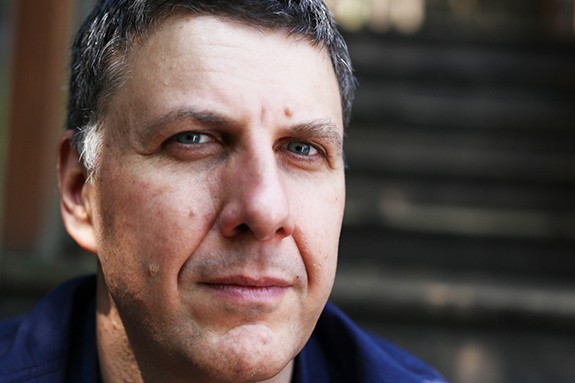
Matthew Zepruder : Photo by B.A. Van Sise : : Matthew Zepruder
Poet and editor Matthew Zapruder ( b. 1967 ) was born in Washington, DC. He earned a BA in Russian literature at Amherst College, an MA in Slavic languages and literature at the University of California, Berkeley, and an MFA in poetry at the University of Massachusetts, Amherst.

Zapruder’s poems employ nuanced, conversational syntax to engage themes of grief, perception, and logic. As Dana Jennings noted in the New York Times, Zapruder has a “razor eye for the remnants and revenants of modern culture.” Discussing his own development as a writer in the Los Angeles Times, Zapruder addressed the role of rhyme in his work: “[T]he rhyme is what I would call ‘conceptual,’ that is, not made of sounds, but of ideas that accomplish what the sounds do in formal poetry: to connect elements that one wouldn’t have expected, and to make the reader or listener, even if just for a moment, feel the complexity and disorder of life, and at the same time what Wallace Stevens called the ‘obscurity of an order, a whole.’”

Zapruder is the author of several collections of poetry, including Father’s Day (2019), Sun Bear (2014), Come On All You Ghosts (2010), The Pajamaist (2006), and American Linden (2002). He collaborated with painter Chris Uphues on For You in Full Bloom (2009) and cotranslated, with historian Radu Ioanid, Romanian poet Eugen Jebeleanu’s last collection, Secret Weapon: Selected Late Poems (2008).

With Brian Henry, Zapruder cofounded Verse Press, which later became Wave Books. As an editor for Wave Books, Zapruder coedited, with Joshua Beckman, the political poetry anthology State of the Union: 50 Political Poems (2008). His own poems have been included in the anthologies Best American Poetry (2013, 2009), Third Rail: The Poetry of Rock and Roll (2007), and Legitimate Dangers: American Poets of the New Century (2006), as well as Poets on Teaching: A Sourcebook (2010). He is also the author of Why Poetry (2017), a book of prose about reading poetry for a general audience.

Zapruder’s poetry has been adapted by some of America’s most exciting young composers. In Fall, 2012, his poetry was adapted and performed at Carnegie Hall by Composer Gabriel Kahane and Brooklyn Rider. In February, 2014, composer Missy Mazzoli, along with Victoire and Glenn Kotche, performed Vespers for a New Dark Age, a piece commissioned by Carnegie Hall for the 2014 Ecstatic Music Festival, and released as a recording on New Amsterdam records in spring, 2015.

Zapruder’s honors include a Guggenheim Fellowship, a Lannan Foundation Residency Fellowship, the William Carlos Williams Award from the Poetry Society of America, and the May Sarton Prize from the American Academy of Arts and Sciences. He has taught at New York University, the New School, the University of California Riverside – Palm Desert Low Residency MFA Program, the University of Massachusetts, Amherst’s Juniper Summer Writing Institute, and at the University of California at Berkeley as the Holloway Fellow.He has also worked as an editor, annually editing the Poetry Column for the New York Times Magazine.

He lives in Oakland, where he is an associate professor in the Saint Mary’s College of California MFA Program in Creative Writing, as well as editor at large for Wave Books. He is also a guitarist in the rock band The Figments. From poetryfoundation.org

December
BY MATTHEW ZAPRUDER
At first we all
went down to the lake
to hold hands,
all the multicolored
signs said
with love
we will resist,
over my head
I lifted my son
so he could see
what people
look like
when they hear
the song Imagine,
a few weeks later
again people stood
at the water,
this time at night
holding flashlights
to say to fire
you came
without permission
and took our young
gentle soldiers
for art
so we will show
even with our old
technology
we can see
each other
without you,
others booed
the mayor which was
my friend said
understandable,
I don’t know
what is anymore,
everyone understands
in a different
contradictory way
the so far purely
abstract
catastrophe
so many millions
of choices
brought us,
not too far
from the water
I sat on the couch
below the sound
of blades
drinking amber
numbing fluid
my thoughts
chopping the air
feeling not
what is the word
to be a father
equipped,
mine never told me
where to hide
a brick of gold,
for a long time
I have known
no voices
will come at last
to tell us how
to stop pretending
we don’t know
if it is not
safe for some
it is not
for anyone.
Matthew Zapruder, “December” from Father’s Day (2019 ) Copper Canyon Press, Source : coppercanyonpress.org. : From poetryfoundation.org : For Educational Purposes only.

Notes for each of the lines Pending visit this post again later on to enjoy the appreciation of the poem V Jayaraj Pune India June 24 , 2023 : : : :

A December Day : Judge J. A. Kerr : : December Poems : : Months Poems : :

A December Day : : Judge J. A. Kerr : : : :

Low-drifting clouds o’erspread the sky;
The day is dull, the landscape drear;
On earth’s fair bosom snowflakes lie,
While trees, their snow-clad branches rear.

From lowering clouds the winter rain,
Cheerless, descends no longer, now;
To patter loud on roof and pane,
But falls the dancing flakes of snow.


The birds give forth no notes of cheer,
For they have flown. The woods are still;
The fields are shorn, and brown, and sear;
Ice-bound are river, brook and rill.

All nature seems grown gray with rime,
And long for rest—to die, to sleep;
Like man, woos sweet rest, courts decline,
And feels the death-chill oer her creep.

Her race seems short, and almost run:
Her knell is tolled by pattering hail.
In clouds of crape is clad the sun;
The wind gives forth a moaning wall.

The earth seems wrapped in her last sleep—
All nature robed in shrouds of snow.
The lowering clouds in pity weep,
That she, like man, is thus laid low.

Stanzas 1, 2 & 3 : : “A December Day”,By Judge J A Kerr is About a “dull day”of December finding “drear landscape”, an affectionate cover on fair looking earth with “dancing snow-flakes” ❄️🌨️, aimlessly floating “clouds overspreading the sky”that cause “cheerless” – “winter Rain” stopped to take the form of snow , the still woods – without chirping of birds, shorn fields appearing dried (” sear”) and brown, “ice – bound river” giving away in “brook” and “rivulet”

Notes for Stanzas 4 , 5 & 6 Pending visit this post again later on to enjoy the appreciation of the poem V Jayaraj Pune India June 23, 2023 : : : :

December: Sir Edwin Arnold : : December Poems : : Months Poems : :

December : : Sir Edwin Arnold: born: 10 June 1832 — 24 March , 1904 , London , U. K. : : : : : ;
In fret-work of frost and spangle of snow
Unto his end the year doth wend;
And sadly for some the days did go,
And glad for some were beginning and end!
But—sad or glad—grieve not for his death,
Mournfully counting your measures of breath,
You, that, before the stars began,
Were seed of woman and promise of man,
You who are older than Aldebaran!
It was but a ring round about the Sun,
One passing dance of the planets done;
One step of the Infinite Minuet
Which the great worlds pace, to a music set
By Life immortal and Love divine:
Whereof is struck, in your threescore and ten,
One chord of the harmony, fair and fine,
Of that which maketh us women and men!
In fret-work of frost and spangle of snow,
Sad or glad—let the old year go.

” December”, By Sir Edwin Arnold , CSI CIE was an English poet and journalist who is most known for his work, The Light of Asia; is About An Sending Off to a Month of December in The poet Speaker’s dispatching last line of expression, ” In fret-work of frost and spangle of snow,
Sad or glad—let the old year go.”.

Notes for each of the lines Pending visit this post again later on to enjoy the appreciation of the poem V Jayaraj Pune India June 22 , 2023 : ; ; :

December : Henry G. Hewlett : : December Poems : : Months Poems : :

December : : By Henry G. Hewlett : :


An old man’s life, dim, colorless and cold,
Is like the earth and sky December shows.
The barest joys of sense are all he knows:
Hope that erewhile made their fruition bold,
Now soars beyond. If one sun-glint of gold,
Rifts in the dense grey firmament disclose,
Earth has enough. ‘Mid purple mist upthrows
The birch her silver; the larch may hold
With fragile needles yet its amber cone,
Tho’ other trees be dark: the pine alone,
Like memory, lingers green, till over all,
Death-like, the snow doth cast its gentle pall.
Child-month and Mother-year in death are one:
The winds of midnight moan memorial.

“December”By Henry G Hewlett is About “An Old man’s life, dim 🔅, colourless and cold ❄️🥶 , like the earth sky as shown by December” and “Death ☠️💀 – like , the snow” ❄️🌨️ , further relating the old man’s paining commemorative memorial vocalised in the sounds of “The winds of midnight.” : : : :

Notes for each of the lines Pending visit this post again later on to enjoy the appreciation of the poem V Jayaraj Pune India June 21 , 2023 : : : :

December : Mary Elizabeth [McGrath] Blake : : December Poems: : Months Poems : :

December : Mary Elizabeth [McGrath] Blake: Chill the night wind moans and sighs, On the sward the stubble dies; Slow across the meadows rank Float the cloud-rifts grim and dank; On the hill-side, bare and brown, Twilight shadows gather down,— ‘Tis December. : : ❄️🌨️❄️🌨️❄️🌨️❄️🌨️❄️🌨️ ❄️🌨️ Stark and gaunt the naked trees Wrestle with the wrestling breeze, While beneath, at every breath, Dead leaves hold a dance of death; But the pine-trees’ sighing grace Greenly decks the barren place, In December. : ❄️ 🌨️ ❄️🌨️❄️🌨️ ❄️ 🌨️ ❄️🌨️❄️🌨️ Chirp of bird nor hum of bee Breaks across the barren lea; Only silence, cold and drear, Nestles closely far and near, While in cloak of russet gray, Nature hides her bloom away With December. : : ❄️ 🌨️ ❄️ 🌨️ 🌨️❄️ 🌨️❄️🌨️ Yet we know that, sleeping sound, Life is waiting underground; Till beneath his April skies God shall bid it once more rise, Warmth and light and beauty rest Hushed and calm, upon the breast Of December.❄️ So, though sometimes winter skies Hide the summer from our eyes, Taking from its old time place Some dear form of love and grace, We can wait, content to bear Barren fields and frosted air, Through December ❄️ We can wait, till some sweet dawn Finds the shadows backward drawn, And beneath its rosy light Maytime flushes, warm and bright, Bring again the bloom that fled When the earth lay cold and dead In December.

– – – Mary-Elizabeth-McGrath-Blake

“December” By Mary Elizabeth ( McGrath ) Blake (September 1, 1840 – February 26, 1907) an Irish-American poet is About pictorial representation of The Season of Winter Cold 🥶 and its impact in the world around.

A Childs Christmas In Wales : Thomas Dylan : : December Poems : : Months Poems : :


.


A Childs Christmas In Wales
by Dylan Thomas
One Christmas was so much like another, in those years around the sea-town corner now and out of all sound
except the distant speaking of the voices I sometimes hear a moment before sleep, that I can never remember
whether it snowed for six days and six nights when I was twelve or whether it snowed for twelve days and twelve
nights when I was six.


All the Christmases roll down toward the two-tongued sea, like a cold and headlong moon bundling down the sky
that was our street; and they stop at the rim of the ice-edged fish-freezing waves, and I plunge my hands in
the snow and bring out whatever I can find.
In goes my hand into that wool-white bell-tongued ball of holidays
resting at the rim of the carol-singing sea, and out come Mrs.
Prothero and the firemen.


It was on the afternoon of the Christmas Eve, and I was in Mrs.
Prothero’s garden, waiting for cats, with her
son Jim.
It was snowing.
It was always snowing at Christmas.
December, in my memory, is white as Lapland,
though there were no reindeers.
But there were cats.
Patient, cold and callous, our hands wrapped in socks, we
waited to snowball the cats.
Sleek and long as jaguars and horrible-whiskered, spitting and snarling, they
would slink and sidle over the white back-garden walls, and the lynx-eyed hunters, Jim and I, fur-capped and
moccasined trappers from Hudson Bay, off Mumbles Road, would hurl our deadly snowballs at the green of their
eyes.
The wise cats never appeared.


We were so still, Eskimo-footed arctic marksmen in the muffling silence of the eternal snows – eternal, ever
since Wednesday – that we never heard Mrs.
Prothero’s first cry from her igloo at the bottom of the garden.
Or,
if we heard it at all, it was, to us, like the far-off challenge of our enemy and prey, the neighbor’s polar
cat.
But soon the voice grew louder.

“Fire!” cried Mrs.
Prothero, and she beat the dinner-gong.


And we ran down the garden, with the snowballs in our arms, toward the house; and smoke, indeed, was pouring
out of the dining-room, and the gong was bombilating, and Mrs.
Prothero was announcing ruin like a town crier
in Pompeii.
This was better than all the cats in Wales standing on the wall in a row.
We bounded into the
house, laden with snowballs, and stopped at the open door of the smoke-filled room.


Something was burning all right; perhaps it was Mr.
Prothero, who always slept there after midday dinner with a
newspaper over his face.
But he was standing in the middle of the room, saying, “A fine Christmas!” and
smacking at the smoke with a slipper.


“Call the fire brigade,” cried Mrs.
Prothero as she beat the gong.

“There won’t be there,” said Mr.
Prothero, “it’s Christmas.

There was no fire to be seen, only clouds of smoke and Mr.
Prothero standing in the middle of them, waving his
slipper as though he were conducting.

“Do something,” he said.
And we threw all our snowballs into the smoke – I think we missed Mr.
Prothero – and
ran out of the house to the telephone box.

“Let’s call the police as well,” Jim said.
“And the ambulance.
” “And Ernie Jenkins, he likes fires.


But we only called the fire brigade, and soon the fire engine came and three tall men in helmets brought a hose
into the house and Mr.
Prothero got out just in time before they turned it on.
Nobody could have had a noisier
Christmas Eve.
And when the firemen turned off the hose and were standing in the wet, smoky room, Jim’s Aunt,
Miss.
Prothero, came downstairs and peered in at them.
Jim and I waited, very quietly, to hear what she would
say to them.
She said the right thing, always.
She looked at the three tall firemen in their shining helmets,
standing among the smoke and cinders and dissolving snowballs, and she said, “Would you like anything to read?”

Years and years ago, when I was a boy, when there were wolves in Wales, and birds the color of red-flannel
petticoats whisked past the harp-shaped hills, when we sang and wallowed all night and day in caves that smelt
like Sunday afternoons in damp front farmhouse parlors, and we chased, with the jawbones of deacons, the
English and the bears, before the motor car, before the wheel, before the duchess-faced horse, when we rode the
daft and happy hills bareback, it snowed and it snowed.
But here a small boy says: “It snowed last year, too.
I
made a snowman and my brother knocked it down and I knocked my brother down and then we had tea.


“But that was not the same snow,” I say.
“Our snow was not only shaken from white wash buckets down the sky, it
came shawling out of the ground and swam and drifted out of the arms and hands and bodies of the trees; snow
grew overnight on the roofs of the houses like a pure and grandfather moss, minutely -ivied the walls and
settled on the postman, opening the gate, like a dumb, numb thunder-storm of white, torn Christmas cards.


“Were there postmen then, too?”
“With sprinkling eyes and wind-cherried noses, on spread, frozen feet they crunched up to the doors and
mittened on them manfully.
But all that the children could hear was a ringing of bells.

“You mean that the postman went rat-a-tat-tat and the doors rang?”
“I mean that the bells the children could hear were inside them.

“I only hear thunder sometimes, never bells.

“There were church bells, too.

“Inside them?”
“No, no, no, in the bat-black, snow-white belfries, tugged by bishops and storks.
And they rang their tidings
over the bandaged town, over the frozen foam of the powder and ice-cream hills, over the crackling sea.
It
seemed that all the churches boomed for joy under my window; and the weathercocks crew for Christmas, on our
fence.


“Get back to the postmen”
“They were just ordinary postmen, found of walking and dogs and Christmas and the snow.
They knocked on the
doors with blue knuckles .
.
.
.

“Ours has got a black knocker.
.
.
.

“And then they stood on the white Welcome mat in the little, drifted porches and huffed and puffed, making
ghosts with their breath, and jogged from foot to foot like small boys wanting to go out.

“And then the presents?”
“And then the Presents, after the Christmas box.
And the cold postman, with a rose on his button-nose, tingled
down the tea-tray-slithered run of the chilly glinting hill.
He went in his ice-bound boots like a man on
fishmonger’s slabs.

“He wagged his bag like a frozen camel’s hump, dizzily turned the corner on one foot, and, by God, he was
gone.


“Get back to the Presents.

“There were the Useful Presents: engulfing mufflers of the old coach days, and mittens made for giant sloths;
zebra scarfs of a substance like silky gum that could be tug-o’-warred down to the galoshes; blinding tam-o’-
shanters like patchwork tea cozies and bunny-suited busbies and balaclavas for victims of head-shrinking
tribes; from aunts who always wore wool next to the skin there were mustached and rasping vests that made you
wonder why the aunts had any skin left at all; and once I had a little crocheted nose bag from an aunt now,
alas, no longer whinnying with us.
And pictureless books in which small boys, though warned with quotations not
to, would skate on Farmer Giles’ pond and did and drowned; and books that told me everything about the wasp,
except why.


“Go on the Useless Presents.

“Bags of moist and many-colored jelly babies and a folded flag and a false nose and a tram-conductor’s cap and
a machine that punched tickets and rang a bell; never a catapult; once, by mistake that no one could explain, a
little hatchet; and a celluloid duck that made, when you pressed it, a most unducklike sound, a mewing moo that
an ambitious cat might make who wished to be a cow; and a painting book in which I could make the grass, the
trees, the sea and the animals any colour I pleased, and still the dazzling sky-blue sheep are grazing in the
red field under the rainbow-billed and pea-green birds.
Hardboileds, toffee, fudge and allsorts, crunches,
cracknels, humbugs, glaciers, marzipan, and butterwelsh for the Welsh.
And troops of bright tin soldiers who,
if they could not fight, could always run.
And Snakes-and-Families and Happy Ladders.
And Easy Hobbi-Games for
Little Engineers, complete with instructions.
Oh, easy for Leonardo! And a whistle to make the dogs bark to
wake up the old man next door to make him beat on the wall with his stick to shake our picture off the wall.

And a packet of cigarettes: you put one in your mouth and you stood at the corner of the street and you waited
for hours, in vain, for an old lady to scold you for smoking a cigarette, and then with a smirk you ate it.
And
then it was breakfast under the balloons.


“Were there Uncles like in our house?”
“There are always Uncles at Christmas.
The same Uncles.
And on Christmas morning, with dog-disturbing whistle
and sugar fags, I would scour the swatched town for the news of the little world, and find always a dead bird
by the Post Office or by the white deserted swings; perhaps a robin, all but one of his fires out.
Men and
women wading or scooping back from chapel, with taproom noses and wind-bussed cheeks, all albinos, huddles
their stiff black jarring feathers against the irreligious snow.
Mistletoe hung from the gas brackets in all
the front parlors; there was sherry and walnuts and bottled beer and crackers by the dessertspoons; and cats in
their fur-abouts watched the fires; and the high-heaped fire spat, all ready for the chestnuts and the mulling
pokers.
Some few large men sat in the front parlors, without their collars, Uncles almost certainly, trying
their new cigars, holding them out judiciously at arms’ length, returning them to their mouths, coughing, then
holding them out again as though waiting for the explosion; and some few small aunts, not wanted in the
kitchen, nor anywhere else for that matter, sat on the very edge of their chairs, poised and brittle, afraid to
break, like faded cups and saucers.


Not many those mornings trod the piling streets: an old man always, fawn-bowlered, yellow-gloved and, at this
time of year, with spats of snow, would take his constitutional to the white bowling green and back, as he
would take it wet or fire on Christmas Day or Doomsday; sometimes two hale young men, with big pipes blazing,
no overcoats and wind blown scarfs, would trudge, unspeaking, down to the forlorn sea, to work up an appetite,
to blow away the fumes, who knows, to walk into the waves until nothing of them was left but the two furling
smoke clouds of their inextinguishable briars.
Then I would be slap-dashing home, the gravy smell of the
dinners of others, the bird smell, the brandy, the pudding and mince, coiling up to my nostrils, when out of a
snow-clogged side lane would come a boy the spit of myself, with a pink-tipped cigarette and the violet past of
a black eye, cocky as a bullfinch, leering all to himself.


I hated him on sight and sound, and would be about to put my dog whistle to my lips and blow him off the face
of Christmas when suddenly he, with a violet wink, put his whistle to his lips and blew so stridently, so high,
so exquisitely loud, that gobbling faces, their cheeks bulged with goose, would press against their tinsled
windows, the whole length of the white echoing street.
For dinner we had turkey and blazing pudding, and after
dinner the Uncles sat in front of the fire, loosened all buttons, put their large moist hands over their watch
chains, groaned a little and slept.
Mothers, aunts and sisters scuttled to and fro, bearing tureens.
Auntie
Bessie, who had already been frightened, twice, by a clock-work mouse, whimpered at the sideboard and had some
elderberry wine.
The dog was sick.
Auntie Dosie had to have three aspirins, but Auntie Hannah, who liked port,
stood in the middle of the snowbound back yard, singing like a big-bosomed thrush.
I would blow up balloons to
see how big they would blow up to; and, when they burst, which they all did, the Uncles jumped and rumbled.
In
the rich and heavy afternoon, the Uncles breathing like dolphins and the snow descending, I would sit among
festoons and Chinese lanterns and nibble dates and try to make a model man-o’-war, following the Instructions
for Little Engineers, and produce what might be mistaken for a sea-going tramcar.


Or I would go out, my bright new boots squeaking, into the white world, on to the seaward hill, to call on Jim
and Dan and Jack and to pad through the still streets, leaving huge footprints on the hidden pavements.

“I bet people will think there’s been hippos.

“What would you do if you saw a hippo coming down our street?”
“I’d go like this, bang! I’d throw him over the railings and roll him down the hill and then I’d tickle him
under the ear and he’d wag his tail.

“What would you do if you saw two hippos?”

Iron-flanked and bellowing he-hippos clanked and battered through the scudding snow toward us as we passed Mr.

Daniel’s house.

“Let’s post Mr.
Daniel a snow-ball through his letter box.

“Let’s write things in the snow.

“Let’s write, ‘Mr.
Daniel looks like a spaniel’ all over his lawn.

Or we walked on the white shore.
“Can the fishes see it’s snowing?”

The silent one-clouded heavens drifted on to the sea.
Now we were snow-blind travelers lost on the north hills,
and vast dewlapped dogs, with flasks round their necks, ambled and shambled up to us, baying “Excelsior.
” We
returned home through the poor streets where only a few children fumbled with bare red fingers in the wheel-
rutted snow and cat-called after us, their voices fading away, as we trudged uphill, into the cries of the dock
birds and the hooting of ships out in the whirling bay.
And then, at tea the recovered Uncles would be jolly;
and the ice cake loomed in the center of the table like a marble grave.
Auntie Hannah laced her tea with rum,
because it was only once a year.


Bring out the tall tales now that we told by the fire as the gaslight bubbled like a diver.
Ghosts whooed like
owls in the long nights when I dared not look over my shoulder; animals lurked in the cubbyhole under the
stairs and the gas meter ticked.
And I remember that we went singing carols once, when there wasn’t the shaving
of a moon to light the flying streets.
At the end of a long road was a drive that led to a large house, and we
stumbled up the darkness of the drive that night, each one of us afraid, each one holding a stone in his hand
in case, and all of us too brave to say a word.
The wind through the trees made noises as of old and unpleasant
and maybe webfooted men wheezing in caves.
We reached the black bulk of the house.
“What shall we give them?
Hark the Herald?”
“No,” Jack said, “Good King Wencelas.
I’ll count three.
” One, two three, and we began to sing, our voices high
and seemingly distant in the snow-felted darkness round the house that was occupied by nobody we knew.
We stood
close together, near the dark door.
Good King Wencelas looked out On the Feast of Stephen .
.
.
And then a small,
dry voice, like the voice of someone who has not spoken for a long time, joined our singing: a small, dry,
eggshell voice from the other side of the door: a small dry voice through the keyhole.
And when we stopped
running we were outside our house; the front room was lovely; balloons floated under the hot-water-bottle-
gulping gas; everything was good again and shone over the town.

“Perhaps it was a ghost,” Jim said.

“Perhaps it was trolls,” Dan said, who was always reading.

“Let’s go in and see if there’s any jelly left,” Jack said.
And we did that.


Always on Christmas night there was music.
An uncle played the fiddle, a cousin sang “Cherry Ripe,” and another
uncle sang “Drake’s Drum.
” It was very warm in the little house.
Auntie Hannah, who had got on to the parsnip
wine, sang a song about Bleeding Hearts and Death, and then another in which she said her heart was like a
Bird’s Nest; and then everybody laughed again; and then I went to bed.
Looking through my bedroom window, out
into the moonlight and the unending smoke-colored snow, I could see the lights in the windows of all the other
houses on our hill and hear the music rising from them up the long, steady falling night.
I turned the gas
down, I got into bed.
I said some words to the close and holy darkness, and then I slept.
— Dylan Thomas
Portrait of a Lady : T.S. Eliot : : December Poems : : Months Poems ; :

Portrait of a Lady : : T.S. Eliot : : : : from Prufrock and Other Observations (1915)

Thou hast committed —
Fornication: but that was in another country,
And besides, the wench is dead.
–The Jew of Malta

I

Among the smoke and fog of a December afternoon 1
You have the scene arrange itself–as it will seem to do–
With “I have saved this afternoon for you”;
And four wax candles in the darkened room,
Four rings of light upon the ceiling overhead, 5
An atmosphere of Juliet’s tomb
Prepared for all the things to be said, or left unsaid.
We have been, let us say, to hear the latest Pole
Transmit the Preludes, through his hair and finger tips. 10
“So intimate, this Chopin , that I think his soul
Should be resurrected only among friends
Some two or three, who will not touch the bloom
That is rubbed and questioned in the concert room.”
–And so the conversation slips 15
Among velleities and carefully caught regrets
Through attenuated tones of violins
Mingled with remote cornets
And begins.
“You do not know how much they mean to me, my friends, 20
And how, how rare and strange it is, to find
In a life composed so much, so much of odds and ends,
(For indeed I do not love it … you knew? you are not blind!
How keen you are!)
To find a friend who has these qualities, 25
Who has, and gives
Those qualities upon which friendship lives.
How much it means that I say this to you–
Without these friendships–life, what cauchemar!”

Among the windings of the violins 30
And the ariettes
Of cracked cornets
Inside my brain a dull tom-tom begins
Absurdly hammering a prelude of its own,
Capricious monotone 35
That is at least one definite “false note.”
–Let us take the air, in a tobacco trance,
Admire the monuments
Discuss the late events,
Correct our watches by the public clocks. 40
Then sit for half an hour and drink our bocks.

II

Now that lilacs are in bloom


She has a bowl of lilacs in her room
And twists one in her fingers while she talks.
“Ah, my friend, you do not know, you do not know 45
What life is, you who hold it in your hands”;
(Slowly twisting the lilac stalks)
“You let it flow from you, you let it flow,
And youth is cruel, and has no remorse
And smiles at situations which it cannot see.” 50
I smile, of course,
And go on drinking tea.
“Yet with these April sunsets, that somehow recall
My buried life, and Paris in the Spring
feel immeasurably at peace, and find the world 55
To be wonderful and youthful, afterall. voice returns like the insistent out-of-tune
Of a broken violin on an August afternoon:
“I am always sure that you understand
My feelings, always sure that you feel, 60
Sure that across the gulf you reach your hand.
You are invulnerable, you have no Achilles’ heel.
You will go on, and when you have prevailed
You can say: at this point many a one has failed.
But what have I, but what have I, my friend, 65
To give you, what can you receive from me?
Only the friendship and the sympathy
Of one about to reach her journey’s end. I shall sit here, serving tea to friends …. ”

I take my hat: how can I make a cowardly amends 70
For what she has said to me?
You will see me any morning in the park
Reading the comics and the sporting page.
Particularly I remark
An English countess goes upon the stage. 75
A Greek was murdered at a Polish dance,
Another bank defaulter has confessed.
I keep my countenance,
I remain self-possessed
Except when a street piano, mechanical and tired 80
Reiterates some worn-out common song
With the smell of hyacinths across the garden
Recalling things that other people have desired.
Are these ideas right or wrong?

III : : : : : : : : The October night comes down; returning as before 85

Except for a slight sensation of being ill at ease
I mount the stairs and turn the handle of the door
And feel as if I had mounted on my hands and knees.
“And so you are going abroad; and when do you return?
But that’s a useless question. 90
You hardly know when you are coming back,
You will find so much to learn.”
My smile falls heavily among the brick-a -brack .

” Perhaps you can write to me.”
My self-possession flares up for a second; 95
This is as I had reckoned.
“I have been wondering frequently of late
(But our beginnings never know our ends!)
Why we have not developed into friends.”
I feel like one who smiles, and turning shall remark 100
Suddenly, his expression in a glass.
My self-possession gutters; we are really in the dark.

“For everybody said so, all our friends,
They all were sure our feelings would relate
So closely! I myself can hardly understand. 105
We must leave it now to fate.
You will write, at any rate.
Perhaps it is not too late
I shall sit here, serving tea to friends”.

And I must borrow every changing shape 110
To find expression … dance, dance
Like a dancing bear,
Cry like a parrot, chatter like an ape.
Let us take the air, in a tobacco trance–

Well ! and what if she should die some afternoon, 115
Afternoon grey and smoky, evening yellow and rose;
Should die and leave me sitting pen in hand
With the smoke coming down above the housetops;
Doubtful, for quite a while
Not knowing what to feel or if I understand 120
Or whether wise or foolish, tardy or too soon …
Would she not have the advantage, after all?
This music is successful with a “dying fall”
Now that we talk of dying–
And should I have the right to smile? 125

“Portrait of a Lady” By T S Eliot A December poem, is about the degenerating relationship between a man–the narrator–and an older lady of upper middle-class background. The poem divides itself into III Parts that trace the trajectory of the friendship from winter (“Among the smoke and fog of a December.) The two meet and discuss music, friendship, youth, and regret during these three seasons until the man decides to leave the country in the final section.

Notes for each of the lines Pending visit this post again later on to enjoy the appreciation of the poem V Jayaraj Pune India June 18, 2023 : : : :

The Chinese Nightingale :Vachel Lindsay : : December Poems : : Months Poems : :

Vachel Lindsay in 1913 : November 10, 1879 Springfield, Illinois, United States — December 5, 1931 (aged 52) Springfield, Illinois, United States : : an American poet. He is considered a founder of modern singing poetry, as he referred to it, in which verses are meant to be sung or chanted. “I think that my first poetic impulse is for music; second a definite conception with the ring of the universe…” (Vachel Lindsay, Edgar Lee Masters 1935, page 62) This is evidenced by the 1931 recording he made just before his suicide, his still-radical performances of ‘The Mysterious Cat’, ‘The Flower-Fed Buffaloes’ and parts of ‘The Congo’ exhibiting a fiery and furious, zany, at times incoherent delivery that appears to have owed more to jazz than poetry, though the highly religious Lindsay was always reluctant to align himself thus.

Part of the success and great fame that Lindsay achieved—albeit briefly—was due to the singular manner in which he presented his poetry “fundamentally as a performance, as an aural and temporal experience…meant…to be chanted, whispered, belted out, sung, amplified by gesticulation and movement, and punctuated by shouts and whoops.”Lindsay’s fame as a poet grew in the 1910s. Because Harriet Monroe showcased him with two other Illinois poets—Carl Sandburg and Edgar Lee Masters—his name became linked to theirs. The success of either of the other two, in turn, seemed to help the third.

In 1932, Edgar Lee Masters published an article on modern poetry in The American Mercury that praised Lindsay extensively and wrote a biography of Lindsay in 1935 (four years after its subject’s death) entitled Vachel Lindsay: A Poet in America.
Vachel Lindsay in 1912 : deadly voo-doo rattle,
Harry the uplands,
Steal all the cattle,
Rattle-rattle, rattle-rattle,
Bing.
Boomlay, boomlay, boomlay, Boom …

“The Congo” ,
His best-known poem, exemplified his revolutionary aesthetic of sound for sound’s sake. It imitates the pounding of the drums in the rhythms and in onomatopoeic nonsense words. At parts, the poem ceases to use conventional words when representing the chants of Congo’s indigenous people, relying just on sound alone.

Lindsay’s extensive correspondence with the poet W. B. Yeats details his intentions of reviving the musical qualities of poetry as they were practiced by the ancient Greeks. Because of his identity as a performance artist and his use of American midwestern themes, Lindsay became known in the 1910s as the “Prairie Troubador.”

In the final twenty years of his life, Lindsay was one of the best known poets in the U.S. His reputation enabled him to befriend, encourage and mentor other poets, such as Langston Hughes and Sara Teasdale. His poetry, though, lacked elements which encouraged the attention of academic scholarship, and, after his death, he became an obscure figure. Most contemporaries acknowledged Lindsay’s intention to be an advocate for African-Americans. This intention was particularly evident in the 1918 poem “The Jazz Birds”, praising the war efforts of African-Americans during World War I, an issue to which the vast majority of the white US seemed blind.Lindsay saw himself as anti-racist not only in his own writing but in his encouragement of a writer he credited himself with discovering: Langston Hughes, who, while working as a busboy at a Washington, D.C. restaurant where Lindsay ate, gave Lindsay copies of his poems. : : Subtitled “A Study of the Negro Race” and beginning with a section titled “Their Basic Savagery”, “The Congo” reflects the tensions within a relatively isolated and pastoral society suddenly confronted by the industrialized world. The poem was inspired by a sermon preached in October 1913 that detailed the drowning of a missionary in the Congo River; this event had drawn worldwide criticism, as had the colonial exploitation of the Congo under the government of Leopold II of Belgium. : : Conversely, Susan Gubar notes approvingly that “the poem contains lines blaming black violence on white imperialism.” While acknowledging that the poem seems to have given its author and audiences an excuse to indulge in “‘romantic racism’ or ‘slumming in slang,'” she also observes that Lindsay was “much more liberal than many of his poetic contemporaries,” and that he seems to have intended a statement against the kind of racist violence perpetrated under Leopold in the Congo. : : Lindsay himself indicated in the 1915 preface to “The Congo” that no less a figure than William Butler Yeats respected his work. Yeats felt they shared a concern for capturing the sound of the primitive and of singing in poetry. In 1915, Lindsay gave a poetry reading to President Woodrow Wilson and the entire Cabinet. : : : : Crushed by financial worry and in failing health from his six-month road trip, Lindsay sank into depression. On December 5, 1931, he committed suicide by drinking a bottle of lye. His last words were: “They tried to get me; I got them first!”: : : : : : : : : : : : : : : LITERARY LEGACY: : Lindsay, a versatile and prolific writer and poet, helped to “keep alive the appreciation of poetry as a spoken art” whose poetry was said to “abound in meter and rhymes and is no shredded prose”, had a traditional verse structure and was described by a contemporary in 1924 as “pungent phrases, clinging cadences, dramatic energy, comic thrust, lyric seriousness and tragic intensity”. Lindsay’s biographer, Dennis Camp, says that Lindsay’s ideas on “civic beauty and civic tolerance” were published in 1912 in his broadside “The Gospel of Beauty” and that later, in 1915, Lindsay published the first American study of film as an art form, The Art of The Moving Picture. Camp notes that on Lindsay’s tombstone is recorded a single word, “Poet”.

Chinese Nightingale
by Vachel Lindsay
A Song in Chinese Tapestries


“How, how,” he said.
“Friend Chang,” I said,
“San Francisco sleeps as the dead—
Ended license, lust and play:
Why do you iron the night away?
Your big clock speaks with a deadly sound,
With a tick and a wail till dawn comes round.

While the monster shadows glower and creep,
What can be better for man than sleep?”

“I will tell you a secret,” Chang replied;
“My breast with vision is satisfied,
And I see green trees and fluttering wings,
And my deathless bird from Shanghai sings.

Then he lit five fire-crackers in a pan.

“Pop, pop,” said the fire-crackers, “cra-cra-crack.

He lit a joss stick long and black.

Then the proud gray joss in the corner stirred;
On his wrist appeared a gray small bird,
And this was the song of the gray small bird:
“Where is the princess, loved forever,
Who made Chang first of the kings of men?”

And the joss in the corner stirred again;
And the carved dog, curled in his arms, awoke,
Barked forth a smoke-cloud that whirled and broke.

It piled in a maze round the ironing-place,
And there on the snowy table wide
Stood a Chinese lady of high degree,
With a scornful, witching, tea-rose face.
.
.
.

Yet she put away all form and pride,
And laid her glimmering veil aside
With a childlike smile for Chang and for me.


The walls fell back, night was a flower,
The table gleamed in a moonlit bower,
While Chang, with a countenance carved of stone,
Ironed and ironed, all alone.

And thus she sang to the busy man Chang:
“Have you forgotten.
.
.
.

Deep in the ages, long, long ago,
I was your sweetheart, there on the sand—
Storm-worn beach of the Chinese land?
We sold our grain in the peacock town
Built on the edge of the sea-sands brown—
Built on the edge of the sea-sands brown.
.
.
.


“When all the world was drinking blood
From the skulls of men and bulls
And all the world had swords and clubs of stone,
We drank our tea in China beneath the sacred spice-trees,
And heard the curled waves of the harbor moan.

And this gray bird, in Love’s first spring,
With a bright-bronze breast and a bronze-brown wing,
Captured the world with his carolling.

Do you remember, ages after,
At last the world we were born to own?
You were the heir of the yellow throne—
The world was the field of the Chinese man
And we were the pride of the Sons of Han?
We copied deep books and and we carved in jade,
And wove blue silks in the mulberry shade.
.
.
.


“I remember, I remember
That Spring came on forever,
That Spring came on forever,”
Said the Chinese nightingale.


My heart was filled with marvel and dream,
Though I saw the western street-lamps gleam,
Though dawn was bringing the western day,
Though Chang was a laundryman ironing away.
.
.
.

Mingled there with the streets and alleys,
The railroad-yard and the clock-tower bright,
Demon clouds crossed ancient valleys;
Across wide lotus-ponds of light
I marked a giant firefly’s flight.


And the lady, rosy-red,
Flourished her fan, her shimmering fan,
Stretched her hand toward Chang, and said:
“Do you remember,
Ages after,
Our palace of heart-red stone?
Do you remember
The little doll-faced children
With their lanterns full of moon-fire,
That came from all the empire
Honoring the throne?—
The loveliest fête and carnival
Our world had ever known?
The sages sat about us
With their heads bowed in their beards,
With proper meditation on the sight.

Confucius was not born;
We lived in those great days
Confucius later said were lived aright.
.
.
.


And this gray bird, on that day of spring,
With a bright bronze breast, and a bronze-brown wing,
Captured the world with his carolling.

Late at night his tune was spent.

Peasants,
Sages,
Children,
Homeward went,
And then the bronze bird sang for you and me.

We walked alone.
Our hearts were high and free.

I had a silvery name, I had a silvery name,
I had a silvery name — do you remember
The name you cried beside the tumbling sea?”

Chang turned not to the lady slim—
He bent to his work, ironing away;
But she was arch, and knowing and glowing,
And the bird on his shoulder spoke for him.


“Darling .
.
.
darling .
.
.
darling .
.
.
darling .
.
.

Said the Chinese nightingale.


The great gray joss on a rustic shelf,
Rakish and shrewd, with his collar awry,
Sang impolitely, as though by himself,
Drowning with his bellowing the nightingale’s cry:
“Back through a hundred, hundred years
Hear the waves as they climb the piers,
Hear the howl of the silver seas,
Hear the thunder.

Hear the gongs of holy China
How the waves and tunes combine
In a rhythmic clashing wonder,
Incantation old and fine:
`Dragons, dragons, Chinese dragons,
Red fire-crackers, and green fire-crackers,
And dragons, dragons, Chinese dragons.
‘”

Then the lady, rosy-red,
Turned to her lover Chang and said:
“Dare you forget that turquoise dawn
When we stood in our mist-hung velvet lawn,
And worked a spell this great joss taught
Till a God of the Dragons was charmed and caught?
From the flag high over our palace home
He flew to our feet in rainbow-foam —
A king of beauty and tempest and thunder
Panting to tear our sorrows asunder.

A dragon of fair adventure and wonder.

We mounted the back of that royal slave
With thoughts of desire that were noble and grave.

We swam down the shore to the dragon-mountains,
We whirled to the peaks and the fiery fountains.

To our secret ivory house we were bourne.

We looked down the wonderful wing-filled regions
Where the dragons darted in glimmering legions.

Right by my breast the nightingale sang;
The old rhymes rang in the sunlit mist
That we this hour regain —
Song-fire for the brain.

When my hands and my hair and my feet you kissed,
When you cried for your heart’s new pain,
What was my name in the dragon-mist,
In the rings of rainbowed rain?”

“Sorrow and love, glory and love,”
Said the Chinese nightingale.

“Sorrow and love, glory and love,”
Said the Chinese nightingale.


And now the joss broke in with his song:
“Dying ember, bird of Chang,
Soul of Chang, do you remember? —
Ere you returned to the shining harbor
There were pirates by ten thousand
Descended on the town
In vessels mountain-high and red and brown,
Moon-ships that climbed the storms and cut the skies.

On their prows were painted terrible bright eyes.

But I was then a wizard and a scholar and a priest;
I stood upon the sand;
With lifted hand I looked upon them
And sunk their vessels with my wizard eyes,
And the stately lacquer-gate made safe again.

Deep, deep below the bay, the sea-weed and the spray,
Embalmed in amber every pirate lies,
Embalmed in amber every pirate lies.


Then this did the noble lady say:
“Bird, do you dream of our home-coming day
When you flew like a courier on before
From the dragon-peak to our palace-door,
And we drove the steed in your singing path—
The ramping dragon of laughter and wrath:
And found our city all aglow,
And knighted this joss that decked it so?
There were golden fishes in the purple river
And silver fishes and rainbow fishes.

There were golden junks in the laughing river,
And silver junks and rainbow junks:
There were golden lilies by the bay and river,
And silver lilies and tiger-lilies,
And tinkling wind-bells in the gardens of the town
By the black-lacquer gate
Where walked in state
The kind king Chang
And his sweet-heart mate.
.
.
.

With his flag-born dragon
And his crown of pearl.
.
.
and.
.
.
jade,
And his nightingale reigning in the mulberry shade,
And sailors and soldiers on the sea-sands brown,
And priests who bowed them down to your song—
By the city called Han, the peacock town,
By the city called Han, the nightingale town,
The nightingale town.


Then sang the bird, so strangely gay,
Fluttering, fluttering, ghostly and gray,
A vague, unravelling, final tune,
Like a long unwinding silk cocoon;
Sang as though for the soul of him
Who ironed away in that bower dim: —
“I have forgotten
Your dragons great,
Merry and mad and friendly and bold.


Dim is your proud lost palace-gate.

I vaguely know
There were heroes of old,
Troubles more than the heart could hold,
There were wolves in the woods
Yet lambs in the fold,
Nests in the top of the almond tree.
.
.
.

The evergreen tree.
.
.
and the mulberry tree.
.
.

Life and hurry and joy forgotten,
Years on years I but half-remember.
.
.

Man is a torch, then ashes soon,
May and June, then dead December,
Dead December, then again June.

Who shall end my dream’s confusion?
Life is a loom, weaving illusion.
.
.

I remember, I remember
There were ghostly veils and laces.
.
.

In the shadowy bowery places.
.
.

With lovers’ ardent faces
Bending to one another,
Speaking each his part.

They infinitely echo
In the red cave of my heart.

`Sweetheart, sweetheart, sweetheart.

They said to one another.


They spoke, I think, of peace at last.

One thing I remember:
Spring came on forever,
Spring came on forever,”
Said the Chinese nightingale.

“Chinese Nightingale, The: A Song in Chinese Tapestries”, A December Poem By American Poet, Vachel Lindsay is the title piece of a book (1917). During a night visit to his friend Chang, a Chinese laundryman of San Francisco, the poet dreams of a “gray small bird” perched on Chang’s wrist, and “a Chinese lady of high degree” who stands “on the snowy table wide,” singing to the laundryman of their idyllic love in China, ages before. Chang is too busy to reply, but the nightingale sings (“I remember, I remember That Spring came on forever …”), evoking a delicate picture of ancient China, strongly contrasted with the present surroundings of Chang and the musing poet” ( Oxford reference.com ) : : : :

Courage : Robert William Service : December Poems : : Months Poems : ;

Service c. 1905 : : Robert William Service
16 January 1874
Preston, Lancashire, England – – 11 September 1958 (aged 84)
Lancieux, Côtes-d’Armor, France. : : Writer, poet, Canadian Great North adventurer. : Alma mater
University of Glasgow, and McGill University : Genre
Poetry, Novel : Notable works
Songs of a Sourdough, Rhymes of a Red Cross Man, The Trail of ’98 : : Robert William Service (16 January 1874 – 11 September 1958) was a British-Canadian poet and writer, often called “the Bard of the Yukon”. Born in Lancashire of Scottish descent, he was a bank clerk by trade, but spent long periods travelling in the west in the United States and Canada, often in poverty. When his bank sent him to the Yukon, he was inspired by tales of the Klondike Gold Rush, and wrote two poems, “The Shooting of Dan McGrew” and “The Cremation of Sam McGee”, which showed remarkable authenticity from an author with no experience of the gold rush or mining, and enjoyed immediate popularity. Encouraged by this, he quickly wrote more poems on the same theme, which were published as Songs of a Sourdough (re-titled The Spell of the Yukon and Other Verses in the U.S.), and achieved a massive sale. When his next collection, Ballads of a Cheechako, proved equally successful, Service could afford to travel widely and live a leisurely life, basing himself in Paris and the French Riviera. Partly because of their popularity, and the speed with which he wrote them, his works were dismissed as doggerel by the critics, who tended to say the same of Rudyard Kipling, with whom Service was often compared. This did not worry Service, who was happy to classify his work as “verse, not poetry”. : : : :
Cabin of Robert Service in Dawson City, Yukon.Service dreamed and listened to the stories of the great gold rush.” He also “took part in the extremely active Whitehorse social life. As was popular at the time he recited at concerts – things such as ‘Casey at the Bat’ and ‘Gunga Din’, but they were getting stale. : Returning from a walk one Saturday night, Service heard the sounds of revelry from a saloon, and the phrase “A bunch of the boys were whooping it up” popped into his head. Inspired, he ran to the bank to write it down (almost being shot as a burglar), and by the next morning “The Shooting of Dan McGrew” was complete. : A month or so later he heard a gold rush yarn from a Dawson mining man about a fellow who cremated his pal.” He spent the night walking in the woods composing “The Cremation of Sam McGee”, and wrote it down from memory the next day. : Other verses quickly followed. “In the early spring he stood above the heights of Miles Canyon… the line ‘I have gazed on naked grandeur where there’s nothing else to gaze on’ came into his mind and again he hammered out a complete poem, “The Call of the Wild”. Conversations with locals led Service to write about things he had not seen (some of which had not even happened) as well. He did not set foot in Dawson City until 1908, : His father took the manuscript to William Briggs in Toronto, whose employees loved the book. “The foreman and printers recited the ballads while they worked. A salesman read the proofs out loud as they came off the typesetting machines.” An “enterprising salesman sold 1700 copies in advance orders from galley proofs.”The publisher “sent Robert’s cheque back to him and offered a ten percent royalty contract for the book. : Service’s book, Songs of a Sourdough, given the more Jack London-ish title, The Spell of the Yukon and Other Verses in the United States, was “an immediate success.” It went through seven printings even before its official release date. Ultimately, Briggs “sold fifteen impressions in 1907. That same yea r there was an edition in New York, Philadelphia, and London. The London publisher, T. Fisher Unwin, struck a twenty-third printing in 1910, and thirteen more by 1917.” “Service eventually earned in excess of $100,000 for Songs of a Sourdough alone” (equal to about $3.1 million today after inflation). Newly wealthy, Service was able to travel to Paris, the French Riviera, Hollywood, and beyond. He returned to Dawson City in 1912 to write his third book of poetry, Rhymes of a Rolling Stone (1912). :Service left Dawson City for good in 1912. From 1912 to 1913 he was a correspondent for the Toronto Star during the Balkan Wars. : He briefly covered the war for the Toronto Star (from 11 December 1915, through 29 January 1916), but “was arrested and nearly executed in an outbreak of spy hysteria in Dunkirk.” He then “worked as a stretcher bearer and ambulance driver with the Ambulance Corps of the American Red Cross, until his health broke. : the end of the war, Service “settled down to being a rich man in Paris.. his next book of poetry, Ballads of a Bohemian (1921): “The poems are given in the persona of an American poet in Paris who serves as an ambulance driver and an infantryman in the war. The verses are separated by diary entries over a period of four years.” : During the winter season, Service used to live in Nice with his family, where he met British writers, including H. G. Wells, A. K. Bruce, Somerset Maugham, Rex Ingram, Frank Scully, James Joyce, Frank Harris, and Frieda Lawrence, who all spent their winters in the French Riviera, and he wrote that he had been lucky to have had lunch with Colette. He also visited the USSR in the 1930s and later wrote a satirical “Ballad of Lenin’s Tomb” . For this reason his poetry was never translated into Russian in the USSR, and he was never mentioned in Soviet encyclopedias. : During World War II, Service lived in California, “and Hollywood had him join with other celebrities in helping the morale of troops – visiting U.S. Army camps to recite his poems. although he wintered in Monte Carlo on the French Riviera.[23] Service’s wife and daughter, Iris, travelled to the Yukon in 1946 “and visited Whitehorse and Dawson City, which by then was becoming a ghost town. Service could not bring himself to go back. He preferred to remember the town as it had been.”[14][check quotation syntax] Service lived in Monaco from 1947 to 1958.[25] He wrote prolifically during his last years, writing two volumes of autobiography, Ploughman of the Moon (1945) and Harper of Heaven (1948), as well as six books of verse, which were published from 1949 to 1955. He died in Lancieux and is buried in the local cemetery.
Robert Service Memorial, Kilwinning, Ayrshire.

Courage : : : : Robert William Service : : : :
Today I opened wide my eyes, 1
And stared with wonder and surprise, 2
To see beneath November skies 3
An apple blossom peer; 4
Upon a branch as bleak as night 5
It gleamed exultant on my sight, 6
A fairy beacon burning bright 7
Of hope and cheer. 8


“Alas!” said I, “poor foolish thing, 9
Have you mistaken this for Spring? 10
Behold, the thrush has taken wing, 11
And Winter’s near. 12

Serene it seemed to lift its head: 13
“The Winter’s wrath I do not dread, 14
Because I am,” it proudly said, 15
“A Pioneer. 16


“Some apple blossom must be first, 17
With beauty’s urgency to burst 18
Into a world for joy athirst, 19
And so I dare; 20
And I shall see what none shall see – 21
December skies gloom over me, 22
And mock them with my April glee, 23
And fearless fare. 24


“And I shall hear what none shall hear – 25
The hardy robin piping clear, 26
The Storm King gallop dark and drear 27
Across the sky; 28
And I shall know what none shall know – 29
The silent kisses of the snow, 30
The Christmas candles’ silver glow, 31
Before I die. 32


“Then from your frost-gemmed window pane 33
One morning you will look in vain, 34
My smile of delicate disdain 35
No more to see; 36
But though I pass before my time, 37
And perish in the grale and grime, 38
Maybe you’ll have a little rhyme 39
To spare for me. 40

“Courage “A 6 Stanz in 40 lines : A December Poem By Robert William Service is About a talk between The Poet Speaker and Apple 🍎🍏 blossom. It is amazing for him how the Apple grew up in winter ❄️☃️ for which he had to have a conversation with Apple blossom. Cold is preferred to Spring ! Why!? As said to the Poet Speaker by Apple blossom blossom in last line
“Then from your frost-gemmed window pane 33
One morning you will look in vain, 34
My smile of delicate disdain 35
No more to see; 36
But though I pass before my time, 37
And perish in the grale and grime, 38
Maybe you’ll have a little rhyme 39
To spare for me.” 40 ; ; : :

Further notes for each of the Stanzas Pending visit this post again later on to enjoy the appreciation of the poem V Jayaraj Pune India June 16 , ,2023 : : : : : : : :

Who Runs America ? : Allen Ginsberg : December Poems : : Months Poems : :

Allen Ginsberg
Who Runs America? : : By Allen Ginsberg : : ::
Oil brown smog over Denver
Oil red dung colored smoke
level to level across the horizon

blue tainted sky above
Oil car smog gasoline
hazing red Denver’s day

December bare trees

sticking up from housetop streets

Plane lands rumbling, planes rise over

radar wheels, black smoke

drifts from tailfins

Oil millions of cars speeding the cracked plains
Oil from Texas, Bahrein , Venezuela Mexico
Oil that turns General Motors

revs up Ford
lights up General Electric, oil that crackles

thru International Business Machine computers,

charges dynamos for ITT
sparks Western
Electric

runs thru Amer Telephone & Telegraph wires

Oil that flows thru Exxon New Jersey hoses,
rings in Mobil gas tank cranks, rumbles

Chrysler engines

shoots thru Texaco pipelines

blackens ocean from broken Gulf tankers
spills onto Santa Barbara beaches from

Standard of California derricks offshore.

“Who Runs America ? ” By American Poet Allen Ginsberg is About “December bare trees sticking up from housetop streets ” Amidst brown smog of millions of oil – cars , red dung coloured smoke black smoke from the tailfins of planes in actions , blue tainted sky , dynamos for electric company and wires for Telephone company , pipelines for oils and oils spillage blackening the ocean on to beaches and offshore. That is for the Automobile Four Wheel economy and computers and communication technology which runs America run by only few progressive companies. : : : :

Notes for each of the lines Pending visit this post again later on to enjoy the appreciation of the poem V Jayaraj Pune India June 15 , 2023 : ; ; :

Design a site like this with WordPress.com
Get started