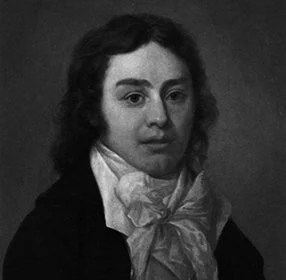
Thou Gloomy December : : By Robert Burns : 1796 – 1859 : : Ayrshire / Scotland : : : : : : : : : : :
Ance mair I hail thee thou Gloomy December. Ance mair I hail thee with sorrow and care. Sad was the parting thou made me remember. Parting wi’ Nancy o nair to meet mair. Fond lover’s parting is sweet painful pleasure. Hope beaming mild on the soft parting hour. But the dire feeling, o farewell forever. Anguish unmingled and agony pure.
Wild as the winter now tearing the forest. Till the last leaf O the summer is flown. Such is the tempest has shaken my bosom. Till my last hope and last comfort is gone. Still shall I hail thee; thou Gloomy December. Still shall I hail thee with sorrow and care. For sad was the parting, thou makes me remember. Parting wi’ Nancy, O nair to meet mair. : : : : : For the Educational Purposes only. : : : :
“Thou Gloomy December”, 19 lines ( in 4 Stanzas ( A Regret Song Of Love By Robert Burns , The Ploughman Poet Of Scotland & lyrical writer of Love Songsis AboutDecember 6 , 1791 when Robert Burns and Nancy ( Agnes ) McLehose finally parted with ,”anguished unmingled and agony pure”: they said Goodbye, “Nair to meet mair.” : : Meaning ” never to meet more” : ” o farewell forever” : “Mire” meaning more is a word repeated four times in the song which emphasise an image for quantifying greater extent , or degree of the theme. Should it be interesting to remember and note herewith ,an Englishstatesman named as Sir Thomas More who opposed Henry VIII divorce from Catherine Of Aragon and was imprisoned and beheaded ; recalled for his concept of Utopia , the ideal State. This Poem / LyricalSong of love regretshould be remembered, for distress full frustrated meet run in to , in the life , with the parting lovers. Original Songs in Simplified English is Given HERE In BELOW : : : :
Once more I hail you, you gloomy December! Once more I hail you with sorrow and care! Sad was the parting you makes me remember: Parting with Nancy, O, never to meet more!
Fond lovers parting is sweet, painful pleasure, Hope beaming mild on the soft parting hour; But the dire feeling, O farewell for ever! Anguish unmingled and agony pure!
Wild as the winter now tearing the forest, Till the last leaf of the summer is flown – Such is the tempest has shaken my bosom, Till my last hope and last comfort is gone!
Still as I hail you, you gloomy December, Still shall I hail thee with sorrow and care; For sad was the parting you makes me remember: Parting with Nancy, O, never to meet more
Notes for each of the lines Pending visit this post again later on to enjoy the appreciation of the poem V Jayaraj Pune India June 2 , 2023 : : : : : : : :
Samuel Taylor Coleridge ( 1772 – 1834 ) a leader of the British Romantic movement, was born on October 21, 1772, in Devonshire, England.The youngest child in 14 children family, Coleridge was a student at his father’s school and an avid reader. After his father died in 1781, Coleridge attended Christ’s Hospital School in London, where he met lifelong friend Charles Lamb. While in London, he also befriended a classmate named Tom Evans, who introduced Coleridge to his family. Coleridge fell in love with Tom’s older sister, Mary. : : Coleridge entered Jesus College, University of Cambridge in 1791, he focused on a future in the Church of England. Coleridge’s views, however, began to change over the course of his first year at Cambridge. Financial problems continued to plague him throughout his life, and he constantly depended on the support of others. : : Coleridge and Southey envisioned ‘pantisocracy—equal government by all , ( influenced by Plato’s Republic ) the men sharing the workload, a great library, philosophical discussions, and freedom of religious and political beliefs. : : Sarah. Coleridge wed in 1795, in spite of the fact that he still loved Mary Evans, Coleridge and Southey collaborated on a play titled The Fall of Robespierre (1795). : Coleridge focussed on his writing and never returned to Cambridge to finish his degree. : : In 1795 Coleridge befriended William Wordsworth, who greatly influenced Coleridge’s verse. Coleridge, whose early work was celebratory and conventional, began writing in a more natural style. In his “conversation poems,” such as “The Eolian Harp” and “This Lime-Tree Bower My Prison,” Coleridge used his intimate friends and their experiences as subjects. : Coleridge published his first volume of poetry, Poems on Various Subjects,From 1797 to 1798 he lived near Wordsworth and his sister, Dorothy, in Somersetshire. In 1798 the two men collaborated on a joint volume of poetry entitled Lyrical Ballads. The collection is considered the first great work of the Romantic school of poetry and contains Coleridge’s famous poem, “The Rime of the Ancient Mariner.” : : That autumn the two poets traveled to the Continent together. Coleridge spent most of the trip in Germany, studying the philosophy of Immanuel Kant, Jakob Boehme, and G. E. Lessing. While there, he mastered the German language and began translating. When he returned to England in 1800, he settled with family and friends at Keswick. Over the next two decades, Coleridge lectured on literature and philosophy, wrote about religious and political theory, spent two years on the island of Malta as a secretary to the governor in an effort to overcome his poor health and his opium addiction, and lived off of financial donations and grants. Still addicted to opium, he moved in with the physician James Gillman in 1816. In 1817, he published Biographia Literaria, which contained his finest literary criticism. He continued to publish poetry and prose, notably Sibylline Leaves (1817), Aids to Reflection (1825), and Church and State (1830). : : Samuel Taylor Coleridge died in London on July 25, 1834. : : ( Based on biography in poets.org ) Photograph By Russ Burden : oorphotographer.com : “A low, ground-level vantage point allows the photographer to get close to the base of the subject, which can net a unique perspective. Most images are made from an upright position, so a low vantage point often grabs a viewer’s attention. A high vantage point allows the photographer to shoot down on a subject and provide an overview of the area. In this case, high isn’t defined as “standing position.” One needs to get elevated to create a “high” view point. There are pluses and minuses regarding both. Let the subject determine whether you click from a low or high angle. Regardless of which you choose, visual drama is the goal to net a novel presentation.” ( TEXT by Russ Burden , the Photographer )
Fragment 3: Come, come thou bleak December wind BY SAMUEL TAYLOR COLERIDGE Come, come thou bleak December wind, And blow the dry leaves from the tree! Flash, like a Love-thought, thro’ me, Death And take a Life that wearies me
“Fragment 3: Come, come thou bleak December wind” A December Poem By Samuel Taylor Coleridge ( 1772 – 1834 ) is About “bleak” , that is, inhospitable “December Wind” and “thought of love” and “death and life” that wearies the Poet Speaker. He has to embrace this December Wind for a brief period of 30 days ! which is widespread, extensive and perhaps with such compelling nature that he has lost interestorbored with it. It’s bleakly characteristics offer little or no hope. Who would like unpleasantly cutting❄️ “Cold Wind” dampening the human spirit !? : : : :
With the bleak December wind, the Wind represents a death yet the poet welcomes “death” like a lover. The poem shows Coleridge at his most despondency. ( Please find his heartsick life reading his brief biography as HERE In ABOVE ): The title of the poem is “fragment 3 : The December Wind is welcome to ” blow the dry leaves from the tree.” Here, the tree represents 🧬 life whereas the dry leaves stand for the ‘end of life’ having broken off or blown on through the current of Wind. The word Blow , blew and thereby “blown” is an adjective explaining the ‘dispoiek’ ( British / Canadian ) or ‘dyspnoel’ ( ‘dyspneal’ in ,US ) state of breathlessness. Thus the leaves are blown or moved upon by moving Wind which stands for death ; the dry , breathless leaves cut off in this way willfloat in theair and will then meet its fate, to be fragmentized : This cutting cold wind entwine the years -long fibres in the loop of life in such a tight concentrated manner “through” ( “me”, he says ,”flash like a love-thought”) that isPoet’s consciousness, that a momentary brightness 🔅 🔆 , comes in , stays briefly and goes off taking 🧬 life that has been not 🤔 interesting. The “death” clinches a victory 🙌✌️: : : : It will be interesting to compare the heartsick feelings of hopelessness shown by Coleridge with John Masefield’s ‘hope for a LIFE’ in his Poem ,”watchingby a Sick-bed” presented HERE In BELOW : :
Watching by a Sick-Bed By John Masefield I HEARD the wind all day,
And what it was trying to say.
I heard the wind all night
Rave as it ran to fight;
After the wind the rain,
And then the wind again
Running across the hill
As it runs still.
And all day long the sea
Would not let the land be,
But all night heaped her sand
On to the land;
I saw her glimmer white
All through the night,
Tossing the horrid hair
Still tossing there.
And all day long the stone
Felt how the wind was blown;
And all night long the rock
Stood the sea’s shock;
While, from the window, I
Looked out, and wondered why,
Why at such length
Such force should fight such strength.
In the above Poem , The Poet Speaker is ‘witnessing a fight between life and death’ inwhichhe is hoping for a‘Victory for LIFE : LETLIFE BE TRIUMPHANT : The Extensive and widespread “Wind” as heard by The Poet Speaker stands here too, for “death” and the image of the land it strikes forcefully and repeatedly stands for life. YetThe PoetSpeaker“wonders why” these two great forces, “at such length and force should fight” each other using “such strengthand energy.!? ” : :
“Fragment 3: Come, come thou bleak December wind” BY SAMUEL TAYLOR COLERIDGE Information Appreciation and poem Analysis Presented by V Jayaraj Pune India June 1 , 2023 : : : : : : : :
Mistletoe bunch hanged on red ribbon isolated on a white background. : Old World Parasitic Shrub having branching green stems with leathery leaves and waxy white gluttonous berries . Traditionally , Mistletoe of Christmas. An oak branch covered with snow and ice with a dry leaf in the forest during a snowfall. A lonely leaf on a branch in winter time of December Multi colored Christmas decorations made of recycled materials hanging from bare plane tree. Plastic glasses and bottles, tree trunk. Vilalba, Lugo province, Galicia, Spain
December by Joseph D. Herron
Child of the grand old winter, December floateth by; And the ground without is bare and white As the moon in the cloudless sky.
The wind blows cold and dreary, Across the whitened plain; And we see the oaks with their branches bare, Through the frost on the window pane.
But within where the yule-log’s burning, Each heart is happy and gay; For the loving Prince of earth and Heaven, Was born on Christmas day.
Then hail! grand old December, We welcome you once more! For the memory sweet of a night you bring, That came in the days of yore.
“December”, By Joseph D Herron, is About wintry panorama of December landscape and joyfully welcoming of A Christmas Day. The Stanza 1 calls December as a “Child of the grand old Winter. The Stanza 2 says, “The Whitened “plain” is a “white barren ground” “As the 🌝”Moon is in the cloudless sky. : “The blowing wind.. .“Across the Plains”is cold and dreary ( dull and dismal , lacking charm ). And here they “see the oaks with their branches bare, Through the frost on the window pane.” : : : :
“Yule”: Yoo(-u)l is a Christmas time,the season around 25 Th December ( traditionally extending from 24 Th December To 6 Th January ) , also called , X-Mas / Crimbo / Noel / Yuletide ): ” Each heart ❤️💜 is happy and gay where the ” Yule- log is burning” during this Snowy Winter Season of Yuletide, ” For the loving Prince of earth and Heaven, Was born on Christmas day, “As A Child – Jesus Christ was born on The eve of Christmas day. The Stanza 3 speaks about this time of happiness. : : : :
The Stanza 4 is about enthusiastic Greetings to the “grand ( noble , dignified and impressive ) old December, when they “welcome once more”of the repeated time of happiness as they loudly herald for receiving the joyfulness. The “sweet memories of night the old month of “December bring That came in the yore” : Meaning ‘A Time Long Past.’: : : :
“December”, A December Poem / Christmas Poem / Winter Poem By Joseph D Herron Information Appreciation and poem Analysis Presented by V Jayaraj Pune India May 31 , 2023 : : : : : : : :
*November Love (My First Poem) (Two Versions) Poem by GREENWOLFE 1962 : : : : ::
Below, you will see two versions of my very first poem. Its important to understand that the first version of the poem is exactly as I wrote it at 6: 15 to 6: 30 PM on November 2nd 1970. I made no changes to it. It is also important to know that this was, in fact, my first ever attempt to write a poem of any kind whatsoever. The second version is modified from the first because I wanted to demonstrate how a few simple word changes can convert a rather average poem of some quality into a poem of great quality and structure.
In early November the air is clear With many sounds of lovers near. Not as the April birds that sing Nor as the Sunday church bells ring. But rather to the rhythm of rain, The hearts of lovers beat again. For it’s not true love that blooms in spring Nor is it of love that birds do sing. Rather of that love soon gone And never seems to carry on. That April love that all partake, But very few ever make. It’s all year long this false love swells Till in November true love dwells.
In November the air is clear With many sounds of lovers near. Not as the April birds that sing Nor as the Sunday church bells ring. Rather to the rhythm of rain, The hearts of lovers beat again. It’s not true love that blooms in spring. Nor is it love, that birds will sing. But rather of that love soon gone Which never seems to carry on. That April love that all partake And very few will ever make. It’s all year long this false love swells Till in November, true love dwells.
I have removed the voting option on this poem and placed it in my Hall Of Fame, due to its history described above and its usefulness as an example to the readers.
Old November, sere and brown, Clothes the country, haunts the town, Sheds its cloak of withered leaves, Brings its sighing, soughing breeze. Prophet of the dying year, Builder of its funeral bier, Bring your message here to men; Sound it forth that they may ken What of Life and what of Death Linger on your frosty breath. Let men know to you are given Days of thanks to God in heaven; Thanks for things which we deem best, Thanks, O God, for all the rest That have taught us–(trouble, strife, Bring thru Death a larger life)– Death of our base self and fear– (Even as the dying year, Though through cold and frost, shall bring Forth a new and glorious spring)– Shall shed over us the sway Of a new and brighter day, With Hope, Faith and Love alway.
— Joseph Seamon Cotter : : From poemhunter.com
*** [month Of] November Poem by Hilaire Belloc : : La Celle-Saint-Cloud : : : : : : : : : : : : : :
November is that historied Emperor, Conquered in age, but foot to foot with fate, Who from his refuge high has heard the roar Of squadrons in pursuit, and now, too late, Stirrups the storm and calls the winds to war, And arms the garrison of his last heirloom, And shakes the sky to its extremest shore With battle against irrevocable doom.
Till, driven and hurled from his strong citadels, He flies in hurrying cloud and spurs him on, Empty of lingerings, empty of farewells And final benedictions, and is gone. But in my garden all the trees have shed Their legacies of the light, and all the flowers are dead.
— Hilaire Belloc : : From poemhunter.com
**** “November” By Billy Collins : From poetryfoundation.org / Poetry Magazine , December 1998 issue.
**** * November : : By John Keble : : : : : : : : : : Red o-er the forest peers the setting sun; The line of yellow light dies fast away That crown-d the eastern copse; and chill and dun Falls on the moor the brief November day.
Now the tired hunter winds a parting note, And Echo bids good-night from every glade; Yet wait awhile and see the calm leaves float Each to his rest beneath their parent shade.
How like decaying life they seem to glide And yet no second spring have they in store; And where they fall, forgotten to abide Is all their portion, and they ask no more.
Soon o-er their heads blithe April airs shall sing, A thousand wild-flowers round them shall unfold, The green buds glisten in the dews of Spring, And all be vernal rapture as of old.
Unconscious they in waste oblivion lie, In all the world of busy life around No thought of them-in all the bounteous sky No drop, for them, of kindly influence found.
Man-s portion is to die and rise again: Yet he complains, while these unmurmuring part With their sweet lives, as pure from sin and stain As his when Eden held his virgin heart.
— John Keble : : From internetpoem.com : : : : :
**** ** “November”By Edward Thomas ( 1878 – 1917 ) : : From poets.org
**** *** November Rain : : By Hazel Durham :
The November rain Is drenching his constant inner pain, Of letting go his heart’s embrace, She has flame coloured hair and a heart-shaped face,
Like a Celtic goddess running through the fields with her wonderful grace, She is immersed in his thoughts that is the case, He is consumed like a mighty warrior to conquer her bruised heart, Always longing for her sultry glance, green eyes wonder,
Now without her he hears the sound of angry thunder, That tears his heart asunder, She has run from the past to a bar stool, She drinks rum and black to attack,
The hell of her memories, Of her father who destroyed her budding soul, She has run away before she gets too old, From her father’s rage and arrogance so bold,
She sings and plays a weeping tune, Worshipping the power of the full moon, To take her away to a softer planet soon, She used to snuggle up to him on damp afternoons,
Laughing at the joy of their eternal love, But she continued drinking and like a white dove She finds peace from the awful memories of her home He was there to protect her from being alone,
He had to leave her, a certainty like the tide leaves the shore, She is the woman he adores, But her self destruction he deplores, He searches for her sultry glance in the eyes of other women,
The light has been switched off in his life, The only woman he wanted for his wife, He is left with the shocking pain In the November rain.
— Hazel Durham ; From poemshunter.com :
**** **** ” The World That The Shooter Left Us : November 12 , 2018 : Poetry : By Noelle Kakimoto : From thisisnoelle.com **** **** * “November” By Lynna Odel : From Reddit.com X : “November” By Marjorie Allen Seiffert : In Poetry Magazine ( 69 ), November 1917 issue : : From poetryfoundation.org X * “Even Though Snow : Barns In November” : From Poetry Magazine ( 66 ) November 1935 Issue :: By James Hearst : From poetryfoundation.org
X** When the Year Grows Old Edna St. Vincent Millay : : : : : : I cannot but remember When the year grows old— October—November— How she disliked the cold!
She used to watch the swallows Go down across the sky, And turn from the window With a little sharp sigh.
And often when the brown leaves Were brittle on the ground, And the wind in the chimney Made a melancholy sound,
She had a look about her That I wish I could forget— The look of a scared thing Sitting in a net!
Oh, beautiful at nightfall The soft spitting snow! And beautiful the bare boughs Rubbing to and fro!
But the roaring of the fire, And the warmth of fur, And the boiling of the kettle Were beautiful to her!
I cannot but remember When the year grows old — October — November — How she disliked the cold!
X*** My November Guest Robert Frost My Sorrow, when she’s here with me, Thinks these dark days of autumn rain Are beautiful as days can be; She loves the bare, the withered tree; She walks the sodden pasture lane.
Her pleasure will not let me stay.
She talks and I am fain to list: She’s glad the birds are gone away, She’s glad her simple worsted grady Is silver now with clinging mist.
The desolate, deserted trees, The faded earth, the heavy sky, The beauties she so ryly sees, She thinks I have no eye for these, And vexes me for reason why.
Not yesterday I learned to know The love of bare November days Before the coming of the snow, But it were vain to tell he so, And they are better for her praise.
X **** “The Crazy Woman” By Gwendolyn Brooks ( 1917 – 2000 ) : From Englewood review.org
XV ” How Happy I Was If I Could Forget : : : : : By Emily Dickinson
How happy I was if I could forget To remember how sad I am Would be an easy adversity But the recollecting of Bloom
Keeps making November difficult Till I who was almost bold Lose my way like a little Child And perish of the cold.
XV * “November Night” BY ADELAIDE CRAPSEY Listen. . With faint dry sound, Like steps of passing ghosts, The leaves, frost-crisp’d, break from the trees And fall.
Thicker Than Rain-Drops On November Thorn (Fragment) : : By Samuel Taylor Coleridge, Devon , England : : : : : : : : : : : : : : : :
Thicker than rain-drops on November thorn.
— Samuel Taylor Coleridge
The shortest, and in many ways the most mysterious, November poem is Fragment 8: “Thicker than rain-drops on November thorn” by Samuel Taylor Coleridge . It reads:
“Thicker than rain-drops on November thorn.” With imagination any creative mind might attempt to set his / her own observation in the wordage of Coleridge. ; : For Example : :
1. “Colder than lamplight on a sunless morn” 2. “Slower than standing water flows my blood” : ; From a Blogger’s writing in allpoetry.com. ( Aug 2004 ) : : : :
3. Crude Oil Thicker than the thickest Soldier’s Blood . ( V Jayaraj)
Anybody else , with a sharper and wittier mind .. . !?
It is officially designated as Fragment 8 in the Poet’s collected works. : The line is not part of a larger poem but rather one of Coleridge’s many notebook entries or brief jottings. It showcases his well-documented habit of recording , vivid observations , or musical phrases that he never expanded into full poems. : : This fragment is often associated with the poet’s time living in the West Country, particularly his periods in Devon and Somerset ( e.g., Nether Stowey ) where the moody, damp, and rugged English landscapes heavily influenced his atmospheric, sensory writing. : : It was first compiled and published in posthumous collections of his poetry by scholars such as James Dykes Campbell (1893) and Ernest Hartley Coleridge (1912).
It is a mysterious because it compresses emotion, season, memory, and atmosphere into a single image. Though extremely short, it carries the depth typical of Romantic poetry.
A November thorn suggests a thorny bush or hedge in late autumn — cold, leafless, dark, wet, and almost lifeless. November in poetry often symbolizes :decline,loneliness,fading warmth,melancholy, and the edge between life and death. Rain-drops gathering thickly upon thorns create an image of heavy accumulation — something dense, crowded, and burdened.: :
The emotions or thoughts that are : more numerous than rain-dropsand more painful because they cling to “thorns,” or more intensely sorrowful than a bleak November scene. : : : :
The line feels unfinished intentionally, like a fragment of a dream or memory. Coleridge often used suggestive imagery rather than direct explanation. The mystery lies in the fact that he does not tell us what is “thicker.” The reader must inwardly complete the feeling.
The Pictorial Reverberance symbolises in Rain-drops → tears, fleeting thoughts, sadness. Whereas , In Thorn → pain, suffering, emotional wounds ; and in November → decay, emotional winter, spiritual exhaustion.
Together, the image evokes sorrow or emotional density so overwhelming that nature itself becomes a mirror of the soul . : :
The beauty of the jotting comes from : its incompleteness, its musical sound, and the stark visual image . It resembles a sudden flash of consciousness — as though the poet glimpsed a mood too deep to fully articulate. The line therefore works less as a statement and more as an atmosphere of feeling : a wet, thorn-filled loneliness where grief hangs densely in the air.
So , Coleridge ‘s prickly November line , ” Thicker than rain-drops on November thorn.” , is in a way , haunting. : : : :
Poetic Meaning and Analysis, presented by V Jayaraj Pune India . May 29 , 2023 : Updated May 29, 2026 : : : : : : : :
In the years to come they will say, “They fell like the leaves In the autumn of nineteen thirty-nine.” November has come to the forest, To the meadows where we picked the cyclamen. The year fades with the white frost On the brown sedge in the hazy meadows, Where the deer tracks were black in the morning. Ice forms in the shadows; Disheveled maples hang over the water; Deep gold sunlight glistens on the shrunken stream. Somnolent trout move through pillars of brown and gold. The yellow maple leaves eddy above them, The glittering leaves of the cottonwood, The olive, velvety alder leaves, The scarlet dogwood leaves, Most poignant of all. In the afternoon thin blades of cloud Move over the mountains; The storm clouds follow them; Fine rain falls without wind. The forest is filled with wet resonant silence. When the rain pauses the clouds Cling to the cliffs and the waterfalls. In the evening the wind changes; Snow falls in the sunset. We stand in the snowy twilight And watch the moon rise in a breach of cloud. Between the black pines lie narrow bands of moonlight, Glimmering with floating snow. An owl cries in the sifting darkness. The moon has a sheen like a glacier.
From thenatureofthings blog For Educational Purposes only.
“Falling Leaves and Early Snow”, A November Poem By Kenneth Rexroth is About The Forest and the meadows – its day and night: From Morning through Afternoon and an Evening : From glittering Sunlight to Snowy twilight , and Rain without wind ; glimmering Moonrise and finallyin darkness. : “Falling Leaves”in Autumn and dropping leafage bears an impressionistic fruition upon the minds of the People living in the years to come will say ,“They fell like the leaves In the autumn of nineteen thirty-nine.” : : : :
Notes for each of the lines Pending visit this post again later on to enjoy the appreciation of the poem V Jayaraj Pune India May 28, 2023 : : : : : : : :
I am thirty this November. You are still small, in your fourth year. We stand watching the yellow leaves go queer, flapping in the winter rain, falling flat and washed. And I remember mostly the three autumns you did not live here. They said I’d never get you back again. I tell you what you’ll never really know: all the medical hypothesis that explained my brain will never be as true as these struck leaves letting go.
I, who chose two times to kill myself, had said your nickname the mewling months when you first came; until a fever rattled in your throat and I moved like a pantomime above your head. Ugly angels spoke to me. The blame, I heard them say, was mine. They tattled like green witches in my head, letting doom leak like a broken faucet; as if doom had flooded my belly and filled your bassinet, an old debt I must assume.
Death was simpler than I’d thought. The day life made you well and whole I let the witches take away my guilty soul. I pretended I was dead until the white men pumped the poison out, putting me armless and washed through the rigamarole of talking boxes and the electric bed. I laughed to see the private iron in that hotel. Today the yellow leaves go queer. You ask me where they go. I say today believed in itself, or else it fell.
Today, my small child, Joyce, love your self’s self where it lives. There is no special God to refer to; or if there is, why did I let you grow in another place. You did not know my voice when I came back to call. All the superlatives of tomorrow’s white tree and mistletoe will not help you know the holidays you had to miss. The time I did not love myself, I visited your shoveled walks; you held my glove. There was new snow after this.
2.
They sent me letters with news of you and I made moccasins that I would never use. When I grew well enough to tolerate myself, I lived with my mother. Too late, too late, to live with your mother, the witches said. But I didn’t leave. I had my portrait done instead.
Part way back from Bedlam I came to my mother’s house in Gloucester, Massachusetts. And this is how I came to catch at her; and this is how I lost her. I cannot forgive your suicide, my mother said. And she never could. She had my portrait done instead.
I lived like an angry guest, like a partly mended thing, an outgrown child. I remember my mother did her best. She took me to Boston and had my hair restyled. Your smile is like your mother’s, the artist said. I didn’t seem to care. I had my portrait done instead.
There was a church where I grew up with its white cupboards where they locked us up, row by row, like puritans or shipmates singing together. My father passed the plate. Too late to be forgiven now, the witches said. I wasn’t exactly forgiven. They had my portrait done instead.
3.
All that summer sprinklers arched over the seaside grass. We talked of drought while the salt-parched field grew sweet again. To help time pass I tried to mow the lawn and in the morning I had my portrait done, holding my smile in place, till it grew formal. Once I mailed you a picture of a rabbit and a postcard of Motif number one, as if it were normal to be a mother and be gone.
They hung my portrait in the chill north light, matching me to keep me well. Only my mother grew ill. She turned from me, as if death were catching, as if death transferred, as if my dying had eaten inside of her. That August you were two, but I timed my days with doubt. On the first of September she looked at me and said I gave her cancer. They carved her sweet hills out and still I couldn’t answer.
4.
That winter she came part way back from her sterile suite of doctors, the seasick cruise of the X-ray, the cells’ arithmetic gone wild. Surgery incomplete, the fat arm, the prognosis poor, I heard them say.
During the sea blizzards she had her own portrait painted. A cave of mirror placed on the south wall; matching smile, matching contour. And you resembled me; unacquainted with my face, you wore it. But you were mine after all.
I wintered in Boston, childless bride, nothing sweet to spare with witches at my side. I missed your babyhood, tried a second suicide, tried the sealed hotel a second year. On April Fool you fooled me. We laughed and this was good.
5.
I checked out for the last time on the first of May; graduate of the mental cases, with my analyst’s okay, my complete book of rhymes, my typewriter and my suitcases.
All that summer I learned life back into my own seven rooms, visited the swan boats, the market, answered the phone, served cocktails as a wife should, made love among my petticoats
and August tan. And you came each weekend. But I lie. You seldom came. I just pretended you, small piglet, butterfly girl with jelly bean cheeks, disobedient three, my splendid
stranger. And I had to learn why I would rather die than love, how your innocence would hurt and how I gather guilt like a young intern his symptoms, his certain evidence.
That October day we went to Gloucester the red hills reminded me of the dry red fur fox coat I played in as a child; stock-still like a bear or a tent, like a great cave laughing or a red fur fox.
We drove past the hatchery, the hut that sells bait, past Pigeon Cove, past the Yacht Club, past Squall’s Hill, to the house that waits still, on the top of the sea, and two portraits hung on the opposite walls.
6.
In north light, my smile is held in place, the shadow marks my bone. What could I have been dreaming as I sat there, all of me waiting in the eyes, the zone of the smile, the young face, the foxes’ snare.
In south light, her smile is held in place, her cheeks wilting like a dry orchid; my mocking mirror, my overthrown love, my first image. She eyes me from that face, that stony head of death I had outgrown.
The artist caught us at the turning; we smiled in our canvas home before we chose our foreknown separate ways. The dry red fur fox coat was made for burning. I rot on the wall, my own Dorian Gray.
And this was the cave of the mirror, that double woman who stares at herself, as if she were petrified in time — two ladies sitting in umber chairs. You kissed your grandmother and she cried.
7.
I could not get you back except for weekends. You came each time, clutching the picture of a rabbit that I had sent you. For the last time I unpack your things. We touch from habit. The first visit you asked my name. Now you stay for good. I will forget how we bumped away from each other like marionettes on strings. It wasn’t the same as love, letting weekends contain us. You scrape your knee. You learn my name, wobbling up the sidewalk, calling and crying. You call me mother and I remember my mother again, somewhere in greater Boston, dying.
I remember we named you Joyce so we could call you Joy. You came like an awkward guest that first time, all wrapped and moist and strange at my heavy breast. I needed you. I didn’t want a boy, only a girl, a small milky mouse of a girl, already loved, already loud in the house of herself. We named you Joy. I, who was never quite sure about being a girl, needed another life, another image to remind me. And this was my worst guilt; you could not cure nor soothe it. I made you to find me. — Anne Sexton, “The Double Image” from The Complete Poems of Anne Sexton, published by Houghton Mifflin Harcourt. Source: The Complete Poems of Anne Sexton (Houghton Mifflin, 1981) : : : : From poetryfoundation.org : For Educational Purposes only.
“The Double Image”, A November Poem By Anne Sexton is About The Poet Speaker’s personal world in which feelings of death is present but defeated. The prevailing forces are counterpoised by the love between mothers and daughters which offsets equally to the madness , the folly and two suicidal attempts. : : Finally, however love being subjected to suffering inspires to continue to live avoiding dying. Self – loving subserves to overcome the duress. The Poet Speaker tells her daughter at the end in thefollowing lines : :
“And this was my worst guilt; you could not cure nor soothe it. I made you to find me.” : : : : About Both admission and defying explanation for endurance to live befitting odds, Same Way the Wintery Cold of November is also the forerunner of a new spring to come.” : : : :
“The Double Image” A November Poem / Conversation Poem By Anne Sexton Information Appreciation and poem Analysis Presented by V Jayaraj Pune India May 27 , 2023 : : : : : : : :
Denise Levertov 1923–1997 : : Photo by Chris Felver : a highly regarded body of poetry that reflected her beliefs as an artist and a humanist. Her work embraced a wide variety of genres and themes, including nature lyrics, love poems, protest poetry, and poetry inspired by her faith in God. one of America’s most respected poets,” wrote Amy Gerstler in the Los Angeles Times Book Review, adding that Levertov possessed “a clear uncluttered voice—a voice committed to acute observation and engagement with the earthly, in all its attendant beauty, mystery and pain.” : Levertov was born in England and raised in Ilford in Essex, England. Levertov and her older sister, Olga, were educated by their Welsh mother,and came to the United States in 1948; during her lifetime she was associated with Black Mountain poets such as Robert Duncan and Robert Creeley. Invested in the organic, open-form procedures of William Carlos Williams, Levertov’s body of quietly passionate poems, attuned to mystic insights and mapping quests for harmony, : her political activism against the Vietnam War. In Modern American Women Poets, Jean Gould called Levertov “a poet of definite political and social consciousness.” :Her mother read aloud to the family the great works of 19th-century fiction, and she read poetry, especially the lyrics of Tennyson. … Her father, a prolific writer in Hebrew, Russian, German, and English, used to buy secondhand books by the lot to obtain particular volumes. ; Levertov grew up surrounded by books. At the age of 12 when she sent several of her poems directly to T.S. Eliot: “She received a two-page typewritten letter from him, offering her ‘excellent advice.’ … His letter gave her renewed impetus for making poems and sending them out. During World War II, Levertov pursued nurse’s training and spent three years as a civilian nurse at several hospitals in the London area, during which time she continued to write poetry. Her first book of poems, The Double Image (1946), was published just after the war. Levertov’s second collection, Here and Now (1957), considered to be her first “American” book. by the time With Eyes at the Back of Our Heads (1959) was published, Levertov was “regarded as a bona fide American poet.” With the onset of the United States’ involvement in Vietnam during the 1960s, Levertov’s social consciousness was risen. With Muriel Rukeyser and several other poets, Levertov founded the Writers and Artists Protest against the War inVietnam.In the ensuing decades she spoke out against nuclear weaponry, American aid to El Salvador, and the Persian Gulf War. The Sorrow Dance (1967), Relearning the Alphabet (1970), To Stay Alive (1971), and, to an extent, Candles in Babylon (1982), as well as other poetry collections, address many social and political themes such as the Vietnam War, the Detroit riots, and nuclear disarmament. Her goal was to motivate others into an awareness of these various issues, particularly the Vietnam War and ecological concerns. One can stress the religious elements in Levertov’s work. Levertov deals both with problems of personal conscience and social issues, such as AIDS, the Gulf War, pollution, and the ongoing threat of nuclear annihilation. poet, Levertov taught her craft at several colleges and universities nationwide; she translated a number of works, particularly those of the French poet Jean Joubert; she was poetry editor of the Nation from 1961-62 and Mother Jones from 1976-78; and she authored several collections of essays and criticism, including The Poet in the World (1973), Light up the Cave (1981), and New & Selected Essays (1992).Essays on poets who influenced Levertov cover William Carlos Williams, Robert Duncan, and Rainer Maria Rilke. 1995 work, Tesserae: Memories and Suppositions, contained 27 autobiographical prose essays. : : Levertov died of lymphoma at the age of 74. Almost until the moment of her death she continued to compose poetry, and some forty of them were published posthumously in This Great Unknowing: Last Poems (1999). Posthumous collections of Levertov’s work include Poems: 1972-1982. : : A contributor in Concise Dictionary of American Literary Biography commended Levertov for “the emphasis in her work on uniting cultures and races through an awareness of their common spiritual heritage and their common responsibility to a shared planet.” : : : : Badges and stickers : Second Moratorium March November 15, 1969 Washington, D.C.On Moratorium Day, half a million demonstrators gathered across from the White House for a rally where they were led by Pete Seeger in singing John Lennon’s new song “Give Peace A Chance” for ten minutes or more Near US Capitol The first nationwide Moratorium was followed on Saturday, November 15, 1969, by a second massive Moratorium march in Washington, D.C., which attracted over 500,000 demonstrators against the war, including many performers and activists.[13] This massive Saturday march and rally was preceded by the March against Death, which began on Thursday evening and continued throughout that night and all the next day. Over 40,000 people gathered to parade silently down Pennsylvania Avenue to the White House. Hour after hour, they walked in single file, each bearing a placard with the name of a dead American soldier or a destroyed Vietnamese village, and carrying a candle. The march was silent except for the playing of six drums, which played funeral tunes.The marchers finished in front of the Capitol building, where the placards were placed in coffins. Despite his public disdain, Nixon watched the march on television, staying up until 11 pm as he obsessively watched the demonstration outside of the White House and tried to count how many people were participating, eventually reaching the figure of 325,000.Nixon joked that he should send helicopters to blow out the candles. Near Washington Monument : The Moratorium to End the War in Vietnam was a massive demonstration and teach-in across the United States against the United States involvement in the Vietnam War. It took place on October 15, 1969,[1] followed a month later, on November 15, 1969, by a large Moratorium March in Washington, D.C. Goals Create peaceful mass action to end American involvement in the Vietnam War. Resulted in Richard Nixon’s “Silent majority” speech Growing protest movement. Fred Halstead writes that it was “the first time [the anti-war movement] reached the level of a full-fledged mass movement. The vast majority of demonstrators during these days were peaceful; however, late on Friday, a small conflict broke out at DuPont Circle, and the police sprayed the crowd with tear gas. The people of Washington, D.C., generously opened schools, seminaries, and other places of shelter to the thousands of students and others who converged for this purpose. In addition, the Smithsonian Museum complex was opened to allow protesters a place to sleep. A daytime march before the White House was lined by parked tour buses and uniformed police officers, some flashing peace symbols on the inside of their jackets in a show of support for the crowd. The second Moratorium drew an even larger crowd than the first, and it is considered to have been the largest demonstration ever in Washington, D.C.[15] The Woodstock Music Festival had drawn about 400,000 people in August 1969, and it was estimated by some that the second Moratorium had brought out a number equal to “two Woodstocks”
At the Justice Department November 15, 1969 BY DENISE LEVERTOV Brown gas-fog, white beneath the street lamps. Cut off on three sides, all space filled with our bodies. Bodies that stumble in brown airlessness, whitened in light, a mildew glare, that stumble hand in hand, blinded, retching. Wanting it, wanting to be here, the body believing it’s dying in its nausea, my head clear in its despair, a kind of joy, knowing this is by no means death, is trivial, an incident, a fragile instant. Wanting it, wanting with all my hunger this anguish, this knowing in the body the grim odds we’re up against, wanting it real. Up that bank where gas curled in the ivy, dragging each other up, strangers, brothers and sisters. Nothing will do but to taste the bitter taste. No life other, apart from. — Denise Levertov : From Poems 1968-1972. Source: Poems 1968-1972 (New Directions Publishing Corporation, 2002) : From poetry foundation.org : For Educational Purposes only.
“At the Justice Department November 15, 1969″ A November Poem By Denise Livertov is About events surrounding another war. On November 15 , 1969 in Washington DC, Half-a-million people gathered to protest peacefully against US involvement in Vietnam. : : The Poem opens with this description : : ” Brown gas-fog, white beneath the street lamps. Cut off on three sides, all space filled with our bodies. Bodies that stumble ( that is , nearly fall on hits received ) in brown airlessness, whitened in light, a mildew glare, ( that is, become mouldy in humidity that shines ) that stumble hand in hand, blinded, ( that is unable to see or perceive ) retching. ( that is, strain to vomit ) Wanting it, wanting to be here, the body believing it’s dying in its nausea, my head clear in its despair, ( hope is lost , so desperate ) a kind of joy, knowing this is by no means death, is trivial, an incident, a fragile instant fog, ( that is, flimsy thin layer ) and the streetlights shining through it.” : : : : So , the weather in Mid November is not an extraordinary weather with thefog that is tear gas. The tear gas disperse the crowd , yet the same tear gas bringing them closer together. The protester’s sufferings are comparable with the experience of the soldiers in the war.
“with all my hunger this anguish, ( that is, torture and sufferings ) this knowing in the body the grim odds we’re up against, wanting it real.( that is , odds are unappeasable: “grim odds” Up that bank where gas ( the bank of Potomac River in Washington DC is referred ) curled in the ivy, dragging each otherup ,( body’y posture turned into ivy vine twist and curl ; years of dragging war which is a strangely effort full but painfully slow in manner and approach ) strangers, brothers and sisters. Nothing will do but to taste the bitter taste. No life other, apart from.” ( The last lines are marked by resentment and cynicism and stinging sensation : hence bitter taste of protester’s experience.) The bitter sorrowful struggle against the enemies of War as well as in Protest against the Own Government ) : : : :
At the Justice Department November 15, 1969 : A November ( War ) Poem / Political Poem By America’s most respected Poet Denise LevertovInformation Appreciation and poem Analysis Presented by V Jayaraj Pune India May 26 , 2023 : : : : : : : :
“The Night is Freezing Fast” , A November Poem By A E Housman Is About remembering , on the eve of December , an old friend who died and The hateful cold doesn’t bother him. : : : :
Notes for each of the lines Pending visit this post again later on to enjoy the appreciation of the poem V Jayaraj Pune India May 25 , 2023 : : : : : : : :
Rita Dove born in Akron, Ohio in 1952. Rita Dove was born in Akron, Ohio in 1952. A 1970 Presidential Scholar, she attended Miami University of Ohio, Universität Tübingen in Germany, and the University of Iowa, where she earned her creative writing MFA in 1977. In 1987, she was awarded the Pulitzer Prize for her third collection of poetry, Thomas and Beulah, and from 1993 to 1995, she served as U.S. Poet Laureate at the Library of Congress. Dove is a recipient of the 2022 Ruth Lilly Poetry Prize.
Author of a novel, a book of short stories, essays, and numerous volumes of poetry, among them the National Book Award finalist and NAACP Image Award winner Collected Poems 1974–2004, she also edited The Best American Poetry 2000 and the Penguin Anthology of 20th-Century American Poetry (2011). Dove wrote poetry columns for the New York Times Magazine from 2018 to 2019 and The Washington Post from 2000 to 2002. Her drama The Darker Face of the Earth opened at the Oregon Shakespeare Festival in 1996 and the Kennedy Center in Washington in 1997, followed by its European premiere at the National Theatre in London in 1999. Her song cycle Seven for Luck, with music by John Williams, was premiered by Cynthia Haymon with the Boston Symphony in 1998, and her song sequence A Standing Witness, 14 poems with music by Richard Danielpour, was sung by Susan Graham with the Copland House musicians at the Kennedy Center, the Tanglewood Music Festival, and other venues in 2021 and 2022. W.W. Norton published Dove’s latest volume of poems, Playlist for the Apocalypse, called “a vital collection of poems about history and mortality” by the New York Times while naming it a Top Book of 2021.
Dove’s numerous honors include Lifetime Achievement Medals from the Library of Virginia and the Fulbright Association, the 2014 Carole Weinstein Poetry Prize, the 2019 Wallace Stevens Award from the Academy of American Poets, and the 2021 Gold Medal for Poetry from the American Academy of Arts and Letters, the 16th (and third female and first African American) poet in the Medal’s 110-year history. In 1996, she received the National Humanities Medal from President Bill Clinton and in 2011, the National Medal of Arts from President Barack Obama—the only poet ever to receive both medals. To date, 29 honorary doctorates have been conferred upon Dove, most recently by Yale University, Emory University, Smith College, Harvard University, the University of Michigan, and the University of Iowa. She has served as president of the Association of Writers and Writing Programs (AWP), as a chancellor of Phi Beta Kappa, and as a chancellor of the Academy of American Poets. A member of the American Philosophical Society, the American Academy of Arts and Sciences, and the American Academy of Arts and Letters, she teaches at the University of Virginia in Charlottesville, where she is the Henry Hoyns Professor of Creative Writing. ( Photo courtesy by The Poet ) and Poet’s Biography From poetryfoundation.org“November For Beginners” By Rita Dove appears in Poetry : 100 Years : Issue of June 2012.
“November for Beginners ” : : Rita Dove: : Snow would be the easy way out—that softening sky like a sigh of relief at finally being allowed to yield. No dice. We stack twigs for burning in glistening patches but the rain won’t give.
So we wait, breeding mood, making music of decline. We sit down in the smell of the past and rise in a light that is already leaving. We ache in secret, memorizing
a gloomy line or two of German. When spring comes we promise to act the fool. Pour, rain! Sail, wind, with your cargo of zithers!
— Rita Dove : : November 1981
Source: Poetry( June 2012 ). : From poetryfoundation.org For Educational Purposes only.
“November For Beginners”, A Witty and moving November Poem by America’s greatest contemporary poets , is About the ‘right’ way to do November. : : She talks not only about herself but also about Others ( as she speaks in second person : “We”. She tells what would happen at some time in her childhood and what she would do which is plainly taken for granted.Moreover she also talks about spring when as she says, “We promise to act the fool.”This is playful and the same playfulness can be obviously noted as she talks about stacking twigs for burning , making music which describe weather, the sameway while “sharing secrets and while talking about Spring. Her talking is as good as we read from her childhood diary of monologues.
“November For Beginners “, A Poem about Childhood at the time of November, Information Appreciation and poem Analysis Presented by V Jayaraj Pune India May 24 , 2023 : : : : : : : :