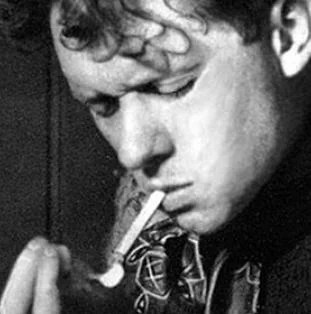
The most important thing we’ve learned, So far as children are concerned, 2 Is never, NEVER, NEVER let Them near your television set – 4 Or better still, just don’t install The idiotic thing at all. 6 In almost every house we’ve been, We’ve watched them gaping at the screen. 8 They loll and slop and lounge about, And stare until their eyes pop out. 10 (Last week in someone’s place we saw A dozen eyeballs on the floor.) 12 They sit and stare and stare and sit Until they’re hypnotised by it, 14 Until they’re absolutely drunk With all that shocking ghastly junk. 16 Oh yes, we know it keeps them still, They don’t climb out the window sill, 18 They never fight or kick or punch, They leave you free to cook the lunch 20 And wash the dishes in the sink – But did you ever stop to think, 22 To wonder just exactly what This does to your beloved tot?24 IT ROTS THE SENSE IN THE HEAD! IT KILLS IMAGINATION DEAD! 26 IT CLOGS AND CLUTTERS UP THE MIND! IT MAKES A CHILD SO DULL AND BLIND 28 HE CAN NO LONGER UNDERSTAND A FANTASY, A FAIRYLAND! 30 HIS BRAIN BECOMES AS SOFT AS CHEESE! HIS POWERS OF THINKING RUST AND FREEZE! 32 HE CANNOT THINK – HE ONLY SEES! 33 ‘All right! ‘ you’ll cry. ‘All right! ‘ you’ll say, ‘But if we take the set away, 34 What shall we do to entertain Our darling children? Please explain! ‘ 36 We’ll answer this by asking you, ‘What used the darling ones to do? 38 ‘How used they keep themselves contented Before this monster was invented? ‘ 40 Have you forgotten? Don’t you know? We’ll say it very loud and slow: 42 THEY… USED… TO… READ! They’d READ and READ, AND READ and READ, and then proceed 44 To READ some more. Great Scott! Gadzooks! One half their lives was reading books! 46 The nursery shelves held books galore! Books cluttered up the nursery floor! 48 And in the bedroom, by the bed, More books were waiting to be read! 50 Such wondrous, fine, fantastic tales Of dragons, gypsies, queens, and whales 52 And treasure isles, and distant shores Where smugglers rowed with muffled oars,54 And pirates wearing purple pants, And sailing ships and elephants, 56 And cannibals crouching ’round the pot, Stirring away at something hot. 58 (It smells so good, what can it be? Good gracious, it’s Penelope.) 60 The younger ones had Beatrix Potter With Mr. Tod, the dirty rotter, 62 And Squirrel Nutkin, Pigling Bland, And Mrs. Tiggy-Winkle and- 64 Just How The Camel Got His Hump, And How the Monkey Lost His Rump, 68 And Mr. Toad, and bless my soul, There’s Mr. Rat and Mr. Mole- 70 Oh, books, what books they used to know, Those children living long ago! 72 So please, oh please, we beg, we pray, Go throw your TV set away, 74 And in its place you can install A lovely bookshelf on the wall. 76 Then fill the shelves with lots of books, Ignoring all the dirty looks, 78 The screams and yells, the bites and kicks, And children hitting you with sticks- 80 Fear not, because we promise you That, in about a week or two 82 Of having nothing else to do, They’ll now begin to feel the need Of having something to read. 84 And once they start – oh boy, oh boy! You watch the slowly growing joy 86 That fills their hearts. They’ll grow so keen They’ll wonder what they’d ever seen 88 In that ridiculous machine, That nauseating, foul, unclean, 90 Repulsive television screen! And later, each and every kid92 Will love you more for what you did. 93
“Television”By Ronald Dahl is about the Perils of Television and pinpointing to salvage the children from being ruined lost or harmed. The hideous risks include a child’s brain- melting and loss of h(is)er desire to understand the world. Parents are appealed earnestly to do whatever they can to get their kids away from theTelevision. Parents are suggested to install a lovely bookshelf on the wall in place of the Television and fill the shelves with lots of books. The Speaker promises that in about a week or two , they will begin to feel the need of having something to read and that will slowly but surely fill their hearts with growing joy. And , later , each and every kid will love you more for what you did in their real good interest.
Notes for each of the 47 Couplets in 93+ 1 =94 lines Pending visit this post again later on to enjoy the appreciation of the poem V Jayaraj Pune India December 14 , 2022 : : : : : : : :
Born: May 26, 1963 (age 59) Huddersfield England Title / Office: poet laureate (2019) Notable Works: “Book of Matches” “Kid” “Killing Time” “Tyrannosaurus Rex Versus the Corduroy Kid” Encyclopedia Britannica Simon Armitage Home Literature Novels & Short Stories Novelists A-K Simon Armitage British poet, playwright, and novelist Alternate titles: Simon Robert Armitage By Pat Bauer Edit History Simon Armitage, in full Simon Robert Armitage, (born May 26, 1963, Huddersfield, Yorkshire [now in Kirklees], England), British poet, playwright, and novelist whose poetry is attuned to modern life and vernacular language and has been regarded as both accessible and revelatory. His works were widely anthologized and have been broadly popular. In 2019 Armitage became poet laureate of Great Britain.
His work combines wry colloquialism and humour with frequent poignancy, treating such perennial subjects as death, violence, and lost love with directness and wit.But he believes that a poet’s life is more than just words – Armitage insists that his life is fulfilled through teaching and taking poetry around the world. often darkly comic poetry is influenced by the work of Ted Hughes, W.H. Auden, and Philip Larkin. Armitage grew up in the West Yorkshire village of Marsden, where his father was active in amateur theatre. Armitage wrote his first poem as a school assignment. He studied geography at Portsmouth Polytechnic (now the University of Portsmouth), from which he graduated in 1984. Four years later he earned a master’s degree in social work from the Victoria University of Manchester (now the University of Manchester), and he subsequently found work as a probation officer. At the same time, he wrote poetry, and his first collection, Zoom!, appeared in 1989. It garnered immediate notice and was followed by the 1992 poem-film Xanadu. By 1994 Armitage was able to resign his job and focus on a writing career. : : : : : 10 Best Poems By Simone Armitage Can be recommended for reading Are listed as HERE In BELOW: : : : : : : : : 1) Poem 2) A Vision 3) I say I say I say 4) You May Turn Over And Begin 5) The Shout 6) Chainsaw Versus The Pampas Grass 7) To his lost lover 8) About His Person 9) The Catch 10) Give : : To discover more of Simon Armitage’s poetry, the readers are recommend to see , excellent “Paper Aeroplane: Selected Poems”1989-2014
.
You May Turn Over and Begin : Simone Armitage : : “Which of these films was Dirk Bogarde not in? One hundredweight of bauxite 2 makes how much aluminium? how many tales in ‘The Decameron’?” 4 General Studies, the upper sixth, a doddle, a cinch for anyone with an ounce of common sense 6 or a calculator with a memory feature.8 Having galloped through but not caring enough to check or double-check, I was dreaming of 10 milk-white breasts and nakedness, or more specifically virginity. 12 That term – everybody felt the heat but the girls were having none of it: 14 long and cool like cocktails, out of reach, their buns and pigtails 16 only let out for older guys with studded jackets and motor-bikes and spare helmets. 18 One jot of consolation was the tall spindly girl riding pillion 20 on her man’s new Honda who, with the lights at amber, 22 put down both feet and stood to stretch her limbs, to lift the visor and push back her fringe 24 and to smooth her tight jeans. As he pulled off down the street26 she stood there like a wishbone, high and dry, her legs wide open, 28 and rumour has it he didn’t notice til he came round in the ambulance 30 having underbalanced on a tight 31 left-hander. 32 ‘A Taste of Honey’. Now I remember.Source: “Words and Music: Memory”, BBC Radio 3. Originally Aired: Sun 22 Feb 2015 : : For Educational purposes only. : :
“You May Turn Over And Begin”, the most read “School Poem” By Simone Armitage, is about Teenagers , Adolescence, Sexual desires ,and Sitting the General Studies. : : A person is sitting an exam on the subject of General Studies and we come to know about his utterance that reveals his inner self. We in India know how an examination hall Supervisor tells the candidates with his vigilant eyeing look , ” You May Turn Over And Begin” : That’s theTitle of this everything else said are the thoughts of the Speaker.The Speaker sits the exam hall and thinks deeply on the questions asked in the paper.His other thoughts are also conveyed as he completes with the answers. : : : : : : : :
The Poet has not clarified a gender/ sexuality of the Speaker referable in the 1 ST Person only, within / through anyone of the 16 Couplets written as the speech or as monologues of the Speaker as well as in histhoughts expressed.
“One jot of consolation was the tall spindly girl riding pillion 20 on her man’s new Honda who, with the lights at amber, 22 put down both feet and stood to stretch her limbs, to lift the visor and push back her fringe 24 and to smooth her tight jeans. As he pulled off down the street 26 she stood there like a wishbone, high and dry, her legs wide open,” 28
In the Couplets 10 Through 14 ( lines 19 To 28 ) the tall spindly , that is long and lean girl riding pillion on her man’s new Honda motor -bike, has been described by her feet , stretched limbs ,fringe , tight jeans, high &dry wide openlegs. : Which conveys her sexuality significantly ; she must be a teenager girl as evident in lines 24 To 27 ( also because of the structure of poem is in 16 Couplets ), and would spread story like a rumour , referable in lines 29/30 of 15 Th Couplet. We learn that she dresses with elaborate care. : Some of the thoughts of the Speaker are very personalizedas expressedin lines 10 To 14 of the 5 Th , 6 TH& 7 TH Couplets which also convey his sexuality.
One may find that the spindly girl in tight jeans is very anxious and comic in her elaborate care of dressing as a pillion rider on her man’s Honda motor – bike. Having expressed thoughts and monologues conveying man’s and teenager girl’s Sexuality while taking the General Studies Exam Paper which is merely memory calling and may run off as seemingly wasteful and thriftless; unproductive and unappreciative. : : : : : : : :
“You May Turn Over And Begin “, A School Poem By Simone Armitage , Information Appreciation and poem Analysis Presented by V Jayaraj Pune India December 13, 2022 : : : : : : : :
Philip Larkin (August 9 , 1922 , Coventry , England- December 2 , 1985 , died 63 years , At Kingston Upper Hul England , Cottingham municipal Cemetery ) Photograph By Fay Godwin (1970) : : “The cloakroom pegs are empty” now, And “locked the classroom door” : “The hollow desks are lined with dust, And slow across the floor”. .. “A sunbeam creeps between the chairs Till the sun shines no more.”“Doors locked , classroom desk is empty now , the hollow , lined with dust”Ah ! No ink in Inkpot , empty now !! : : Remembering the Students in the past. ..Tina’s Fountain pen is empty , Making INKWith Magic letters .. . Tina wants to fill up the Inkpot & her empty Fountain penwith fresh INK : : Who is 67 now , who has used a Fountain pen in his School years !? And Dipping into the Fresh INK Blue to write a letter to me. .. !?“Whose notes are now so still?”A Young Girl Practising Piano with Notes of Music: A Painting.“Who practiced this 🎹 Piano , Whose notes are now so still ?” : Old Vintage Piano & Notes of Music , lying on its Keys. A Piano 🎹 With it’s Player’s bench lying unattended in the Piano Room for Music in the School , now observing a Summer holidays/ Vacation: As seen by A Music Teacher: lonely & sad , without any sound of music! “And even swimming groups can fade, Games mistresses turn grey” : A lonely Ageing Teacher before the empty classroom during the August / Summer Holidays / Vacation And seniors grow tomorrow From the juniors today, : The Youth attaining maturity looking high up in the Sky with more learnings and an Advancement
“The School In August” Written in 1943 , A School Poem , By Philip Larkin is about a School.
The School In August : : By Philip Larkin : : The cloakroom pegs are empty now, And locked the classroom door, The hollow desks are lined with dust, And slow across the floor A sunbeam creeps between the chairs Till the sun shines no more.
Who did their hair before this glass? Who scratched ‘Elaine loves Jill’ One drowsy summer sewing-class With scissors on the sill? Who practised this piano Whose notes are now so still?
Ah, notices are taken down, And scorebooks stowed away, And seniors grow tomorrow From the juniors today, And even swimming groups can fade, Games mistresses turn grey. — Philip Larkin : :
” School In August” Written in 1943 , A School Poem , one of his best of his Poems of 20s. By PhilipLarkin is about the School which is empty , unused , and closed during the quiet days of school holidays in the drowsy summer. : : : :
Stanza 1 : : “The School In August : : By Philip Larkin : : The cloakroom pegs are empty now, 1 And locked the classroom door, 2 The hollow desks are lined with dust, 3 And slow across the floor 4 A sunbeam creeps between the chairs5 Till the sun shines no more.”6 : : : : lines 1 To 6 : : : :
The closed School is described by the Speaker / Now, Ageing Teacher ( by One More Year ).: the Classroom doors are locked. ( As in line 2 )”The cloakroom pegs are empty”( line 1 ), Meaning , a room where outdoor clothings are placed” are empty ,as no students are in the school for their day-long stay. Pegs are such places for a temporary storage. “The hollow desks are lined with dust” , Meaning, the desks assigned to the students for writing and the drawers / shelf ( shelves alongside in lines) below the writing surface are hollow, that is the cavities are devoid of the satchels , hence lookvacuous: “lined with dust” ( line 3 ) : ” A sunbeam creeps between the chairs , Till the sun shines no more ( lines 5 & 6 ) : Here , line 5 is the examples of ‘Personification’ : ( because A sunbeam is described by the Speaker / Ageing Teacher, with its crawling / dragging its body spreading between the chairs/ benches for study , “on slow across the floor” of the closed classroom : like some small animal on locomotion on hands & knees ) & line 6 is an example of ‘Pathetic Fallacy’: ( pathetic fallacy is the fallacy , i.e. false belief due to incorrect reasoning ,of attributing human feelings to inanimate objects ; here , “the sun shines no more”is an example of pathetic fallacy. : : All these observations & feelings of the Speaker / Ageing Teacher createlame , boring and dull time , as well as, give lonely and sad feeling and add to the atmosphere of the poem’s quietness. The word “empty” and ” slow across the floor” create the lonely, blank and unfilled feelings of less vibrancy. : : : :
Stanza 2 : : “Who did their hair before this glass? 7 Who scratched ‘Elaine loves Jill’ 8 One drowsy summer sewing-class 9 With scissors on the sill? 10 Who practised this piano 11 Whose notes are now so still?” 12: : : : lines 7 To 12 : : : :
There are some signs listed here in Stanza 2 : that have been still traceable in the scene of activities : For example , , someone’s hair are still there before the mirror. Someone scratched / cut the surface with scissors during one drowsy summer sewing,-class . And some 🎹 Piano notes are lying all the same without any change , but surely out of a piano – practice.: The aforesaid examples express non moving silence or calm ; inactivity and inattentive boredom and slow down. : : : :
Stanza 3 : : “Ah, notices are taken down, 13 And scorebooks stowed away,14 And seniors grow tomorrow15 From the juniors today, 16 And even swimming groups can fade,17 Games mistresses turn grey.”18 : : : : lines 13 To 18 : : : :
The last remarks made in the last stanza are : “notices are taken down” ( line 13 ) & “Andscorebooks stowed away.” ( line 14 ) : One more academic year has ended with a start of intervening Summer holidays / Vacation. Because the time is sleeping away to a new start of studies and teachings and learning activities , with the juniors becoming senior , by one more year, and also , some new entrants of students , will be joining, from the next session. Hence , the Noticeboards are no more required to retain the old notifications , news of activities, Etc. Similarly , scorebooks of the marks and grades earned by the students of the previous classes have become history and are “stowed away” , Meaning , packed in to a bundle tightly or filed as past records. : :
The youths are attaining maturity : “seniors grow from the juniors” , as if “Tomorrow is grown from Today”: ( lines 15 & 16 ) : that is very quickly. It’s a fleeting glance by The lonely Speaker / Teacher, who has to experience the sleeping away of the ‘Time’ to turn to Ageing. As in the last lines of the poem, ” even swimming groups can fade,” ( line 17 ) “Games mistresses turn grey” ( line 18 ) : : Meaning , life is always going forward, like some Sporty Games the participant Groups of which can fade , that is , they will become less visible , disappear gradually or seemingly. The Strict Schoolmistress ( yes , She is Strict Teacher ) , that is why She has noticed the things and atmosphere in the School , during the August Vacation of Holidays, Changes from the activities To Inactivity and Slow down as well as Stillness and Silence ; From VibrancyTo lifelessness and emergent loneliness & boredom which she senses in the School , as well as , within herself. As the juniors becoming seniors, likewise , she has also grown and has become older by One more year ( her hairs ) “turn grey” ( line 18 ) :: : : : : : :
“The School In August” , A School Poem , By Philip Larkin : Information Appreciation and poem Analysis Presented by V Jayaraj Pune India December 12 , 2022 : : : : : : : :
Vernon Scannell ( born January 23 , 1922 , At Spilsby, Lincolnshire, – died November 16 , 2007 , Aged 85 , West Yorkshire , England : Studied University of Leeds ,Spouse : Joe Higson , Painter : : He received the Heinemann Award for Literature in 1961 for an early poetry volume, The Masks of Love,[6] and the Cholmondeley Award for poetry in 1974. He was elected a Fellow of the Royal Society of Literature in 1960 and granted a Civil List pension in recognition of his services to literature in 1981. : : Known for the sturdy metrical pace and structure with combination of mordancy and a sense of mortality”in his Poetry. John Carey, the critic commented: “Scannell nearly always works on two levels, one realistic and external, the other imaginative, metaphorical, haunted by memory and desire. A master of the dramatic monologue, his work is drenched in humanity. It resounds with memories.” Scannell also wrote the verse narration for BBC Television film A House that Died. : : He also received a special award from the Wilfred Owen Association “in recognition of his contribution to war poetry”.: : Scannell’s best-known book of war poetry is Walking Wounded (1965). The title poem recollects a column of men returning from battle: “No one was suffering from a lethal hurt, They were not magnified by noble wounds, There was no splendour in that company.” : : Scannell is also the author of a memoir, The Tiger and the Rose (1983) : : Historian Martin Johnes has used Scannell’s 1951 novel The Fight to explore racial attitudes in 1950s Britain. He argues that its depictions of reactions to a black boxer illustrate the diversity of racial attitudes, including outright racism, better than contemporary sociological studies where private assumptions and thoughts were hidden. : : Scannell spent the final years of his life living in Otley, West Yorkshire, where he died at his home at the age of 85 after a long illness.
And now another autumn morning finds me With chalk dust on my sleeve and in my breath, Preoccupied with vague, habitual speculation On the huge inevitability of death.
Not wholly wretched, yet knowing absolutely That I shall never reacquaint myself with joy, I sniff the smell of ink and chalk and my mortality And think of when I rolled, a gormless boy,
And rollicked round the playground of my hours, And wonder when precisely tolled the bell Which summoned me from summer liberties And brought me to this chill autumnal cell
From which I gaze upon the april faces That gleam before me, like apples ranged on shelves, And yet I feel no pinch or prick of envy Nor would I have them know their sentenced selves.
With careful effort I can separate the faces, The dull, the clever, the various shapes and sizes, But in the autumn shades I find I only Brood upon death, who carries off all the prizes.
— Vernon Scannell
” Ageing School Master : : Written On November 23 , 2007 , A School Poem By Vernon Scannell ( 1922 – 2007 ) is , about the Poet’s unavoidable Own death. He was stricken with throat cancer, emphysema and much else, and had been bedridden for some months. : : In this Poem , The chalk and the board and the classroom with his own mortality, are consociated with each September bringing him closerto the grave . But he sees the ‘April faces’ of the young schoolchildren have their whole lives ahead of them. : : At the end of the poem, The Poet says , ” But in the Autumn shades I find I find only, Brood upon death , who carries off all the prizes ” : The Thoughts and Feelings of An Approaching Death , comes in to his viewing constantly and in a looming way; often habitually telling to himself “On the huge inevitability of death”: : : :
Notes for each of the 5 Stanzas Pending visit this post again later on to enjoy the appreciation of the poem V Jayaraj Pune India December 11 , 2022 : : : : : : : :
William Butler Yeats (1865-1939) is one of the greatest of all Irish poets. His first collection, Crossways, appeared in 1889 in his Mind 20s under the influence of Romanticism.. : : His Creative Innovations came with modernism in the early decades of the 20 Th century. : He retained traditional Verses & Rhymes , but reflected relationships & indirect references, in more conciseway and forcefully. His 1927 poem ‘Sailing to Byzantium’, about growing old, show a thoughtful and contemplative poet whose imagery and references resist easy exegesis ( with Biblical & critical interpretations. ) : However , he focussed on his Readers who would locate his poetry moving out from T. S. Eliot’s & Ezra Pound’s Works. : Throughout much of his life, a woman named Maud Gonne was his muse. Yeats asked her to marry him several times, but she always refused. She knew she could be of more use to him as a muse than as a wife or lover. Yeats was in favour of Irish independence but, in poems such as ‘Easter 1916’ which respond to the Easter Rising, he reveals himself to be uneasy with the violent and drastic political and military methods of many Irish Persons. : He was awarded the Nobel Prize for Literature in 1923. : : Years died in 1939. : :
Among School Children BY WILLIAM BUTLER YEATS I
I walk through the long schoolroom questioning; A kind old nun in a white hood replies; The children learn to cipher and to sing, To study reading-books and history, To cut and sew, be neat in everything In the best modern way—the children’s eyes In momentary wonder stare upon A sixty-year-old smiling public man.
II
I dream of a Ledaean body, bent Above a sinking fire, a tale that she Told of a harsh reproof, or trivial event That changed some childish day to tragedy— Told, and it seemed that our two natures blent Into a sphere from youthful sympathy, Or else, to alter Plato’s parable, Into the yolk and white of the one shell.
III
And thinking of that fit of grief or rage I look upon one child or t’other there And wonder if she stood so at that age— For even daughters of the swan can share Something of every paddler’s heritage— And had that colour upon cheek or hair, And thereupon my heart is driven wild: She stands before me as a living child.
IV
Her present image floats into the mind— Did Quattrocento finger fashion it Hollow of cheek as though it drank the wind And took a mess of shadows for its meat? And I though never of Ledaean kind Had pretty plumage once—enough of that, Better to smile on all that smile, and show There is a comfortable kind of old scarecrow.
V
What youthful mother, a shape upon her lap Honey of generation had betrayed, And that must sleep, shriek, struggle to escape As recollection or the drug decide, Would think her son, did she but see that shape With sixty or more winters on its head, A compensation for the pang of his birth, Or the uncertainty of his setting forth?
VI
Plato thought nature but a spume that plays Upon a ghostly paradigm of things; Solider Aristotle played the taws Upon the bottom of a king of kings; World-famous golden-thighed Pythagoras Fingered upon a fiddle-stick or strings What a star sang and careless Muses heard: Old clothes upon old sticks to scare a bird.
VII
Both nuns and mothers worship images, But those the candles light are not as those That animate a mother’s reveries, But keep a marble or a bronze repose. And yet they too break hearts—O Presences That passion, piety or affection knows, And that all heavenly glory symbolise— O self-born mockers of man’s enterprise;
VIII
Labour is blossoming or dancing where The body is not bruised to pleasure soul, Nor beauty born out of its own despair, Nor blear-eyed wisdom out of midnight oil. O chestnut tree, great rooted blossomer, Are you the leaf, the blossom or the bole? O body swayed to music, O brightening glance, How can we know the dancer from the dance? W. B. Yeats, “Among School Children” from The Poems of W. B. Yeats: A New Edition, edited by Richard J. Finneran. : Source: The Collected Poems of W. B. Yeats (1989) : : From poetryfoundation.org : : For Educational purposes only. : :
“Among School Children” A School Poem / Childhood Poem, is about a visit made by the ageing Yeats to a convent school in Waterford, Ireland in February 1926. As a Senator, & his private thoughts. : We learn from this poem that, although old age brings a decline from the beauty and freshness of youth, the speaker comes to see life as a harmonious whole—meaning that every moment has its own source of happiness and payoff & honour. : : : :
Notes for each of the I To VIII StanzasPending visit this post again later on to enjoy the appreciation of the poem V Jayaraj Pune India December 10 , 2022 : : : : : : : :
Dame Carol Ann Duffy DBE FRSL Carol Ann Duffy ( born December 23 , 1955 , 65 years : At Glasgow , U. K. Duffy in June 2009 Poet Laureate of the United Kingdom In office 1 May 2009 – 10 May 2019: preceded by Andrew Motion : succeeded by Simon Armitage. : : Alma Mater University of Liverpool : B. A. (Honours ( Philosophy ) : Poet & Playwright: Dame Carol Ann Duffy DBE FRSL HonFBA HonFRSE , is a Scottish Poet and Playwright. She is a professor of contemporary poetry at Manchester Metropolitan University, and was appointed Poet Laureate in May 2009, resigning in 2019. She was the first female poet, the first Scottish-born poet and the first openly gay poet to hold the Poet Laureate position.: : Her collections include Standing Female Nude (1985), winner of a Scottish Arts Council Award; Selling Manhattan (1987), which won a Somerset Maugham Award; Mean Time (1993), which won the Whitbread Poetry Award; and Rapture (2005), which won the T. S. Eliot Prize. Her poems address issues such as oppression, gender, and violence in accessible language. : : She was a passionate reader from an early age, and always wanted to be a writer, producing poems from the age of 11. When one of her English teachers died, she wrote: :
You sat on your desk, swinging your legs, reading a poem by Yeats to the bored girls, except my heart stumbled and blushed as it fell in love with the words and I saw the tree in the scratched old desk under my hands, heard the bird in the oak outside scribble itself on the air
Some days, although we cannot pray, a prayer utters itself. So, a woman will lift her head from the sieve of her hands and stare at the minims sung by a tree, a sudden gift.
Some nights, although we are faithless, the truth enters our hearts, that small familiar pain; then a man will stand stock-still, hearing his youth in the distant Latin chanting of a train. — Dame Carroll Ann Duffy : From “Prayer”, Mean Time, Anvil, 1994
In Mrs Tilscher’s Class Carol Ann Duffy
You could travel up the Blue Nile with your finger, tracing the route while Mrs Tilscher chanted the scenery. Tana. Ethiopia. Khartoum. Aswân. That for an hour, then a skittle of milk and the chalky Pyramids rubbed into dust. A window opened with a long pole. The laugh of a bell swung by a running child.
This was better than home. Enthralling books. The classroom glowed like a sweet shop. Sugar paper. Coloured shapes. Brady and Hindley faded, like the faint, uneasy smudge of a mistake. Mrs Tilscher loved you. Some mornings, you found she’d left a good gold star by your name. The scent of a pencil slowly, carefully, shaved. A xylophone’s nonsense heard from another form.
Over the Easter term, the inky tadpoles changed from commas into exclamation marks. Three frogs hopped in the playground, freed by a dunce, followed by a line of kids, jumping and croaking away from the lunch queue. A rough boy told you how you were born. You kicked him, but stared at your parents, appalled, when you got back home.
That feverish July, the air tasted of electricity. A tangible alarm made you always untidy, hot, fractious under the heavy, sexy sky. You asked her how you were born and Mrs Tilscher smiled, then turned away. Reports were handed out. You ran through the gates, impatient to be grown, as the sky split open into a thunderstorm.
from The Other Country (Picador, 1990) : : From scottishpoetrylibrary.org.uk
“In Mrs. Tilcher’s Class” , A Childhood Poem, drawn from Duffy’s own experience , is about a loving Teacher in real and a young child’s positive memories whilegrowing upwithin anurturing environment of primary environment. Duffy uses different times of year to represent the stages in the child’s journey towardsadulthood.Mrs Tilscher seems to protect the children from the unwholesome ( detrimental to physical or moral wellbeing ) world outside but it does not live on continuously. The students , on verge of adulthood leave Mrs. Tilcher’s Class behind,and move forward to undergomodern awareness and sense datum. : : : :
Notes for each of the 4 Stanzas Pending visit this post again later on to enjoy the appreciation of the poem V Jayaraj Pune India December 9, 2022 : : : : : : : :
Roger Joseph McGough CBE FRSL (/məˈɡɒf/; born 9 November 1937 : : Age 85 ) ) is an English poet, performance poet, broadcaster, children’s author and playwright. He presents the BBC Radio 4 programme Poetry Please, as well as performing his own poetry. McGough was one of the leading members of the Liverpool poets, a group of young poets influenced by Beat poetry and the popular music and culture of 1960s Liverpool. He is an honorary fellow of Liverpool John Moores University, fellow of the Royal Society of Literature and President of the Poetry Society. : : B. A. French & Geography: Alma Mater: University of Hull : Notable awards OBE 1997; CBE 2004;Cholmondeley Award 1998Clockwise from top: Sperry Top-Sider, Le Chameau, Jeantex, Aigle, Gill, Helly-Hansen and Newport short and tall rubber sailing wellingtons. : : Refer to “Yellow Wellies” , Wellington Gum boots useful when there is puddles” The Speaker Child speaks in lines 23 To 25 : on his ” First Day At School ” A childhood Poem By Roger McGough.Portrait by Thomas Lawrence, c. 1815-16 : : Prime Minister of the United Kingdom : : Arthur Wellesley, 1st Duke of Wellington, KG, GCB, GCH, PC, FRS (1 May 1769 – 14 September 1852) was an Anglo-Irish soldier and Tory statesman who was one of the leading military and political figures of 19th-century Britain, serving twice as prime minister of the United Kingdom. He is among the commanders who won and ended the Napoleonic Wars when the coalition defeated Napoleon at the Battle of Waterloo in 1815.
Field Marshal His Grace The Duke of Wellington KG GCB GCH PC FRSThe Duke of Wellington at Waterloo. By James Lonsdale, 1815. Here he is portrayed wearing tasselled Hessian boots : Originally a type of leather boot adapted from Hessian boots, a style of military riding boot. By 1813, and the victory at the Battle of Vittoria, Wellington’s fame led others to start wearing this new style of boot. The name was subsequently given to waterproof boots made of rubber.Now commonly used for a range of agricultural and outdoors pursuits : : Original Wellington Boots!? Useful in the leadway /Waterloo Battlefield which was flooded with rain & black coal – dust Mud. :Nursery teacher and new comers & older children having a fun at ease in K. G. Group.Nursery Teacher guiding KG StudentsTeacher At Montessori School helping Reading To ChildrenAllowing Friendship Or Fun !? In the school. The boy hods a girl by the pigtail and makes a face : A school – boy wearing “Yellow Wellies” : The Gum boots “useful when there is puddles” !? Calm funny toddler baby girl 2 years old in yellow raincoat walking on the asphalt road in raining day. Stylish girl is wearing yellow waterproof jacket and yellow rubber ( gum ) boots to play outside.
First Day At School : : By Roger MC Gough : :
A millionbillionwillion miles from home Waiting for the bell to go. (To go where?) Why are they all so big, other children? So noisy? So much at home they Must have been born in uniform Lived all their lives in playgrounds Spent the years inventing games That don’t let me in. Games That are rough, that swallow you up.
And the railings. All around, the railings. Are they to keep out wolves and monsters? Things that carry off and eat children? Things you don’t take sweets from? Perhaps they’re to stop us getting out Running away from the lessins. Lessin. What does a lessin look like? Sounds small and slimy. They keep them in the glassrooms. Whole rooms made out of glass. Imagine.
I wish I could remember my name Mummy said it would come in useful. Like wellies. When there’s puddles. Yellowwellies. I wish she was here. I think my name is sewn on somewhere Perhaps the teacher will read it for me. Tea-cher. The one who makes the tea.
“First Day At School” , A light-hearted Childhood Poem By Roger McGough , is about a Child’s First Day At School , his new experience, baffling confusions, and misunderstanding dealt by him , presented withfunny misspelt wordings due to a child’s wrong pronouncing. He doesn’tknow how to fit in with older students. : : : :
Stanza 1 : : : : A millionbillionwillion miles from home1 Waiting for the bell to go. (To go where?)2 Why are they all so big, other children? 3 So noisy? So much at home they4 Must have been born in uniform 5 Lived all their lives in playgrounds 6 Spent the years inventing games7 That don’t let me in. Games 8 That are rough, that swallow you up.” 9 : : : : lines 1 To 9 : : : :
The poem begins with a nonsense word, “millionbillionwillion.” ( line 1 ) : A Kid has a difficulty in dealing with distances, time, uniforms , and what the other children are like , their roughness, Etc. : For example , he faces questions like : “To go where?”, “Why are the other children all so big ?”, ” So noisy?” , “Were they born in uniform ? “, “Did they spend the years inventing games ?”: ( lines 2 , 3 , 4 , 5 , & 7 ) : : He has his own suppositions as answers to few questions, but remains confused about understanding many more. It is uneasy for his appraising eyes when he says, “so much at home they”: : He wants to be a part of the games the other children play , but is not sure how he could be let in by them and he supposes that the rough mannered children might “swallow up”him if he tries. : : : :
Stanza 2 : : “And the railings.11 All around, the railings. 12 Are they to keep out wolves and monsters?13 Things that carry off and eat children? 14 Things you don’t take sweets from? 15 Perhaps they’re to stop us getting out16 Running away from the lessins. Lessin. 17 What does a lessin look like? 18 Sounds small and slimy. 19 They keep them in the glassrooms. 20 Whole rooms made out of glass. Imagine.” 21
His love for raising questions has continued, likewise : : ” Are the all around railings to keep out wolves and monsters ?”, ” Things that carry off and eat children ?”, Or, “Things you don’t take sweets from ?”, “What does the lessins look like ?” ( lines 11 To 15 ), He supposes that the railings are kept in the school to stop the children getting out, and isn’t he right !? He supposes that the lessins sounds like “small” ( that is , little and not in many ) and “slimy” ( that is , slippery , ugli & worthless ) , and isn’t he partly right!? His fantasy about the railings to keep the wolves and monsters out so that they wouldn’t eat up children ( As in line 13 , 14 , & 15 ) is laughable but seriously required by them to ensure their safety & security. Obviously , the lessins are untouchables to them. So they value these as worthless ( As in lines 17 , 18 , & 19 ) and keep these untouchables in the “glassroom”( line 20 ) Atleast , he has perhaps heard that the lessins are given in glassroom, and he is right except for the misspellings. Afterall , he doesn’t understand what a ‘class’ is ( So, he isn’t classy ! ) ; but ofcourse he knows ‘glass’, and so calls it glassroom : An area made entirely with the glass !? How beautiful & innovative concept ! ( Hey, Any take ? dear School Owners !? ) : Don’t we hear from so called super intelligent , wise observers , here & there , who tell even publically that they find our present day Education, in the old traditions of the system of Schools, Etc. As useless or worthless, and are concerned with actual use or practice !? Our newcomer child is still inexperienced and so imaginative about the stay he is required , for his learnings & educations to becomesomething important. : : : :
Stanza 3 : : “I wish I could remember my name22 Mummy said it would come in useful. 23 Like wellies. When there’s puddles. 24 Yellowwellies. I wish she was here. 25 I think my name is sewn on somewhere 26 Perhaps the teacher will read it for me. 27 Tea-cher. The one who makes the tea.” 28 : : : : : : lines 22 To 28 : : : :
Our child has been told perhaps by his Mummy that there will be a Teacher in the classroomwho wouldhelp him as his Mummy will not be with her. He calls his teacher , as Tea-cher, “The one who makes the tea.” ( line 28 ) Again, a misspelling , which is also with a word he calls as “Yellowwellies” ( line 25 ) : He believes that his “name is sewn on somewhere”: Many children doesn’t remember the real name calling for him / her/ them. No brawling with me / or with them please. Afterall , We all have started with a practice of byname & nickname by which the children have been called upon every now and then, by everybody , known & unknown ; that have dubbed and redubbed sounding recorded on the minds of our children; And you can’t undub the same. . . And then , they are instructed to tell us real name , a longer version which plainly , a small child would not remember. The same thing is happening with our hero Kid who says , ” I wish I could remember my name , Mummy said it would come in useful.. . I wish she was here”( line 22 , 23 & 25 ) : : What , why & how is this “useful” !? Our child answers : ” Like wellies. When there is puddles. YellowWellies,” ( lines 24 & 25 ) : “Wellies”are high boots/ gum boots , made of rubber, also called ‘Wellington Boot(s)’: ( Even before his great victory over Napoleon at the Battle of Waterloo in 1815, Wellington was on his way to becoming a fashion icon. They duly became known as ‘Wellingtons’. They were worn and popularised by Arthur Wellesley, 1st Duke of Wellington.The name was subsequently given to waterproof boots made of rubber.Now being useful , used especially in rain or mud. ) : : The too many images & confusions set up in the School , have deluged or flooded out the mind of Our child who has come for his studiesOn his ” FirstDay At School” and submerged with uncontrollable emotions filled with too much sensory inputs. : Having admitted to have forgotten his own real Name , perhaps long & rarely heard in his, Age hardlyof 150 Weeks ( For some 1 St. Standard entrant in India, up to 250 Weeks. ) : May be he has seen or has liked it , he couldremember a name “‘YellowWellies’ usefulwhen there is puddles “( line 25 : Sure, He doesn’t like “puddles” ) calling playfully as “YellowWellies” again by misspelling. : : Overwhelmed , by his ‘First Day Experience’ At the School , he does not remember where his name is sewn on somewhere” , but he surely supposes in his words, ” Perhaps the Tea-cher will read it for me.” ( line 27 ) : Because , “Tea-cher, the one who makes the tea.” ( line28 ) : Our Hero , a small little Kid does take it to mean someone who makes Tea. : ( like his Mummy makes. And like Mummy , the Tea-cher will help him / her / them , in much awaited long Studies , as long as the real long Names , and Learnings & Actual Education ) : This Hilarious , Seriocomic and pleasing misunderstanding touches us , and makes disguised reference to really go a longway to go in their Actual Education. : : : : As aforesaid Child / like millions of Children being on his / her / their “First Day At School” , let us know from you , my dear serious, learned & high- hearted reader, your Esteemed Views on the always timely Questions , ” What do you think, Our Protagonist Children are going to learn , from their ” First Day At School”Onwards Through ‘The Most Useful Years Of Development’ ? ” Or will they have to be what is called the ” Fantasisers !?” : : Would they turn out into a Victorious Person , say ,like ‘Duke OfWellington’ & PM of U. K. twice ( Yes, U. K. Since 1801, didn’t you know!? ) Or ultimately a looserKing Of France,like ‘Napolian’ !? Always in fantasy of winning the whole world as then known to him, Or of teaching a lesson ( not ‘lessins’) : : And most importantly , Dear Teacher / Tea-cher. , Are you there to help yourNation’s child /Children for /and On his / her / their “First DayAtSchool”Or will make fun of them with buffoonish remark(s) like a Clown !? : : : : : : : :
“First Day At School”, A Childhood Poem, By Roger McGough : :, Information Appreciation and poem Admiration V Jayaraj Pune India December 8 , 2022:: : : : : : :
Napoleon Bonaparte[a] (born Napoleone Buonaparte; 15 August 1769 born on the island of Corsica – 5 May 1821), later known by his regnal name Napoleon I,: He was a French military commander and political leader who rose to prominence during the French Revolution and led successful campaigns during the Revolutionary Wars. He was the de facto leader of the French Republic as First Consul from 1799 to 1804, then Emperor of the French from 1804 until 1814 and again in 1815. : :A highly celebrated and controversial leader. : He initiated many liberal reforms that have persisted in society, and is considered one of the greatest military commanders in history, but between three and six million civilians and soldiers perished in what became known as the Napoleonic Wars : : The resurgent Napoleon’s strategy was to isolate the Anglo-allied and Prussian armies and annihilate each one separately. : : Napoleon breakfasted off silver plate at Le Caillou, the house where he had spent the night.Napoleon said, “Just because you have all been beaten by Wellington, you think he’s a good general. I tell you Wellington is a bad general, the English are bad troops, and this affair is nothing more than eating breakfast”. Napoleon’s seemingly dismissive remark may have been strategic, given his maxim “in war, morale is everything”.on the morning of the battle of Waterloo may have been responding to the pessimism and objections of his chief of staff and senior generals.
Thomas Hood : Sitting in a Pin- Striped Chair. :An editor, publisher, poet, and humorist, Thomas Hood was born in London, the son of a bookseller. After his father died in 1811, Hood worked in a countinghouse until illness forced him to move to Dundee, Scotland, to recover with relatives. In 1818 he returned London to work as an engraver. : : In 1824 Hood married Jane Reynolds and collaborated on Odes and Addresses with his brother-in-law, J.H. Reynolds. Though he was known for his light verse and puns, Hood also depicted the working conditions of the poor in poems such as “Song of the Shirt,” about a seamstress, and “Song of the Labourer.” His publications include Whims and Oddities (1826 and 1827), National Tales (1827), a collection of stories, and The Plea of the Midsummer Fairies (1827). In the 1830s he traveled to continental Europe and lived with his family in Belgium, which provided inspiration for Up the Rhine (1840). Suffering from ill health and troubled finances, he received a grant from the Royal Literary Fund in 1841. : : Hood was associated with a number of magazines throughout his life: the London Magazine and New Monthly Magazine as an editor, and the Athenaeum as a contributor. He also published a magazine called Hood’s Own, or, Laughter from Year to Year and released the Comic Annual series. As a member of the London literary scene, he was familiar with Hartley Coleridge, Thomas De Quincy, William Hazlitt, Charles Lamb, and William Wordsworth. : : His poems include Friendly Address , Ruth , The sea of Death , Silence , Sonnet To Vauxhall , Etc. : :
I Remember, I Remember BY THOMAS HOOD I remember, I remember, The house where I was born, The little window where the sun Came peeping in at morn; He never came a wink too soon, Nor brought too long a day, But now, I often wish the night Had borne my breath away!
I remember, I remember, The roses, red and white, The vi’lets, and the lily-cups, Those flowers made of light! The lilacs where the robin built, And where my brother set The laburnum on his birthday,— The tree is living yet!
I remember, I remember, Where I was used to swing, And thought the air must rush as fresh To swallows on the wing; My spirit flew in feathers then, That is so heavy now, And summer pools could hardly cool The fever on my brow!
I remember, I remember, The fir trees dark and high; I used to think their slender tops Were close against the sky: It was a childish ignorance, But now ’tis little joy To know I’m farther off from heav’n Than when I was a boy.
Source: Poets of the English Language (Viking Press, 1950)
” I Remember , I Remember” , A Childhood Poem By Thomas Hood is about Nostalgia of the memory of childhood. Hood idolizes his ‘childish ignorance’, painting his memories with beautiful colors and images. Hood’s childhood was a time of great happiness, one which he is well aware that he cannot return to. : : It is just not only a reminiscence , but also as an escape from his painful Adult life. : : The poet describes his childhood memories. How the sun look out from his window , how . i.e in this poem he describes his memory . So the title I remember I remember is appropriate. : : : :
God forbade Adam and Eve to eat from in the Garden of Eden. Ignorance and innocence are held up as virtues. Socrates, was considered by the (divine) Delphic Oracle to be the wisest man in Athens because he knew how little he really knew.
Confucius also warned us not to get too overly self confident or self assertive. and start thinking we know it all, just because we know more. ‘I Remember, I Remember’ is a tenderly emotional expression of the same idea. : : : :
Stanza 1 : : “I remember, I remember, 1 The house where I was born, 2 The little window where the sun3 Came peeping in at morn;4 He never came a wink too soon,5 Nor brought too long a day, 6 But now, I often wish the night 7 Had borne my breath away!” 8 : : : : lines 1 To 7 : : : :
About a gloomy change of the Poet’s Orientation. He recalled the little window of his bedroom in the childhood , where the Sun appear as though from hiding: ( “peeping in at morn;” : line 3 & 4 ) : : But , now sometimes wishes he had died before attaining adulthood ; Since then nothing in his life has matched his childhood joy. : ( ” But now , I often wish the night , Had borne my breath away ! ” : lines 7 & 8 ) : : : :
Stanza 2 : : “I remember, I remember, 9 The roses, red and white, 10 The vi’lets, and the lily-cups, 11 Those flowers made of light!12 The lilacs where the robin built,13 And where my brother set14 The laburnum on his birthday,—15 The tree is living yet!” 16: : : : lines9 To 16 : : :
About many “flowers” ( violets, Lily -cups,lilacs , and those made of light ! ) the Poet remembers from his childhood days & laburnum tree set by his brother “on his birthdaywhich is still “living yet ! ” : : : :
Stanza 3 “I remember, I remember, 17 Where I was used to swing, 18 And thought the air must rush as fresh 19 To swallows on the wing;20 My spirit flew in feathers then, 21 That is so heavy now, 22 And summer pools could hardly cool 23 The fever on my brow!” 24 : : : :lines 17 To 24:
About playing on a “Swing” & theway he moved through the air in a light and carefree manner. ( ” thought the air must rush as fresh , To swallows on the wing” : lines 19 & 20 ) : : Fun and playing is a focus of the children. Since those days of childhood ,the Poet’s body and soul have become weighed down by various things (cares? worries? sins?) which did not trouble him as a boy. : : : :
Stanza 4 : : “I remember, I remember, 25 The fir trees dark and high; 26 I used to think their slender tops 27 Were close against the sky: 28 It was a childish ignorance, 29 But now ’tis little joy 30 To know I’m farther off from heav’n31 Than when I was a boy.”32 : : : :lines 25 To 32:
About “dark and high” / tall “Fir” trees touching a Heaven / “slender tops close against the sky” ( lines 26 , 27 & 28 ) : : Although he , as an old and wise knowsthat the fir trees aren’t touching heaven in the sky, But , he misses his “childish ignorance” and feels “farther off from heav’n’ now than when I was a boy” : ( line 31 & 32 ) : : The knowledge and wisdom in older life come at the cost of the innocence which made him more godly and, thus, closer to heaven. : : : : Jubilance of Childhood ignorance And Sense of growing old and wise are thus romantically heralded by the 19 th Century Poet, Thomas Hood , remembered for this Childhood Poem , “I Remember, I Remember” : : Information Appreciation and poem Analysis Presented by V Jayaraj Pune India December 7 , 2022 : : : : : : : :
Philips Larkin ( born August 9 , 1922 , At Coventry , U. K. – Died December 2 , 1985 , At Kingston upon Hull , U. K. ) : : At the Railway Station : Platform To Gate. He left Coventry after WW Ii , broke out. The Railway Station was bombed & got severely damaged. : : : : Philip Arthur Larkin was an English poet, novelist, and librarian. His first book of poetry, The North Ship, was published in 1945, followed by two novels, Jill (1946) and A Girl in Winter (1947), and he came to prominence in 1955 with the publication of his second collection of poems, The Less Deceived, followed by The Whitsun Weddings (1964) and High Windows (1974). He contributed to The Daily Telegraph as its jazz critic from 1961 to 1971, with his articles gathered in All What Jazz: A Record Diary 1961–71 (1985), and edited The Oxford Book of Twentieth Century English Verse (1973).[1] His many honours include the Queen’s Gold Medal for Poetry.[2] He was offered, but declined, the position of Poet Laureate in 1984, following the death of Sir John Betjeman.Bomb damage to Coventry rail station. The station was completly rebuilt in 1960. This image is taken after November 1940 Bomb damage to Coventry rail station. The station was completly rebuilt in 1960. This image is taken after November 1940 or April 1941 c.1940 (Photo by Coventry Telegraph Archive/Mirrorpix/Mirrorpix via Getty Images)Princess Elizabeth paid her first visit to Coventry today and was greeted by huge crowds in glorious weather. She arrived at Coventry railway station at 10.59 am ( 22 May, 1948 ) and as she emerged from the station she was greeted by a fanfare from trumpeters and drummers of Coventry School of Music. She then entered her waiting car – a Humber open Landau, bearing the Royal Standard and sitting beside the Mayor, Mr. W. H. Malcolm, drove off along Eaton Road and Warwick Road en route for the Memorial Park. The Princess came to Coventry to inaugurate the new city centre, the reconstructed Broadgate with its magnificent garden island, and to lay the foundation stone of the new shopping precinct, which in the years to come will be built on the Smithford Street side of the city centre. She wore a calf-length lime green coat of soft woollen material shaped at the front to look like a n (Photo by Coventry Telegraph Archive/Mirrorpix/Mirrorpix via Getty Images)Coventry Railway Station , U. K. As in 1952.Coventry Railway Station , in 2006. : “Men with number plates” : Coventry is a town that builds Motor Cars, which are drawn by men to various garages around the country on trade plates / temporary number plates to make the unregistered vehicles ” Street Legal” : : Welcome To Coventry Welcome to Coventry sign outside the mainline railway station in the UK City of Culture 2021 on 23rd June 2021 in Coventry, United Kingdom. The UK City of Culture is a designation given to a city in the United Kingdom for a period of one year. The aim of the initiative, which is administered by the Department for Digital, Culture, Media and Sport. Coventry is a city which is under a large scale and current regeneration. (photo by Mike Kemp/In Pictures via Getty Images)Splendid Isolation: “I Remember, I Remember”
Coming up England by a different line For once, early in the cold new year, We stopped, and, watching men with number plates Sprint down the platform to familiar gates, “Why, Coventry!” I exclaimed. “I was born here.” 5
I leant far out, and squinnied for a sign That this was still the town that had been ‘mine’ So long, but found I wasn’t even clear Which side was which. From where those cycle-crates Were standing, had we annually departed 10
For all those family hols? . . . A whistle went: Things moved. I sat back, staring at my boots. ‘Was that,’ my friend smiled, ‘where you “have your roots”?’ No, only where my childhood was unspent, I wanted to retort, just where I started: 15
By now I’ve got the whole place clearly charted. Our garden, first: where I did not invent Blinding theologies of flowers and fruits, And wasn’t spoken to by an old hat. And here we have that splendid family 20
I never ran to when I got depressed, The boys all biceps and the girls all chest, Their comic Ford, their farm where I could be ‘Really myself’. I’ll show you, come to that, The bracken where I never trembling sat, 25
Determined to go through with it; where she Lay back, and ‘all became a burning mist’. And, in those offices, my doggerel Was not set up in blunt ten-point, nor read By a distinguished cousin of the mayor, 30
Who didn’t call and tell my father There Before us, had we the gift to see ahead – ‘You look as though you wished the place in Hell,’ My friend said, ‘judging from your face.’ ‘Oh well, I suppose it’s not the place’s fault,’ I said.
‘Nothing, like something, happens anywhere.’ 35
Philip Larkin
“I Remember I Remember” , A Childhood Poem By Philips Larkin ( ) is about The Poet’s / The Speaker’s Thoughtsabout his home , ideal Childhood and how it mismatches. The Poet / The Speaker Ruth-fully lists up things that didn’t happen in his Childhood and what he misses the substantial meaning or purposes of life.Ithas 7 Stanzas each of 5 lines quintains without consistent Rhymes ; written in 1954 on his visiting a birthplaceof Coventry, England. : :
Stanza 1 : : “Coming up England by a different line 1 For once, early in the cold new year, 2 We stopped, and, watching men with number plates 3 Sprint down the platform to familiar gates, 4 “Why, Coventry!” I exclaimed. “I was born here.” 5 : : : : lines 1 To 5 : : : :
The speaker and his friend are “Coming up by a different line ” ( line 1 ) at the Railway Station of Coventry town , his birthplace whileon their waysomewhereand are stopped for a short time. ” Sprint down the platform for familiar gates” ( line 4 ), Meaning , a quick run is taken by him as , the stoppage is for a short time passed mainly in “watching the men with number plates” ( line 3 ) Men comes to Coventry , a Motor Cars manufacturing town , to get the temporary number plates for their unregistered Vehicles are thus getting street legal. : That’s why , this reference in line 4: : He doesn’t recognise the place as it gives him nonostalgic vibe. In fact he has no longing for any familiarity to look around as Coventry was not really a home for him and a memorable place from his unhappy Childhood.. The cold New year has just started. ( line 2 ) : He says aloud, ‘“Why, Coventry!’” Then goes on to tell his friend that he was “born here.” ( line 5 ) : : : :
Stanza 2 : : ” I leant far out, and squinnied for a sign 6 That this was still the town that had been ‘mine’ 7 So long, but found I wasn’t even clear8 Which side was which. From where those cycle-crates 9 Were standing, had we annually departed”10 : : : : ( lines 6 To 10 ) : : : :
He tilted ( “leant far out” ) and “squinnied for a sign.” ( line 6 ) : A word “squin”, means , ‘ with the eye directed one sided’ : Shakespeare used this word squinny – “squin(nied)”for the first time : (“I remember thine eyes well enough. Dost thou squiny at me?” So asks Shakespeare’s mad King Lear of blind Gloucester ; & “This is the foul fiend Flibbertigibbet.… He gives the web and the pin, / squints the eye … mildews the white wheat, / and hurts the poor creature of earth.”: King Lear ) : Here , the Speaker in modern English, meant “sqint- eyed glances” , directed to one side with doubtor envy( unwilling or stingy interest ) He is looking for a sign : a name or something that can evince to search “which side was which from where those cycle – crates were standing” ( lines 9 & 10 ) So , ” That this was still the town that had been ‘mine” (line 7 ) : But nothing out of train window is made clear.He wonders for “those cycle – crates , Were standing , had we annually departed” ( lines 9 & 10 ) “for all those family hols?” ( line 11 in next Stanza 3 ) vacation/holidays!? Usually an annual trip to Sea – side. They generally went to Devon Or Cornwall. : : : :
Stanza 3 : : “For all those family hols? . . . A whistle went: 11 Things moved. I sat back, staring at my boots. 12 ‘Was that,’ my friend smiled, ‘where you “have your roots”?’ 13 No, only where my childhood was unspent14 I wanted to retort, just where I started”: 15 : : : : : ( lines 11 To 15 ) : : : :
With this , his short quick glance is finished. “A whistle went: Things moved, I set back, staring at my boots.” ( lines 11 & 12 ) : His friend looks, smiles , and asks if that previous town was ‘where you “have your roots”? ( lines 13 & 14 ) The Speaker wanted to retort,” ( line 15 ) : He wanted to return cleverly on to his friend’s humour with a quick reply, but said, ” just where I started” ( line 15 ) :And that was just enough , he wanted his friend to know. : : : :
Stanza 4 : : “By now I’ve got the whole place clearly charted. 16 Our garden, first: where I did not invent 17 Blinding theologies of flowers and fruits,18 And wasn’t spoken to by an old hat. 19 And here we have that splendid family” 20 : ( lines 16 To 20 ) : : : :
The Speaker recalls the charted territory of the town , he lived ,so marks off the layout of their garden where he did not invent ( line 17 ) A place where no ideas or plan of doing something new, creative, or innovative things were contrived. Nothing awesome was cracked for him. Not even an‘old fashioned conversations( “old-hat” was spoken” ( line 19 ) tohim.: Could be a reference to Joseph Smith ,who translated a book : Mormon : Who talked to an old-hat in childhood. ) : That is to say , by an adult person who should have given an explanation “of flowers and fruits” or an understanding in religious belief and teachings thatcould have had to reveal as ‘glaring’ ( “Blinding” ) truth in the ( ” theologies ) : ” And here we have that splendid family ” ( line 20 ) : The Speaker says in contempt of a so called super impressive : “splendid” family he was part of. ( D H Lawrence was favourite writer , Larkin used to enjoy reading , and hence , it’s a pleasure to remember , ” Sons And Lovers”( 1913 Novel : Lawrence’s finest work depicting emotional conflicts & suffocating relationships with a demanding mother and two very different lovers, which exert complex influences on the development of the protagonist Paul Moren’s manhood. ) : : : : :
Stanza 5 : : “I never ran to when I got depressed, 21 The boys all biceps and the girls all chest,22 Their comic Ford, their farm where I could be 23 ‘Really myself’. I’ll show you, come to that,24 The bracken where I never trembling sat,” 25 : : : : ( lines 21 To 25 ) : : : :
It was not a genial , receptive and welcominghome. : ” I never ran to when I got depressed,” ( line 21 ) The Speaker revealed his alienating connection.: He reveals furthermore, ” Their comic Ford , their farm where I could be” ( line 23 ) His fellow boys would have owned “Ford” Car , and “their farm”could have provided him with a place for “real himself”( he “could be Really myself” ( as in line 23 / 24 ) But arousing or kicking up of that laughter with ( “comic Ford” ) did not happen in his childhoodwhich generally is amusive in other Children’s happy days. The Speaker complains about no intimate contact with girls : “The boys all biceps , and the girls all chest” ( line 24 ) : Meaning , like other boys , he neverhad anopportunity to give his biceps a flex to impress the girls who were showing pride in the chest. ( Larkin said , ” I had grown up to regard sexual recreation as a remote thing .like Baccarat or clog dancing ,and nothing happened to alter this views. : Reported by Tom O’Bedlam ) The line 25,” The bracken where I never trembling sat ,”is accomplished in line 26 of the next Stanza 6 :
Stanza 6 : : “Determined to go through with it; where she 26 Lay back, and ‘all became a burning mist’. 27 And, in those offices, my doggerel 28 Was not set up in blunt ten-point, nor read 29 By a distinguished cousin of the mayor,” 30. ( lines 26 To 30 ) : : : :
The Speaker envisages what did not happen in his Childhood. : there would be an occasion where he was within the woods, trembling, alongside a girl. The two would have some sort of very intimate close relationship of which he would be afraid of. Thegirlwould take repose by resting place :“Lay back”and “all became “‘a burning mist'”: suggestive of strong sense of passion : it suggests : tears ( “mist” /foggy layer became clear with the fire ( of passion ) lit ) became vapourised ( line 27 ) : He could not take pleasure of the imageries in his girl, or feel even sensational excitement of fear. In “those offices” , that is in those roles assigned, the speaker’s “doggerel”, Meaning , the loosely styled , trivial & badly expressed Verse becoming Comic , especially in the last part , that is some silly jinglesrunningthrough his make-believe -mind orwas not set up in “blunt ten-point.” , that is ‘less lively/ less vigorous And So dull & inferior. He had different set up in giving weighty stress. His set up was not like that of other boys who had recognition; their words “nor read” ( line 29 ) ” By a distinguished cousin of the mayor,” ( line 30 ) : The Speaker did not get this type of recognition or a stylish honour. : : : :
Stanza 7 : : “Who didn’t call and tell my father There 31 Before us, had we the gift to see ahead – ‘You look as though you wished the place in Hell,’ 32 My friend said, ‘judging from your face.’ ‘Oh well, 33 I suppose it’s not the place’s fault,’ I said. 34
In the model world the “distinguished cousin” would’ve called his father and told him of the promise the young boyhad. Here , the Speaker’s friend intervenes. Whether , he (the speaker ) “wished the place in Hell.” The speaker replies that it was not really the “place’s fault.”Meaning , He did not have the childhood he wanted. And finally (the last line 35 ) , ” Nothing, like something, happens anywhere. ” : Meaning , he is convinced that ideal Childhood happens nowhere. He sheds the optimism believing that life is like what he has narrated by sharing with his intimate friend , a companion in the rail journey they together envisaged now, in his youth , the memories of his unhappy Childhood. : : : : The journey of life continues in a different track to his real destiny. : : : :
“I Remember , Remember “, A ChildhoodPoem By Philips Larkin, Information Appreciation and poem Analysis Presented by V Jayaraj Pune India December 6 , 2022 : : : : : : : :
Dylan Marlais Thomas, born October 27, 1914, in South Wales, was the archetypal Romantic poet of the popular American imagination. Dylan Thomas’ best-known work, ‘Do not Go Gentle Into That Good Night’ was first published in 1951. Thomas wrote the poem after his father’s death and used it as an opportunity to address the universality of death and encourage the reader to remain strong until the end.
Fern Hill Dylan Thomas – 1914-1953
Now as I was young and easy under the apple boughs About the lilting house and happy as the grass was green, The night above the dingle starry, Time let me hail and climb Golden in the heydays of his eyes, And honoured among wagons I was prince of the apple towns And once below a time I lordly had the trees and leaves Trail with daisies and barley Down the rivers of the windfall light.
And as I was green and carefree, famous among the barns About the happy yard and singing as the farm was home, In the sun that is young once only, Time let me play and be Golden in the mercy of his means, And green and golden I was huntsman and herdsman, the calves Sang to my horn, the foxes on the hills barked clear and cold, And the sabbath rang slowly In the pebbles of the holy streams.
All the sun long it was running, it was lovely, the hay Fields high as the house, the tunes from the chimneys, it was air And playing, lovely and watery And fire green as grass. And nightly under the simple stars As I rode to sleep the owls were bearing the farm away, All the moon long I heard, blessed among stables, the nightjars Flying with the ricks, and the horses Flashing into the dark.
And then to awake, and the farm, like a wanderer white With the dew, come back, the cock on his shoulder: it was all Shining, it was Adam and maiden, The sky gathered again And the sun grew round that very day. So it must have been after the birth of the simple light In the first, spinning place, the spellbound horses walking warm Out of the whinnying green stable On to the fields of praise.
And honoured among foxes and pheasants by the gay house Under the new made clouds and happy as the heart was long, In the sun born over and over, I ran my heedless ways, My wishes raced through the house high hay And nothing I cared, at my sky blue trades, that time allows In all his tuneful turning so few and such morning songs Before the children green and golden Follow him out of grace,
Nothing I cared, in the lamb white days, that time would take me Up to the swallow thronged loft by the shadow of my hand, In the moon that is always rising, Nor that riding to sleep I should hear him fly with the high fields And wake to the farm forever fled from the childless land. Oh as I was young and easy in the mercy of his means, Time held me green and dying Though I sang in my chains like the sea.
From The Poems of Dylan Thomas, published by New Directions. : From poets.org
“Fern Hill” ,An Autobiographical Childhood Poem By Dylan Thomas is about ‘Memories’ Of ‘Joy’, and ‘Innocence’ To Experience, in ‘Short Childhood‘ and‘Nature Of Time.’ Dylan Thomas based his 1945 poem “Fern Hill” on childhood experiences at his aunt’s farm in Wales, where he grew up. The poem is filled with intensely lyrical language and rich metaphorical descriptions that capture the excitement and joy of playing outside as a child and feeling in harmony with the natural world. The result is a hymn to the wonder and grace of childhood and the pain of its eventual loss. The 6 Stanzas each of 9 lines often follow the half-rhymes as well as internal rhymes.
When I was young and relaxed ( “easy” ) under the larger branches ( boughs ) of the apple trees that surrounded the Swinging ( “lilting” ) happy house, and my happiness was as pictorial as the lifelike “green of the grass”, with the night above the sky in the hollow ( ” dingle” ) “starry Time” let me recognise ( “hail” ) and ( ” climb” ) flourish high. I was “golden in the heydays of his eyes” , Meaning , I was fortunate and blessed with prosperity in its prime time. I was highly respected among the wagons and was the prince of the town full of apple gardens. I was like a Lord who proudly had the trees and their leaves . I went after “the daisy” flowers and “barley” grass ( on the fields ) and also after the “windfall”,that is ,the fruits fallen down from the ( Apple ) Treesby the wind like a “river of light.” : : This is what Stanza 1 states. : : : :
“And I was green and carefree” , Meaning , I was young , inexperienced, and naive – simple child , “I was famous among the barns”, that is among the buildings for the rich grains outlying the farms. and in the happy yard, and “I was singing” all over the farm because it felt like home. “In the sun”, which is “young only once”, time allowed me to play and feel golden as far as his “mercy and means” allowed. “And green and golden”, that is , ‘Young and flourishing’ , I was like a ” Huntsman and herdsman”, that is, hunter or shepherd. “the Calves sang to my horns” , that is, ‘ on blewing a brilliant tone from my ( French ) horns,the young cows /cattles ran back to me. and foxes on the nearby hills barked distinctly ( “clear” ) and without any warmth (“coldly” ) : ” And the sabbath rang slowly In the pebbles of the holy streams.” Meaning , The sabbath : A day of rest and worships / On A Sunday , the Church bell rang slowly abounding in the small stones seemed a steady flow of holiness. : : This is what Stanza 2 states. : : : :
I’d spend the whole, lovely day running about. Farmers had stacks of hay as high as the house’s roof, and the smoke from the chimneys was like a song. The days were full of fresh air and play, beautiful and flowing. The fire was as green as the grass. Every night under the stars I didn’t just fall to sleep, I rode to sleep, and the owls seemed to carry the farm away with them as they took flight. All the moonlit night I could hear the blessed nightjars—nocturnal birds—near the horse stables, flying around the stacks of hay. Light gleamed on the horses’ hair before they disappeared into darkness. : : This is what Stanza 3 states. : : : :
And then I would wake up. The farm seemed to return in that moment, like a wandering person shining with morning dew, a rooster on his shoulder. Everything was shining, in fact; it was like Adam and Eve in the Garden of Eden. The sky returned and the sun rose again, right then and there. This is what it must have been like when God created the world, making the first light over the spinning earth. The first horses would have been mesmerized by what had happened, walking out of their green stables, which were full of their neighing, and into the warmth, into the fields where everything was praising God. : : This is what Stanza 4 states. : : : :
I was also a celebrity among the foxes and the pheasants (a type of bird) near the happy house under the newly-formed clouds. My heart was filled with happiness, in the light of that sun that rose again and again. I ran without a care, all my desires running with me between the tall stacks of hay. And I didn’t care at all—as I went about my tasks, which were blue as the sky—that time, with all his beautiful music, doesn’t allow people to have very many songs of childhood. Soon, children, inexperienced and full of joy, have to follow time out of their innocence. : : This is what Stanza 5 states. : : : :
But I didn’t care, in those days when I was innocent as a lamb, that time would lead me to the attic that was full of swallows (a type of bird), guiding me by my hand’s shadow—all in the light of the moon that seems to keep rising and rising. And I didn’t care that as I went to sleep I would hear time flying over the fields, and that when I woke up the farm would be gone and there would be no more children. Oh! When I was young and happy in the short childhood that I was granted, time embraced me, still young and inexperienced but already dying, even though I was locked in chains, singing like the sea. : : This is what Stanza 6 states. : : : :
“Fern Hill”, A Childhood Poem By Dylan Thomas Information Appreciation and poem Analysis Presented by V Jayaraj Pune India December 5 , 2022 : : : : : : : :