Alfred Lord Tennyson ( August 6 , 1809 – October 6 ,1892 , died at the age 83 Resting place Westminster Abbey ) Alma Mater Trinity College , No Degree : : Cabinet card by Elliott & Fry, late 1860s : : : Poet Laureate of the United Kingdom : In office 19 November 1850 – 6 October 1892 Preceded by William Wordsworth : : : : : : Tennyson also excelled at short lyrics, such as “Break, Break, Break”, “The Charge of the Light Brigade”, “Tears, Idle Tears”, and “Crossing the Bar”. Much of his verse was based on classical mythological themes, such as “Ulysses”. “In Memoriam A.H.H.” was written to commemorate his friend Arthur Hallam. : : Tennyson also wrote some notable blank verse including Idylls of the King, “Ulysses”, and “Tithonus”. During his career, Tennyson attempted drama, but his plays enjoyed little success.: : A number of phrases from Tennyson’s work have become commonplace in the English language, including “Nature, red in tooth and claw” (“In Memoriam A.H.H.”), “‘Tis better to have loved and lost / Than never to have loved at all”, “Theirs not to reason why, / Theirs but to do and die”, “My strength is as the strength of ten, / Because my heart is pure”, “To strive, to seek, to find, and not to yield”, “Knowledge comes, but Wisdom lingers”, and “The old order changeth, yielding place to new”. He is the ninth most frequently quoted writer in The Oxford Dictionary of Quotations.The Eagle driving off from the high up Mountain a towards misty Sea Below against the Azure Skyward
The Eagle BY ALFRED, LORD TENNYSON He clasps the crag with crooked hands; 1 Close to the sun in lonely lands, 2 Ring’d with the azure world, he stands. 3
The wrinkled sea beneath him crawls; 4 He watches from his mountain walls, 5 And like a thunderbolt he falls. 6
“The Eagle (Fragment)” is a short poem by Alfred, Lord Tennyson, which was first published in 1851. “The Eagle” shows Tennyson’s appreciation of nature. Tennyson is known for his imagery and transcendental vantage points. “The Eagle” was inspired by Tennyson’s frequent travels to his favourite p place,the Pyrenees Mountain Range, along with the nearby valley called the Cauteretz, on the border of France ( to deliver money and messages to Spanish Revolutionaries. ) : He frequently saw eagles, raptors, and other birds of prey circling above him in this area. In the poem, Tennyson opted to create an imaginary setting of cliffs by the sea, instead of the mountainside. : : : : The eagle from a mountain is ready to strike. He is at a great altitude where no other bird or human can go. Although alone in his panjandrum and like the dignitaries , with the sun and the bright blue sky , he is forming an elevated magnificence for himself and create the perfect background scenery.
The Stanza 2 shows the surprising action of the eagle. As he watches from the top , the sea moves below him. Then, in the final line, the eagle makes a grand ‘Come Down’ towards the sea And the poem ends up here : However , We may not understand why the eagle dived down from his well balanced high – up , powerfully settled Place/ Position Of ‘Mountain Roost’ To a lower position down, and unsuitable to his grandeur and dignitary.
“The Eagle” : Poem Analysis: : The poem is full of deeper meaning and figurative language, in iambic tetrameter. The end rhymes add to the lyrical sense of the poem and the soothing, soaring nature of the eagle. The alliteration in the words clasps, crag and crooked in the first line is meant to sound like a melody. The eagle appears as regal , important and better than the average bird and human. The Nature being better than humans, is a part of Romanticism of Victorian erain 1800. : : “clasping with crooked hands” ( line 1 ) indicate the firm grasp of the powerful with malevolent hands ; And “close to the sun ( hyperbole : as Sun is millions of miles away from the mountain of the earth ) , lonely lands ( alliteration ) , ring’d with the azure world” ( lines 2 & 3 ) indicate bright blue colour ringed around the eagle , majestically and being close to extremely powerful leaders. : : Thus , ” eagle” is also referred to as a Metaphor for someone in power, ( Often the political corruption ) : : A Splendid 👥 Silhouette : : : :
The “wrinkled sea” ( in line 4 ) is indicated to be the common mass, “crawls”- trembling before the ruler, and that he watches everything happening from his high position. ( in line 5 ) : : “And like a thunderbolt he falls” ( line 6 ) can be interpreted in two ways, 1). The preying upon of a person (political corruption) in a lower hierarchical position. 2). The sudden decline of a person in power. : : : :
Jackson, Marette (1 September 1984). “Tennyson’s The Eagle”. Explicator. 43 (1): 26–27 ; believe that inspite of 3+ 3 = 6 lines , 3 in Each of the 2 Stanzas , the poem is, in fact, complete due to the overall symbolism within the poem. : : Scholars argued that the “fragment”, is a symbol for “the eagle” due to the eagle “breaking away” from the mountain. They say that the fragment is vital to understanding the poem in the way that the mountain depicted is in fact the whole poem and the eagle, being a part of the mountains identity, is a loss when the eagle falls. : : Importantly, what happens to the eagle at the end of the poem , makes the poem , Complete. : : : :
The Eagle was written in 1851, the same year the Ecclesiastical Titles Act of 1851 was passed in England making it a criminal offense for anyone outside the Church of England to use any episcopal title. Tennyson may have written the poem to represent how Catholics were strong and could separate themselves from the English government. “He clasps the crag with crooked hands” ( line 1 ) could represent how the eagle, or Catholics, held onto what they once had, the support of the government. “Close to the sun in lonely lands”( line 2 ) could represent how Catholics were made to be illegal and were alone. “The wrinkled sea beneath him crawls; He watches from his mountain walls” ( line 4 & 5 ) shows how the government needed Catholics, based on Tennyson’s writing. The English government suffered and “crawls” and the Catholics stand there watching this collapse happen. “Like a thunderbolt he falls” ( line 6 ) represents how the eagle, or Catholics, needs to stay strong and separate themselves from the beliefs of the English government. : : This is ‘Another Theory’ surrounding the poem : that the eagle represents Christians. : : : :
The Above Analysis Of The Poem ” The Eagle” is based on Wikipedia’s Article. : : : :
The Eagle” 🦅 By Alfred Lord Tennyson : : Information Appreciation and poem Analysis Presented by V Jayaraj Pune India November 24 , 2022 : : : : : : : :
The Children’s Hour BY HENRY WADSWORTH LONGFELLOW Between the dark and the daylight, When the night is beginning to lower, Comes a pause in the day’s occupations, That is known as the Children’s Hour.
I hear in the chamber above me The patter of little feet, The sound of a door that is opened, And voices soft and sweet.
From my study I see in the lamplight, Descending the broad hall stair, Grave Alice, and laughing Allegra, And Edith with golden hair.
A whisper, and then a silence: Yet I know by their merry eyes They are plotting and planning together To take me by surprise.
A sudden rush from the stairway, A sudden raid from the hall! By three doors left unguarded They enter my castle wall!
They climb up into my turret O’er the arms and back of my chair; If I try to escape, they surround me; They seem to be everywhere.
They almost devour me with kisses, Their arms about me entwine, Till I think of the Bishop of Bingen In his Mouse-Tower on the Rhine!
Do you think, O blue-eyed banditti, Because you have scaled the wall, Such an old mustache as I am Is not a match for you all!
I have you fast in my fortress, And will not let you depart, But put you down into the dungeon In the round-tower of my heart.
And there will I keep you forever, Yes, forever and a day, Till the walls shall crumble to ruin, And moulder in dust away!
“The Children’s Hour” is a poem by American poet Henry Wadsworth Longfellow, first published in the September 1860 edition of The Atlantic Monthly.
The poem ( as Wikipedia ) describes , “The poet’s idyllic family life with his own three daughters, Alice, Edith, and Anne Allegra: “grave Alice, and laughing Allegra, and Edith with golden hair.” As the darkness begins to fall, the narrator of the poem (Longfellow himself) is sitting in his study and hears his daughters in the room above. He describes them as an approaching army about to enter through a “sudden rush” and a “sudden raid” via unguarded doors. Climbing into his arms, the girls “devour” their father with kisses, who in turn promises to keep them forever in his heart.” : : : : “The Children’s Hour” was set by Charles Ives and published as number 74 in his 114 Songs collection. : : CLICK HERE In BELOW to enjoy the Song : “The Children’s Hour ” By Henry Wadsworth Longfellow : : Composition : By Charles Ives : : Vocals : By Leah Wool : : June 2021 , Accompanied By : Kristen Kemp : :
CLICK HERE In BELOW to learn and enjoy with the 2016 Connecticut Poetry Out Loud Champion , Emily L Saunders ( RHAM Highschool , Hebron , Reading in National Final At Washington DC On May 3 , 2016 ) : :
Notes for each of the 10 Stanzas Pending visit this post again later on to enjoy the appreciation of the poem : : V Jayaraj Pune India : : November 23 , 2022 ,: : : : : : : :
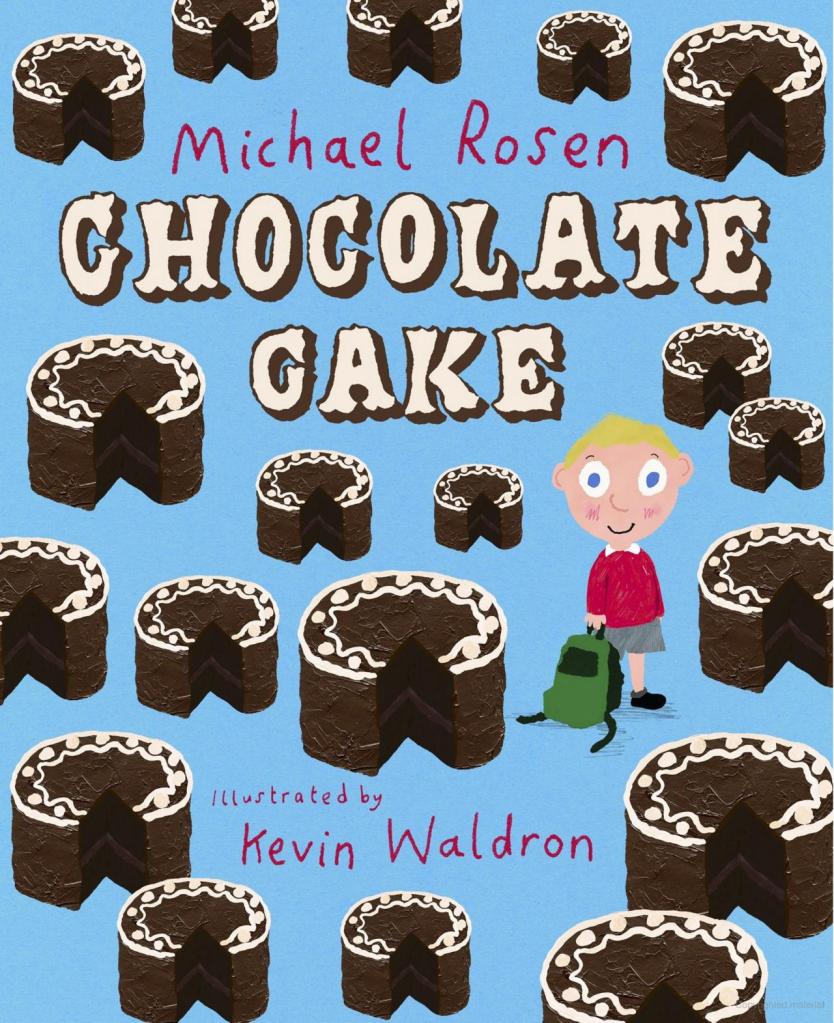
Michael Rosen (born 7 May 1946) is a British children’s author, poet, presenter, political columnist, broadcaster and activist who has written 140 books. He served as Children’s Laureate from 2007 to 2009 : one of the best known figures, not only in the children’s book world but also the British arts scene. His first book of children’s poems was published in 1974, and he has gone on to write numerous and award-winning children’s books such as Quick, Let’s get Out of Here, We’re Going on a Bear Hunt and Chocolate Cake. Alongside this he performs, teaches, lectures, presents Word of Mouth on BBC Radio 4 and reviews books for the Guardian. He was Children’s Laureate from 2007 to 2009, and founded the Roald Dahl Funny Prize in 2008 as part of his laureateship to honour books that make children laugh!Polka, London : April Through May in the year 2018 Rosen’s epic is dished up for the stage in an adaptation that stirs in his poems about fried eggs and baked potatoes. & Chocolate Cake at Polka Theatre. Todd Heppenstall (Brother)witty one-liner, Aminita Francis (Teacher, Mum)warm and engaging as Mum & Mark Houston (Michael) the perkiest chocolate eater. Credit Ellie KurttzAminita Francis as Mum and Todd Heppenstall as Joe in Michael Rosen’s Chocolate Cake. Photograph: Tristram Kenton/The Guardian.Kevin Waldron (Illustrator) Kevin Waldron was born and raised in Dublin.
After graduating with a degree in graphic design from D.I.T., he moved to London to study for an M.A in illustration at Kingston University. His first book, Mr. Peek and the Misunderstanding at the Zoo (Templar Publishing) won the Bologna Ragazzi Opera Prima Award in 2009. He illustrated Tiny Little Fly (Walker Books), written by Michael Rosen which won the Bull-Bransom Award in 2011. The same year, he was also named one of the Booktrust best new illustrators.
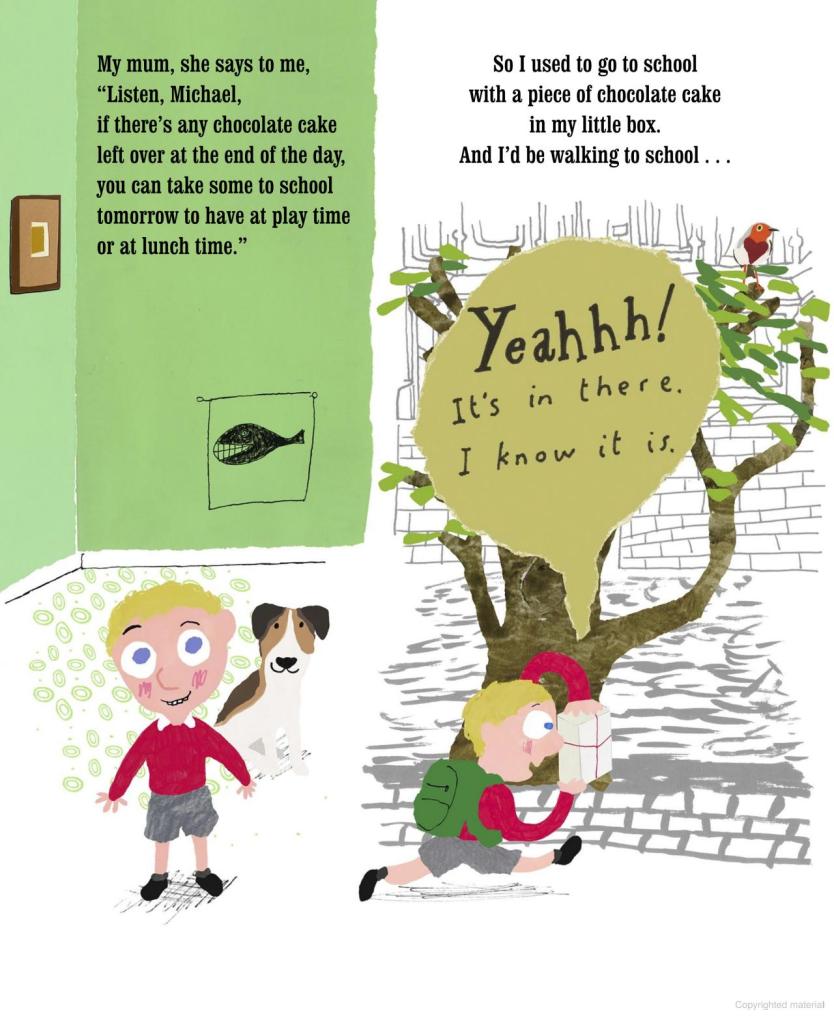
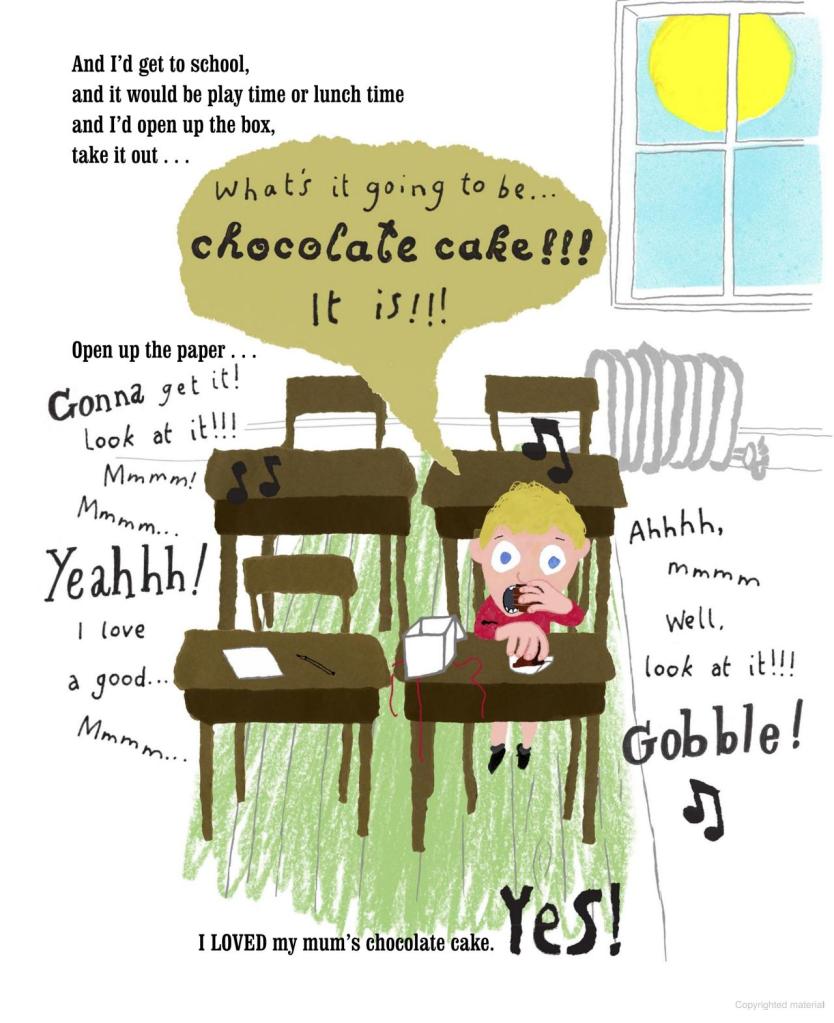
Kevin has now made New York his home. He makes picture books from his studio in Brooklyn. Sometimes his wife comes home & is angry that all the leftover dessert is goneSelected page ( 1 ) of the Book illustration By Kevin Waldron : From the books.google.co.in Page ( 2 ) Page ( 3 )Page ( 4 ) Photo From The Guardian SHINNING CHOCOLATE ALMOND MILK CAKE : Cut to Pieces on Ritz’s 2021 Birthday : Created by his Father
I love chocolate cake. And when I was a boy I loved it even more.
Sometimes we used to have it for tea and Mum used to say, ‘If there’s any left over you can have it to take to school tomorrow to have at playtime.’ And the next day I would take it to school wrapped up in tin foil open it up at playtime and sit in the corner of the playground eating it, you know how the icing on top is all shiny and it cracks as you bite into it, and there’s that other kind of icing in the middle and it sticks to your hands and you can lick your fingers and lick your lips oh it’s lovely. yeah.
Anyway, once we had this chocolate cake for tea and later I went to bed but while I was in bed I found myself waking up licking my lips and smiling. I woke up proper. ‘The chocolate cake.’ It was the first thing 1 thought of.
I could almost see it so I thought, what if I go downstairs and have a little nibble, yeah?
It was all dark everyone was in bed so it must have been really late but I got out of bed, crept out of the door
there’s always a creaky floorboard, isn’t there?
Past Mum and Dad’s room, careful not to tread on bits of broken toys or bits of Lego you know what it’s like treading on Lego with your bare feet,
yowwww shhhhhhh
downstairs into the kitchen open the cupboard and there it is all shining.
So I take it out of the cupboard put it on the table and I see that there’s a few crumbs lying about on the plate, so I lick my finger and run my finger all over the crumbs scooping them up and put them into my mouth.
oooooooommmmmmmmm
nice.
Then I look again and on one side where it’s been cut, it’s all crumbly.
So I take a knife I think I’ll just tidy that up a bit, cut off the crumbly bits scoop them all up and into the mouth
oooooommm mmmm nice.
Look at the cake again.
That looks a bit funny now, one side doesn’t match the other I’ll just even it up a bit, eh?
Take the knife and slice. This time the knife makes a little cracky noise as it goes through that hard icing on top.
A whole slice this time,
into the mouth.
Oh the icing on top and the icing in the middle ohhhhhh oooo mmmmmm.
But now I can’t stop myself Knife – 1 just take any old slice at it and I’ve got this great big chunk and I’m cramming it in what a greedy pig but it’s so nice,
and there’s another and another and I’m squealing and I’m smacking my lips and I’m stuffing myself with it and before I know I’ve eaten the lot. The whole lot.
I look at the plate. It’s all gone.
Oh no they’re bound to notice, aren’t they, a whole chocolate cake doesn’t just disappear does it?
What shall 1 do?
I know. I’ll wash the plate up, and the knife
and put them away and maybe no one will notice, eh?
So I do that and creep creep creep back to bed into bed doze off licking my lips with a lovely feeling in my belly. Mmmmrnmmmmm.
In the morning I get up, downstairs, have breakfast, Mum’s saying, ‘Have you got your dinner money?’ and I say, ‘Yes.’ ‘And don’t forget to take some chocolate cake with you.’ I stopped breathing.
‘What’s the matter,’ she says, ‘you normally jump at chocolate cake?’
I’m still not breathing, and she’s looking at me very closely now.
She’s looking at me just below my mouth. ‘What’s that?’ she says. ‘What’s what?’ I say.
‘What’s that there?’ ‘Where?’ ‘There,’ she says, pointing at my chin. ‘I don’t know,’ I say. ‘It looks like chocolate,’ she says. ‘It’s not chocolate is it?’ No answer. ‘Is it?’ ‘I don’t know.’ She goes to the cupboard looks in, up, top, middle, bottom, turns back to me. ‘It’s gone. It’s gone. You haven’t eaten it, have you?’ ‘I don’t know.’ ‘You don’t know. You don’t know if you’ve eaten a whole chocolate cake or not? When? When did you eat it?’
So I told her,
and she said well what could she say? ‘That’s the last time I give you any cake to take to school. Now go. Get out no wait not before you’ve washed your dirty sticky face.’ I went upstairs looked in the mirror and there it was, just below my mouth, a chocolate smudge. The give-away. Maybe she’ll forget about it by next week.
Michael Rosen
Rosen’s seemingly an autobiographical account on a chapter of childhood enacted as an epic children’s poem is about a kid a perkiest chocolate eater who wakes up in the middle of the night and gobbles down ( “Gobble” is a Sound he made when he ate the Cake ) his brother’s chocolate cake. Imagine with Michael Rosen ‘s playacted narration of the whole story how one night he crept downstairs to eat a bit of the chocolate cake in the kitchen; unable to resist having a few crumbs… and then slicing an edge at the both sides to make it look even / untouched .. . a bit more… until the whole cake is gone!!– and ended up wolfing down the whole lot. Then a child’s thoughtful disguise by washing the dish and knife. Although , his mum got him in the morning at the breakfast table from a smudge near his lips . But our boy denying and saying he didn’t know of it. But he knew his warm hearted Mum . So he was confident and took the give away : ” May be she will forget about it by next week: : Watch the narrative Video Of The Poem( link given At the Top ) : : A Glossy Shinning Sweet Treat : : : :
Any Metaphor we see in a “cake” !? Meaning: To be easy. Example: No problem, it should be a piece of cake. In Ancient Times, some civilizations baked cakes as a kind gesture for their gods and spirits. A round cake was meant to symbolize the cyclical nature of life, as well as the sun and the moon. Incidentally, this theory could explain why we serve cakes at special occasions like birthdays, to symbolize the cycle of life. : : A Chocolate is a great metaphor for life, it’s rich, full of energy, and joyful to the senses. It also represents some of the struggles in life: guilt, complexity, and unrelenting desire for more. To get a standardized results , one must be sure , confident and stick to the accuracy and exact in taking up the ingredients, in following the “How To “aspects of preparation , & baking details and Even in serving.: : Something that’s a piece of cake is as easy as eating a delicious piece of cake would be. The Americanism cakewalk, used to mean “something easy,” came first, in the 1860’s — piece of cake wasn’t used until around 1936. Both cake and pie & slice of cake 🍰 have a long history in the United States as metaphors for things that come easily. : : In time, the cake cutting ceremony began. The symbolism is that the hand of the groom is placed over that of the bride’s, to show his support and as a promise to take care of her and their future. The couple was encouraged to cut from the bottom tier, as a reminder of the relationship’s longevity. : : You can’t have your cake and eat it (too) is a popular English idiomatic proverb or figure of speech. The proverb literally means “you cannot simultaneously retain possession of a cake and eat it, too”. Once the cake is eaten, it is gone. : : A king cake, also known as a three kings cake, is a cake associated in many countries with Epiphany. Its form and ingredients are variable, but in most cases a fève (lit. ’fava bean’) such as a figurine, often said to represent the Christ Child, is hidden inside.After the cake is cut, whoever gets the fève wins a prize. Modern fèves can be made of other materials, and can represent various objects and people. : : Illustrative pictures of king Cake of different countries are given HERE In BELOW. : : : :
KingCake Part of a Louisiana-style king cake with the baby figurine on top
Traditionally, a small porcelain baby, symbolizing Jesus, is hidden in the king cake and is a way for residents of New Orleans to celebrate their Christian faith. The baby symbolizes luck and prosperity to whoever finds it.
Baby figure : Louisiana King Cake . A small porcelain baby, symbolizing Jesus, is hidden in the king cake and is a way for residents of New Orleans to celebrate their Christian faithThe baby symbolizes luck and prosperity to whoever finds it. That person is also responsible for purchasing next year’s cake or hosting the next Mardi Gras party. Bakers have been placing the baby outside of the cake to avoid liability for any choking hazard.Northern French Style galette des rois.Southern French style gâteau des roisA Spanish “roscón de reyes” with creamThe Twelfth Cake, Twelfth-night cake, or Twelfth-tide cake was once popular in the United Kingdom on Twelfth Night. It was frequently baked with a bean hidden in one side and a pea hidden in the other& Also A Silver Coin somewhere inside.: ; the man/lord finding the bean became King for the night, while the woman/lady finding the pea became the Queen – also known as the Lord or Lady of Misrule. Earlier, in the time of Shakespeare, there was only a Lord of Misrule, chosen by the hidden bean, reflected in Shakespeare’s play Twelfth Night: : : : Mary Berry Recipe:: Ingredients 5 large free-range eggs 250g/9oz self-raising flour 250g/9oz caster sugar 250g/9oz butter, softened 75g/2½oz ground almonds 350g/12oz glacé cherries, washed, dried and quartered 200g tin pineapple pieces in natural juice, roughly chopped and dried well on kitchen paper 350g/12oz dried apricots, snipped into small pieces 350g/12oz sultanas 100g/3½oz chopped almonds 2 unwaxed lemons, finely grated zest only To decorate 4 tbsp apricot jam, warmed 500g/1lb 2oz golden marzipan 1kg/2lb 4oz gold fondant icing metallic classic gold food colour dust 100g/3½oz white fondant icing edible silver balls 75g/2½oz icing sugar, sieved edible floral cake lace How-to-videos Method Preheat the oven to 160C/140C Fan/Gas 3. Grease and line a 23cm/9in deep, round cake tin with a single layer of baking paper.
Measure the eggs, butter, flour, sugar and ground almonds into a bowl and whisk together. Add the chopped almonds, lemon zest and dried fruit. Mix well, spoon into the tin and level off the top.
Bake for 2¼–2½ hours until golden-brown. You may need to cover with foil if it’s getting too brown.
Leave the cake to cool in the tin for 30 minutes, before removing onto a wire rack and leaving to cool completely .
To decorate, remove the baking paper and place the cake on a gold cake board. Brush with the apricot jam.
Lightly dust a work surface with a little icing sugar and roll out the marzipan to a cirlce slightly bigger than the cake. Cover and smooth over the surface and sides. Brush with a light sprinkling of water.
Lightly dust a work suface with a little icing sugar. Roll out the gold icing to a circle slightly bigger than the cake. Cover the marzipan and smooth the surface. Trim the excess icing, (reserve this for later) then tuck under the cake. Brush with the gold dust to create a metallic finish.
Wrap the lace around the bottom of the cake and smooth.
Sprinkle icing sugar over the worktop and roll out the white icing. Cut out a scalloped fringe, stars and crown shapes using small cutters. Stick the crowns and stars around the sides of the cake using a little water. Cut out stars from the reserved gold icing and stick on the crowns. Put a sliver ball on the tip of each crown. (Find /See the Mary Berry ‘s Twelfth night Cake Recipe image for design.)Dreikönigskuchen in SwitzerlandMexican Rosca de reyesRosconPortuguese Bolo ReiChocolate Rose Cake : “: : : : Home Cooking Adventure
Menu Chocolate Rose Cake CHOCOLATE RECIPES CHRISTMAS DESSERTS EASTER THANKSGIVING Chocolate Rose Cake By Ella Marincus-HomeCookingAdventure March 22, 2016
As a chocolate lover I have a lot of chocolate recipes , but this is the first time I’m posting a dark chocolate layered cake with a chocolate frosting, all chocolate, inside and out. This Chocolate Rose Cake is by far a dessert for chocolate lovers only, rich, moist and chocolaty, it’s like getting to chocolate heaven indeed.
x For this recipe is essential to use good quality cocoa powder and good quality chocolate, as their combined flavors will make the cake either heavenly or totally disappointing. The cocoa based cake is really moist and soft, doesn’t need any additional syrup to get it moist and melt in your mouth.
For the frosting I did not use the regular buttercream frosting that most of the recipes are using. I kind of stay away from buttercreams, for my taste, buttercream use just too much sugar.. In no way I am going to use like 7 or 8 cups of powdered sugar just to make a frosting able to be piped nicely. I’ve used a chocolate mousse frosting instead, made with only chocolate, whipping cream, cocoa powder for extra flavor and some gelatin to make it hold it’s shape better. No extra sugar in this frosting and it’s amazing.
. indeed. SERVINGS 14 servings PREP TIME 45 mins COOK TIME 35 mins TOTAL TIME 1 hr 20 mins PRINT RECIPE PIN RECIPE
Ingredients 1 ¾ cups (220g) all-purpose flour 3/4 cup (90g) unsweetened cocoa powder 2 tsp (12g) baking soda 1 tsp (5g) salt 2 cups (400g) sugar 2 eggs 1/2 cup (110g) vegetable oil 1 cup (240g) buttermilk 2 tsp (10g) vanilla extract 1 cup (240ml) hot coffee Chocolate Mousse Frosting 16 oz (460g) semisweet chocolate 1 ¼ cup (300g) whipping cream 2 tbsp (16g) cocoa powder 1 tbsp (10g) gelatin powder 4 tbsp (60g) cold water 2 cups (500g) whipping cream , 35% fat
Instructions Preheat oven to 350F (180C). Grease with butter and dust with flour two 9 inch (23 cm) round cake pans. In a large bowl whisk together the flour, cocoa powder, baking soda and salt. In another bowl mix sugar with eggs and oil until combined. Mix in buttermilk and vanilla extract. Incorporate flour mixture until well combined. Add hot coffee and mix to combine. The batter will have a runny consistency. Pour the batter evenly into the prepared pans.
Bake for about 30-35 minutes until a toothpick inserted into the center comes out clean or with few crumbs attached. Let pans cool on a cooling rack for 10-15 minutes. Remove the cakes from the pan and let them cool completely. Prepare the Chocolate Mousse Frosting. Place the chocolate and 1 ¼ cup cream into a small sauce pan. Place over very low heat until chocolate is melted. Stir in cocoa powder then remove from heat. Meanwhile dissolve gelatin in water and let it swell for about 5 to 10 minutes. Place the gelatin over low heat just until the gelatin dissolves and pour it over the melted chocolate mixture. Let cool completely.
Whip the chilled 2 cups of whipping cream until stiff peaks form. Gently fold the chocolate mixture into the whipped cream. Assemble the cake. Place 1 cake layer on your serving plate. Spread evenly with chocolate frosting,about 1- 1/2 cup of frosting. Add the second layer of cake. Gradually spread a thin layer of frosting on top and sides of the cake. Place the rest of the frosting into a piping bag fitted with a star tip. Start with the side of the cake. To make the rose, start in the center, then move your tip in a circle around the center point, once or twice depending on how big you want the rose to be. When the side of the cake is filled with roses continue with the top. Fill any remaining gaps with some frosting.
Refrigerate until ready :
“Chocolate Cake” By Michael Rosen : : A Children Poem : : Information Appreciation and poem Analysis Presented by V Jayaraj Pune India November 22 , 2022 : : WISHING YOU ALL A WONDERFUL HAPPY TWELFTH NIGHT : : : : : : : :
Resource-bank scholastic co.uk Robert Louis Stevenson : born 13 November, 1850 , at Edinburgh , Scotland – died of stroke 3 December , 1894 , Aged 44 : at Vailima, Samoa ; where, alarmed at increasing European and American influence in the South Sea islands, his writing turned away from romance and adventure fiction toward a darker realism.No longer content to be a “romancer”, Stevenson became a reporter and an agitator, firing off letters. In “A Humble Remonstrance”, Stevenson answers Henry James’s claim in “The Art of Fiction” (1884) that the novel competes with life. Stevenson protests that no novel can ever hope to match life’s complexity; it merely abstracts from life to produce a harmonious pattern of its own : During his college years, Stevenson briefly identified himself as a “red-hot socialist”In “The Day after Tomorrow”, appearing in The Contemporary Review (April 1887), Stevenson suggested: “we are all becoming Socialists without knowing it”.Legislation “grows authoritative, philanthropical, bristles with new duties and new penalties, and casts a spawn of inspectors ( under the Factories Act ) , who now begin, note-book in hand, to darken the face of England”. He wrote .In June 1888, Stevenson chartered the yacht Casco and set sail with his family from San Francisco. The vessel “plowed her path of snow across the empty deep, far from all track of commerce, far from any hand of help.” The sea air and thrill of adventure for a time restored his health, and for nearly three years he wandered the eastern and central Pacific, stopping for extended stays at the Hawaiian Islands, where he became a good friend of King Kalākaua. He befriended the king’s niece Princess Victoria Kaiulani, who also had Scottish heritage. He also travelled Australia , & South Sea Islands. Stevenson wrote an estimated 700,000 words during his years on Samoa. He completed The Beach of Falesá, the first-person tale of a Scottish copra trader on a South Sea island. Five years after Stevenson’s death, the Samoan Islands were partitioned between Germany and the United States. : : Alma Mater University of Edinburgh , Victorian era : : Poet , Essayist , Novelist , Travel Writer: ; Notable works Treasure Island , A Child’s Garden of Verses , Kidnapped , Strange Case of Dr. Jeckyll and Mr. Hyde Treasure Island : :Spouse Fanny Van de Grift Osbourne ( m. 1880 – 1894 ) : A celebrity in his lifetime, Stevenson’s critical reputation has fluctuated since his death, though today his works are held in general acclaim. In 2018 he was ranked, just behind Charles Dickens, as the 26th-most-translated author in the world : : Liza Veronin : Epoch Times: Illustration of Train of Victorian era Moder days Travel Experience of Rail journey passing through the hills , plains & Valleys Cheerful Children gazing panorama through the Window of the glass .
Faster than fairies, faster than witches, Bridges and houses, hedges and ditches; 2 And charging along like troops in a battle, 3 All through the meadows the horses and cattle: 4 All of the sights of the hill and the plain 5 Fly as thick as driving rain; 6 And ever again, in the wink of an eye, Painted stations whistle by. 8
Here is a child who clambers and scrambles, 9 All by himself and gathering brambles; 10 Here is a tramp who stands and gazes;11 And there is the green for stringing the daisies! 12 Here is a cart run away in the road13 Lumping along with man and load;14 And here is a mill and there is a river: 15 Each a glimpse and gone for ever!16
Robert Louis Stevenson From A Child’s Garden of Verses (1885 ) : : : :
“From A Railway Carriage” By Robert Louis Stevenson ( 1850 – 1894 ) , is A Children’s Poem and about Travel Experience from A Railway Carriage : The Poet flew about the places and the sights were winking quickly / instantaneously , before him , as the train was speeding fast. Let us also travel along with him by recite this poem : : : :
The train travelled much faster than Fairies ( Good Angels ) and witches ( Evil Women ) : Well , Angels cannot be an evil ! ; Only Humans are evil! ! : : He saw bridges, houses, hedges, and ditches along the way. He felt the train charged forward like troops of soldiers in a battlefield as if ready to attack. : : “All through the meadows the horses and cattle: ( Meaning , the Speed of the train is amazing ) All of the sights of the hill and the plain Fly as thick as driving rain; ” ( lines 4 To 6 ) Meaning that just like heavy rain falls so quickly that it is difficult to distinguish one drop from another, the speeding train also passes by the scenery so quickly that it is difficult to distinguish one sight from another : : He saw many brightly painted stations along the way, as he heard the whistles that indicated the arrival of the stations.
What did the poet see ? : : A Child, scrambling up brambles to gather some blackberry fruits ; A tramp who was standing and gazing at the things happening around him ; A boy who is collecting services hardly and a homeless person who is doing nothing but to stare the train and a man who is lifting the overloaded cart. : : The people stringing daises to make garlands from it; A cart that was lumping along laboriously with the weight of a man and the cartload , “running away in the road”( line 13 &14 ) ; A mill and A river. : “Each glimpse and gone for ever!” ( line 16 ) : All these flashes flaunted briefly before him and leaving behind him with the speed of a train. : : : :
Faster than fairies ; Houses, hedges (A fence formed by the raw of closely planted shrubs & bushes of low hights ; Child who clambers ( awkwardly climbing ) ; Lumping ( Grouped or chunks in cartload ) along with man and load ; Glimpse ( in flashes ) and gone forever : are the powerful imageries that use ‘ Alliteration ‘ : : : :
“From a Railway Carriage” is a masterly piece of versification ( Artful metrical adaptation of what can be described in a prose.) , using its sprightly rhythm full of spirit and vitality, to evoke the movement of a train. The rhythm and syntax rush along and zoom along the lively excitement and cheerful joy of a railway journey. : : : :
“From A Railway Carriage”, By Robert Louis Stevenson , A Children’s Poem , Information Appreciation and poem Analysis Presented by V Jayaraj Pune India November 21 , 2022 :
World Children’s Day was first established in 1954 as Universal Children’s Day and is celebrated on 20 November each year to promote international togetherness, awareness among children worldwide, and improving children’s welfare. On November 20 , 1959 , the he UN General Assembly adopted the Declaration of the Rights of the Child. It is also the date in 1989 when the UN General Assembly adopted the Convention on the Rights of the Child. Since 1990, World Children’s Day also marks the anniversary of the date that these adoptions .Mothers and fathers, teachers, nurses and doctors, government leaders and civil society activists, religious and community elders, corporate moguls and media professionals, as well as young people and children themselves, can play an important part in making World Children’s Day relevant for their societies, communities and nations. You are requested to advocate, promote and celebrate children’s rights, translating into dialogues and actions that will build a better world for children. World Children’s Day is UNICEF’s annual day of action for children, by children.
From climate change, education and mental health, to ending racism and discrimination, children and young people are raising their voices on the issues that matter to their generation and calling for adults to create a better future. Inspire the kids around you soon they will stand up for a more equal, inclusive world. Note the Related Observances from HERE In BELOW : And try to get going with something you can do in its perspectives.
4 June: International Day of Innocent Children Victims of Aggression
12 June: World Day Against Child Labour
12 August: International Youth Day
11 October: International Day of the Girl Child
International XYZ Days & Weeks are powerful tool of advocacy and occasions to educate the public on issues of concern, to mobilize political will and resources to address global problems, and to celebrate and reinforce achievements of humanity.
We , on our this blog : MADHU MALTI, are observing The Cause & Concern, similarly for 10 days of postings from November 19 , 2022 Through November 28 , 2022 , by presenting the Children’s Poems in English Literature, together with recitation, Sing a Song / Rhymes / Quotes/ messages, Etc.for the kids alongwith the appreciation & finding a meaningful learning out of the same . Kindly visit the same by visiting the post Today / This year / Every Year ( To be updated with additions Every year ), and if you like , share among your Friends and Circles. Thank you and HAPPY CHILDREN’S DAY: : : :
Eletelephony Laura Elizabeth Richard
Once there was an elephant, Who tried to use the telephant— No! No! I mean an elephone Who tried to use the telephone—
(Dear me! I am not certain quite That even now I’ve got it right.) Howe’er it was, he got his trunk Entangled in the telephunk;
The more he tried to get it free, The louder buzzed the telephee— (I fear I’d better drop the song Of elephop and telephong!)
“Ele Telephony” , By Laura Elizabeth is a fine laughing poem written in a Sily Pun . Silly means foolish / No seriousness. We generally do not admit our own silly mistakes, and surely say , “don’t be silly” especially in calling misbehaving child or children . Pun or punning is easy playing with words. For instance, here in the above poem, an elephant is trying to use “tele phant”,or “elephone”, the elephant’s trunk , becomes ” telephank ” : And the ” telephee” buzzed louder. In the end , a singer drops the idea of singing a song , calling it ” tele phong” so , that is ” telephony” : transmitting a humorous speech from/at a distance. Why don’t you be a telephoner ! ? Are you telephonist? ? And the last question , Are you becoming as fat as an elephant ? Yes : “હાથીભાઈ તો જાડા.. .” : : Discuss with a kid around you. : : V Jayaraj Pune India : :
Hey Diddle Diddle Author Unknown
Hey diddle diddle, The Cat and the fiddle, The Cow jumped over the moon, The little Dog laughed to see such sport, And the Dish ran away with the Spoon.
Portrait: young woman with corgi puppy, nature backgroundHappy young woman with her happily laughing dog Cow jumping over the Moon !? No ! Boss , its a red Bull : vector illustration of businessman riding bull and jumping over moon . Show me a Cow jumping over the Moon. Wait , See it here in below Illustration of a dairy cow jumping over the moon. A real photo is presumably with One Indian Political party ! Illustration of a Running Spoon ! running cup of coffee and coffee splash“…And the dish ran away with the spoon.” The last line from the old nursery rhyme “Hey Diddle Diddle”. From “R. Caldecott’s Second Collection of Pictures and Songs” containing “The Milkmaid”, “Hey Diddle Diddle”, Baby Bunting”, The Fox Jumps Over the Parson’s Gate”, “A Frog He Would a-Wooing Go”, “Come Lasses and Lads”, “Ride a Cock Horse…”, “A Farmer Went Trotting…”, “Mrs Mary Blaize” and “The Great Panjandrum Himself”. Drawn by Randolph Caldecott; engraved and printed by E. Evans. Published by George Routledge & Sons, London & New York, c1885.Antique children book illustrations: The dish ran after the spoon
The Purple Cow Gelett Burgess
I never saw a purple cow, I never hope to see one, But I can tell you, anyhow, I’d rather see than be one
The Forest Annette Wynne
The forest is the town of trees Where they live quite at their ease, With their neighbors at their side Just as we in cities wide
I’m a Little Teapot George Harold Sanders
I’m a little teapot Short and stout Here is my handle (one hand on hip) Here is my spout (other arm out straight)
When I get all steamed up Hear me shout “Tip me over and pour me out!” (lean over toward spout)
I’m a clever teapot, Yes, it’s true Here let me show you What I can do
I can change my handle And my spout (switch arm positions) Just tip me over and pour me out! (lean over toward spout)
Although originally a poem, this one begs to be sung.
Little Tea Pot : Alice in Wonderland .
There Was an Old Man with a Beard Edward Lear
There was an Old Man with a beard, Who said “It is just how I feared— Two Owls and a hen, For Larks and a wren, Have all built their nests in my beard!”
Ella: Of Infinite Possibilities Wide-eyed in wonder, Ella beholds the world. “How old are you?” her grandfather asks. She holds up five fingers. Ella traces her grandfather’s mosaic of wrinkles, touching his face with those same five fingers. Seeing tears form in her dark, dark eyes, he asks: “Why so sad?” “Because you are shrinking.” “But I am not sad,” Grandfather replies. “Why not?” “Because you are growing.” By Jacqueline Seewald
When Is That Golden Moment? When the scale tells me I’ve not gained a pound When my glasses or phone or keys have been found, When the cop pulls me over but spares me the ticket When my ice cream cone drips and I get to lick it, When I read the obituaries and don’t know a soul, When the car just ahead of me pays for my toll, When my pants can fit without sucking my gut in When I’m on the dance floor and a man asks to cut in, When it’s time for a movie and I get to choose it, When I cut out the coupon and remember to use it. Everyone understands the worth Of a big celebration: a marriage, a birth But moments of joy, too many to mention Brighten each day, when we just pay attention.
By Eileen Hession
“if there are any heavens” if there are any heavens my mother will(all by herself)have one. It will not be a pansy heaven nor a fragile heaven of lilies-of-the-valley but it will be a heaven of blackred roses
—e.e. cummings : : A Mother’s Day Poem : melting her heart
To My Mother with a poem I like.
Bloom I want to tell you about the sunflower I found on the sidewalk yesterday. It is wilting and curled and gorgeous and knows it.
I want to age like that, never forgetting my own beauty, never forgetting how to say bloom
By Anna Voelker
Wilting sunflower bowing its head down in the final days of summer.
The Days of the Months Author Unknown
Thirty days hath September, April, June, and November; February has twenty-eight alone. All the rest have thirty-one, Excepting leap-year—that’s the time When February’s days are twenty-nine.
Rhyme Elizabeth Coatsworth
I like to see a thunderstorm, A dunder storm, A blunder storm, I like to see it, black and slow, Come stumbling down the hill.
I like to hear a thunderstorm, A plunder storm, A wonder storm, Roar loudly at our little house And shake the window sills!
This children’s poem about thunderstorms can make your child laugh at something they may be afraid of.
At the Zoo William Makepeace Thackeray
First I saw the white bear, then I saw the black; Then I saw the camel with a hump upon his back; Then I saw the grey wolf, with mutton in his maw; Then I saw the wombat waddle in the straw; Then I saw the elephant a-waving of his trunk; Then I saw the monkeys – mercy, how unpleasantly they smelt!
Your child will be begging to go to the zoo after hearing this poem. You can even recite it in the car on the way.
Learning Judith Viorst
I’m learning to say thank you. And I’m learning to say please. And I’m learning to use Kleenex, Not my sweater, when I sneeze. And I’m learning not to dribble. And I’m learning not to slurp. And I’m learning (though it sometimes really hurts me) Not to burp. And I’m learning to chew softer When I eat corn on the cob. And I’m learning that it’s much Much easier to be a slob.
Eating corn on the cob quietly is an art that most adults have yet to master and an important lesson to learn.
Going to School, a child thanking his new Bus Driver/ conductor. Teach your child to introduce himself / herself. They should be taught the importance of being prepared and on time, : help their day run more smoothly. it’s a sign of respect to their classmates, playdates, teachers, and family members. Teaching them how to manage transitions from one activity to the next, : : learning to tell time, and always putting away things like shoes and uniform .: Demonstrate how to start a phone call, introduce yourself, and how to take turns speaking. Make sure they know how to handle video calls as well . : And : Saying “you’re welcome” Remembering to say “please” and “thank you” is a great start but you should also be teaching your kids how to politely accept a thank-you, Czink says. “Many children will say ‘no problem,’ ‘whatever,’ ‘OK’, or not reply at all when thanked,” she says. “The proper response is to say ‘you’re welcome’ or even ‘my pleasure.’”Saying Thank you to service workers in restaurants , canteen , To a gas- man delivering refill cylinder , To a courier / postman at your door. : :.Writing thank-you notes or texts is a good pass time with your kids. Waiting to eat until everyone / guests is seated and served. Whether you’re dining at home or in a restaurant, the proper etiquette is still to wait to begin eating the meal until everyone is served, Parker says. Many people are under the impression that children should always get to eat right away but even very young kids can be taught to wait several minutes for everyone else.Covering a cough or sneezing with a handkerchief
Children’s Day is celebrated on different days in different countries. It is celebrated on November 14 in India as a tribute to the country’s first prime minister, Jawaharlal Nehru.
Here are some Children’s Day quotes and wishes to celebrate the day:
Children’s Day quotes Every child is an artist, the problem is how to remain an artist once we grow up – Pablo Picasso There are no seven wonders of the world in the eyes of a child. There are seven million. -Walt Streightiff It’s not our job to toughen our children up to face a cruel and heartless world. It’s our job to raise children who will make the world a little less cruel and heartless. – L R Knost We cannot fashion our children after our desires. We must have them and love them as God has given them to us. – Johann Wolfgang Von Goethe Every time a child is saved from the dark side of life, every time one of us makes the effort to make a difference in a child’s life, we add light and healing to our own lives. – Oprah Winfrey Our children are our greatest treasure. They are our future. Those who abuse them tear at the fabric of our society and weaken our nation. – Nelson Mandela Children must be taught how to think, not what to think. – Margaret Mead A child can always teach an adult three things: to be happy for no reason, to be always busy with something and know how to demand with all his might what you want. – Paulo Coelho Children’s Day wishes The sweetest period of anyone’s life is their childhood. A very happy children’s day to all the kids in the world. Spend this day with unlimited fun! Children spread joy and happiness in every season as they are the most beautiful creation of God. Happy Children’s Day! God loves every child so much that he creates each one of them with unimaginable perfection. Truly, children are blessings from heaven. Happy Children’s Day! On this very special day, let us all celebrate the innocence and purity of our kids. Let them feel precious in every way that we can because they are our future. Happy Children’s Day! The most precious thing in this world is a smile on the face of a child. Happy children’s day to every kid in the world. You’re so special to us! Without children, the world would be devoid of sunshine, laughter, and love. That’s why I believe children are the most precious creation in the world. We should protect, guide and love them with all our might, for they are our greatest treasures. Happy Children’s Day! There are some things that we can’t buy, one such thing is our childhood. Enjoy the spirit of Children’s Day! Every child is a gift of nature. Give them their today, give them time to play, and make way for their future. Happy Children’s Day
( Acknowledgement : Times Now : India . )
2011. День защиты детей в Донецке 174.jpg Children’s Day in Donetsk, Ukraine, 20111958 Soviet stamp commemorating Children’s Day
Edward Lear’s illustration of the Owl and the Pussycat : : The “piggy-wig” in the land of Bong-trees“The Owl and the Pussy-cat went to sea In a beautiful pea-green boat, They took some honey, and plenty of money, Wrapped up in a five-pound note. ” : : : : : : : : A wonderful Fantacy picture is drawn by Edward Lear like Jabberwocky. “The Owl looked up to the stars above, And sang to a small guitar, “O lovely Pussy! O Pussy, my love, What a beautiful Pussy you are”“How charmingly sweet you sing! O let us be married! too long we have tarried: But what shall we do for a ring?” : : “They sailed away, for a year and a day, To the land where the Bong-Tree grows And there in a wood a Piggy-wig stood With a ring at the end of his nose, to sell for one shilling” ” Your ring?” Said the Piggy, “I will.” : : “They.. . were married next day By the Turkey who lives on the hill.”“They dined on mince, and slices of quince, Which they ate with a runcible spoon;”“And hand in hand, on the edge of the sand, They danced by the light of the moon,”
The Owl and the Pussy-Cat BY EDWARD LEAR I The Owl and the Pussy-cat went to sea In a beautiful pea-green boat, They took some honey, and plenty of money, Wrapped up in a five-pound note. The Owl looked up to the stars above, And sang to a small guitar, “O lovely Pussy! O Pussy, my love, What a beautiful Pussy you are, You are, You are! What a beautiful Pussy you are!”
II Pussy said to the Owl, “You elegant fowl! How charmingly sweet you sing! O let us be married! too long we have tarried: But what shall we do for a ring?” They sailed away, for a year and a day, To the land where the Bong-Tree grows And there in a wood a Piggy-wig stood With a ring at the end of his nose, His nose, His nose, With a ring at the end of his nose.
III “Dear Pig, are you willing to sell for one shilling Your ring?” Said the Piggy, “I will.” So they took it away, and were married next day By the Turkey who lives on the hill. They dined on mince, and slices of quince, Which they ate with a runcible spoon; And hand in hand, on the edge of the sand, They danced by the light of the moon, The moon, The moon, They danced by the light of the moon. Source: The Random House Book of Poetry for Children (1983) Edward Lear : :: :
The Owl and the Pussy-cat” is a nonsense poem by Edward Lear, first published in 1870 in the American magazine Our Young Folks: an Illustrated Magazine for Boys and Girls and again the following year in Lear’s own book Nonsense Songs, Stories, Botany, and Alphabets. Lear wrote the poem for a three-year-old girl, Janet Symonds, the daughter of Lear’s friend and fellow poet John Addington Symonds and his wife Catherine Symonds. The term “runcible”, used for the phrase “runcible spoon”, was invented for the poem. runcible’ actually means. (It’s defined by the Oxford English Dictionary as simply ‘A nonsense word originally used by Edward Lear’.) Lear didn’t help matters: as well as applying the word to a spoon, he went on to use ‘runcible’ to describe his hat, a wall, and even his cat! : : : :”The Owl and the Pussy-cat” features four anthropomorphic animals – an owl, a cat, a pig, and a turkey – and tells the story of the love between the title characters who marry in the land “where the Bong-tree grows”. : : : : Portions of an unfinished sequel, “The Children of the Owl and the Pussy-cat” were published first posthumously, during 1938. The children are part fowl and part cat, and love to eat mice.
The family live by places with strange names. The Cat dies, falling from a tall tree, leaving the Owl a single parent. The death causes the Owl great sadness. The money is all spent, but the Owl still sings to the original guitar.
Humphrey Searle in 1951, using twelve-tone technique for the accompanying flute, guitar, and cello, but sprechgesang for the vocal part. Elton Hayes made a recording of the Hely-Hutchinson setting for Parlophone.during 1953.
The poem depicts the idea of love and the truth behind ‘where there is a will there is a way.’ : :
Stanza 1 : : The 🦉 Owl and a Pussy 🐱 Cat went to the sea in a pea-green boat to enjoy honey and money wrapped in a five-pound note. The Owl started singing happily to the tune of the guitar while looking at the stars. He sang to the Pussy cat saying he loves her as she is a very beautiful Pussy cat. With this conversation ,singing and confession of love in his solemn pledge , Cat’s heart got mellowed down. The admiration and togetherness developed the starting of love relationship. : : : :
Stanza 2 : : A Pussy Cat responded to Owl’s pledge of love by herturn in appreciation of The Owl , saying that the voice of beautiful bird is charming and they should be married as they have spent long time in one place doing very little except for hanging around in enjoyment : ” .. . too long we have tarried :” Only thing they require is how they would get a wedding ring ; For which , “they sailed away for a year and a day. To the land where The Bong Tree grows. And there in a wood a Piggy-wig stood With a ring at the end of his nose,” : : Hereby , we learn that ” Where There is a Will , There is a Way ” : : Find a way out , Work out, resolve the issues , and get your desire to marry fulfilled. : : : :
Stanza 3 : : The Piggy- Wig agreed to sell his ring For One Shilling. They bought the ring ang got married next day when a Turkey from the hill became a Witness to their marriage. “Mince and Slices Of Quince” Aromatic Acid tasting , pear shaped Fruits ( from an Asian tree , ‘Quince’ with pinkish flowers & Pear- like fruits ) in small pieces ( Minced ) was a course of their wedding dinner.They used “runcible spoons” during this dinner and “danced hand in hand , on the edge of the sand” in the moonlight – night after having their dinner. Thus, Love , followed by a Marriage, Celebration and Enjoyment , All-to- gather in ‘ felicity ‘ : that is , pleasing and appropriate manner or style gives contentment , intense joy and : Happiness: : :
“The Owl And The Pussy Cat ” : A Children Poem : By Edward Lear, Information Appreciation and poem Analysis Presented by V Jayaraj Pune India November 19 , 2022 :: Happy World Children’s Day : 1 Day To Go : On November 20 , Every Year: :
Jabberwocky BY LEWIS CARROLL ’Twas brillig, and the slithy toves Did gyre and gimble in the wabe: 2 All mimsy were the borogoves, And the mome raths outgrabe. 4
“Beware the Jabberwock, my son! 5 The jaws that bite, the claws that catch! 6 Beware the Jubjub bird, and shun The frumious Bandersnatch!” 8
He took his vorpal sword in hand; 9 Long time the manxome foe he sought- 10 So rested he by the Tumtum tree And stood awhile in thought.12
And, as in uffish thought he stood, 13 The Jabberwock, with eyes of flame, 14 Came whiffling through the tulgey wood, And burbled as it came! 16
One, two! One, two! And through and through 17 The vorpal blade went snicker-snack! 18 He left it dead, and with its head He went galumphing back. 20
“And hast thou slain the Jabberwock? 21 Come to my arms, my beamish boy! 22 O frabjous day! Callooh! Callay!” He chortled in his joy. 24
’Twas brillig, and the slithy tobes 25 Did gyre and gimble in the wabe: 26 All mimsy were the borogoves, And the mome raths outgrabe.28 Source: The Random House Book of Poetry for Children (1983)
“Jabberwocky ” , By Lewis Carroll ( Charles Dodgson ) is An Esteemed ‘Nonsense Poem’ for children, often mistakenly called ‘The Jabberwocky’ ( the ‘titular’: Ranked / Titled’Jabberwock’ is the frightening monster, so the poem is ‘Jabberwocky’). It was included in Lewis Carroll’s 1871 follow-up book to “Alice’s Adventures in Wonderland,Through the Looking-Glass “, : Its 1 ST Stanza was written / printed by the Poet in 1855, in the little periodical ‘Mischmasch’ , which Charles compiled to entertain his family. : :
Inspite of warning by his father, A Boy , The hero leaves home, and goes out into the world, in order to confront the evil. He becomes proficient and courageous , in fighting skills ,so that , with his mission of killing jabberwocky ,the monster successfully, , all evils are uprooted. He overcomes all the difficulties and becomes victorious and beats up his enemy. Then he joyfully comes home again. It’s a Super natural story of fantacy repeatedly told and narrated to the Children as they call ‘Jabberwockyin literature’, featuring from several non – Literary Plots to Fantastical Story lines & Unusually Strangely Coined New Words & Grand , Magnificent Epic With Wonderful And Brave Audacious Heroes & Wicked Scoundrels like Monsters and Villains . : : Anglo-Saxon epic poem , ‘Beowulf’ through ‘Vladimir Propp’ And The Series like ‘The Lord of the Rings’: which have been dramatized and are Big Screen , Cinema Favourites. The Fairy’s Tales, And The Myths associated with England are Several – such as the story of the patron saint of England, St George, slaying the dragon – which utilise this theme / framed design & similar features. And Caroll’s Poems are Full of such and Similar features. : : : :
Notes for each of the 7 Quatrains Pending visit this post again later on to enjoy the appreciation of the poem. : V Jayaraj Pune India November 18 , 2022 : : : : : : : :
March 1962 Stars over the Dordogne BY SYLVIA PLATH Stars Over The Dordogne Stars are dropping thick as stones into the twiggy 1 Picket of trees whose silhouette is darker2 Than the dark of the sky because it is quite starless. 3 The woods are a well. The stars drop silently.4 They seem large, yet they drop, and no gap is visible. 5 Nor do they send up fires where they fall 6 Or any signal of distress or anxiousness. 7 They are eaten immediately by the pines. 8
Where I am at home, only the sparsest stars 9 Arrive at twilight, and then after some effort. 10 And they are wan, dulled by much travelling.11 The smaller and more timid never arrive at all 12 But stay, sitting far out, in their own dust. 13 They are orphans. I cannot see them. They are lost. 14 But tonight they have discovered this river with no trouble, 15 They are scrubbed and self-assured as the great planets. 16
The Big Dipper is my only familiar. 17 I miss Orion and Cassiopeia’s Chair. Maybe they are 18 Hanging shyly under the studded horizon 19 Like a child’s too-simple mathematical problem. 20 Infinite number seems to be the issue up there. 21 Or else they are present, and their disguise so bright 22 I am overlooking them by looking too hard.23 Perhaps it is the season that is not right. 24
And what if the sky here is no different,25 And it is my eyes that have been sharpening themselves? 26 Such a luxury of stars would embarrass me. 27 The few I am used to are plain and durable;28 I think they would not wish for this dressy backcloth 29 Or much company, or the mildness of the south. 30 They are too puritan and solitary for that– 31 When one of them falls it leaves a space, 32
A sense of absence in its old shining place. 33 And where I lie now, back to my own dark star, 34 I see those constellations in my head,35 Unwarmed by the sweet air of this peach orchard. 36 There is too much ease here; these stars treat me too well. 37 On this hill, with its view of lit castles, each swung bell38 Is accounting for its cow. I shut my eyes 39 And drink the small night chill like news of home. 40
” Stars Over The Dordogne” , By Sylvia Plath is about Stars , presented with symbols , images , and description, the theme of ‘depression’ assisting to regard with the thoughts of Eternity , Universe and such ingenious things.
The stars are symbols of good thoughts. The very first line says, ” Stars are dropping thick as stones in to the twiggy ( line 1 ) Picket of trees whose silhouette is darker ( line 2 ) Than the dark of the sky because it is quite starless.”( line 3 ) : which suggest the ‘depression ‘; As a reader we can see the darkness of her mind and no happiness.
” The woods are a well , Stars drop silently” ( line 4 ) ; And “They are orphans. I cannot see them. They are lost. ( line 14 ) ; And “Such a luxury of stars would embarrass me” ( line 27 ) denoting hardness and unsureness in dealing with luxury of stars ; And The falling Stars do not “send up fire” ; “Or any signal of distress and anxiousness” ( lines 6 & 7 ) , but ” They are eaten immediately by the pines” ( line 8 ) denoting rushing sorrows & an expression of getting worried for the falling stars with hasty desire to stop its moving for the pines : All these lines are suggestive of a kind of ‘depression’ : :
“I am overlooking them by looking too hard.23 Perhaps it is the season that is not right. 24
And what if the sky here is no different, 25 And it is my eyes that have been sharpening themselves? “26 : : ( lines 23 To 26 ) shows the confused state of mind as well as precariousness and doubt fullness.
“They seem large, yet they drop, and no gap is visible.” ( line 5 ) ; And “When one of them falls it leaves a space,” ( line 32 ) ; And A sense of absence in its old shining place. ( line 33 ) : : These are the Poetic expressions of linear perspective considering what is followed from the position or a view taken along the ‘Star Trek’ which is suggestive of the event of departure from the Shinning positions, eventually the absence from the heavenly position alloted to Stars so far and ultimately leading to a final , ending state of existence of everything in the Universe : ( affecting Humans & Earthly living beings , too ) . In all , consolidating the overall feelings of uncertainty in livingand resultant ‘depression’. : : : :
“And where I lie now, back to my own dark star.” 34 “I see those constellations in my head” 35 ; And “. .. . I shut my eyes 39 And drink the small night chill like news of home.”40 : : With whatever state of affairs affecting her with ‘depression’, The Poet is apparently sensitive to things beyond the natural range of perception but has not been anomalous for a long and her deviation from the general & common EARTHLY Thoughts gone to constellation return back to her Home , just with the shut of her eyes , “And drink with the small night chill like news of home” : : : : Hence , let us relate to her poem with our own positions and questioning and views different or the same whatsoever. : : : :
Notes for each of the 40 lines in 5 Stanzas , each of 8 lines : pending visit this post again later on to enjoy the appreciation of the poem. V Jayaraj Pune India November 17 , 2022 : : : : : : : :
Thomas Ernest Hulme (T. E. Hulme) was born at Gratton Hall, Endon, Staffordshire on the 16th September 1883. :
The Embankment BY T. E. HULME (The fantasia of a fallen gentleman on a cold, bitter night.) Once, in finesse of fiddles found I ecstasy, In the flash of gold heels on the hard pavement. Now see I That warmth’s the very stuff of poesy. Oh, God, make small The old star-eaten blanket of the sky, That I may fold it round me and in comfort lie.
“The Embankment” A Star Poem : By T E Hulme ( 1887 – 1917 ) , Thomas Ernest Hulme (/hjuːm/; 16 September 1883 – 28 September 1917) was an English critic and poet who, through his writings on art, literature and politics, had a notable influence upon modernism. He was an aesthetic philosopher and the ‘father of imagism’ ( Imagist poetry ) : :He left behind only a handful of short poems. He revolutionised the way English poetry approached issues of rhyme, metre, and imagery. Few before Hulme had thought seriously to liken the moon to a child’s balloon or the ruddy face of a farmer, but Hulme was resolute that poetry, in the hands of the Victorians, had become stale and old, and needed to be reinvented. : : : : Hulme’s masterpiece is the poem, ‘The Embankment’, written around 1908-9 while Hulme was an active member of the Poets’ Club (later the Secession Club) in London. : અર્થ નિર્દેશ આસ્વાદ કાવ્યાર્થ વિચાર વિ જયરાજ : : લંડનના એમ્બૅન્કમેન્ટ પર ( બેઘર લોકો માટે ઉબડખાબડ રાતવાસો કરવા માટે જાણીતો વિસ્તાર ), ‘પડેલા સજ્જન’ તેના ભૂતકાળને પ્રતિબિંબિત કરે છે અને તેને દુન્યવી સામાજિક પ્રવૃત્તિઓમાં કેવી રીતે આનંદ મળ્યો “fineness of fiddles” : ( સારંગી કે વાયોલિન જેવું વાદ્ય : musical dance party સૂચવે છે ) અને સુંદર સ્ત્રીઓ – કદાચ : “In the flash of gold heels on the hard pavement.” રસ્તાની બાજુએ બાંધેલી ફરસબંધી : પથથરજડી પગથી ) courtesans or prostitutes તરફ સૂચવાયેલ દૃશ્ય નજર સામે જોતા જ્યાં હવે, તેના નસીબના કારણે T E Hulme અને મોટા ભાગે બેઘર લોકો , ઉબડખાબડ શેરીઓ માં પડ્યા ઊંઘે છે અને તે સમજે છે કે વાસ્તવમાં હૂંફ ભર્યો ગરમાટો વધારે અગત્યની જરૂરિયાત છે જેને કવિતામાં યથાર્થ સ્વરૂપ સાથે અગ્રતા આપવી જોઈએ.” Now see I That warmth’s the very stuff of poesy. ” ( પોઈસી : કાવ્ય સાહિત્ય : કવિતા ની સામગ્રી માં આ હૂંફ , આ ઉષ્ણતા સંમિલિત થવી જોઈએ , તેનું મહત્વ સમજાયું છે. ) હૂંફ ભર્યો ગરમાટો / ઉષ્ણતા માટેની આ ઈચ્છા પૂરી કરવા માટે , ઇશ્વરને ખરા દિલથી , તારાઓને લાંબા વખતથી ખવડાવ્યુ વિસ્તૃત આકાશમાંથી : અંતરિક્ષમાં થી , ( ઓઢવાનો ) નાનો એવો ધાબળો બનાવી આપવાની આજીજી કરે છે : ” Oh, God, make small The old star-eaten blanket of the sky, That I may fold it round me and in comfort lie.” જેને હું મારી આસપાસ વીંટાળીને , બાથમાં લઈ ભેટીને ઓઢું અને ( પછી ) સુખેથી પડ્યો રહું . : : The Embankment : A Star Poem By T. E. Hulme : : information Appreciation and poem Analysis Presented by V Jayaraj Pune India : : June 6 , 2022 : : અર્થ નિર્દેશ આસ્વાદ કાવ્યાર્થ વિચાર વિ જયરાજ : pending visit this post again later on to enjoy the appreciation of the poem : :
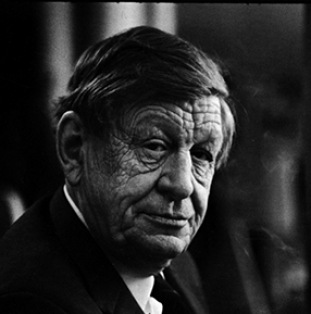
W H Auden ( 1907 – 1973 ) : W. H. Auden was admired for his unsurpassed technical virtuosity and ability to write poems in nearly every imaginable verse form; his incorporation of popular culture, current events, and vernacular speech in his work; and also for the vast range of his intellect, which drew easily from an extraordinary variety of literatures, art forms, social and political theories, and scientific and technical information.Wystan Hugh Auden was born in York, England on February 21, 1907. He moved to Birmingham during childhood and was educated at Christ Church, Oxford. As a young man he was influenced by the poetry of Thomas Hardy and Robert Frost, as well as William Blake, Emily Dickinson, Gerard Manley Hopkins, and Old English verse. At Oxford, his precocity as a poet was immediately apparent, and he formed lifelong friendships with two fellow writers, Stephen Spender and Christopher Isherwood.In 1928, Auden’s collection, Poems, was privately printed, but it wasn’t until 1930, when another collection titled Poems (though its contents were different) was published, that Auden was established as the leading voice of a new generation.: He had a remarkable wit, and often mimicked the writing styles of other poets such as Dickinson, W. B. Yeats, and Henry James. His poetry frequently recounts, literally or metaphorically, a journey or quest, and his travels provided rich material for his verse.: : served in the Spanish Civil War, and, in 1939, moved to the United States, where he met his lover, Chester Kallman, and became an American citizen. His own beliefs changed radically between his youthful career in England, when he was an ardent advocate of socialism and Freudian psychoanalysis, and his later phase in America, when his central preoccupation became Christianity and the theology of modern Protestant theologians. : : Auden was also a noted playwright, librettist, editor, and essayist. Generally considered the greatest English poet of the twentieth century, his work has exerted a major influence on succeeding generations of poets on both sides of the Atlantic. : : W. H. Auden served as a Chancellor of the Academy of American Poets from 1954 to 1973, and divided most of the second half of his life between residences in New York City and Austria. He died in Vienna on September 29, 1973. : : Auden will remain a man associated with Modernism Movement in Art, Poetry ,& litrature.A tour van decorated for The Fault In Our Stars book tour in 2012Theatrical release poster of the 2012 Movie : ” The Fault In Our Stars :Director: Josh Boone: did 307.2 million dollar box office collection business.: The film stars Shailene Woodley and Ansel Elgort, with Laura Dern, Sam Trammell, Nat Wolff, and Willem Dafoe in supporting roles. Woodley plays a sixteen-year-old cancer patient forced by her parents to attend a support group, where she meets and subsequently falls in love with another cancer patient, played by Elgort.A Loving Couple admiring the view of Milky way galaxy during the night time, gazing the Stars & Starlight.
The More Loving One : : : : W H Auden : : : 😦 1907 – 1973 )
Looking up at the stars, I know quite well1 That, for all they care, I can go to hell, 2 But on earth indifference is the least 3 We have to dread from man or beast. 4
How should we like it were stars to burn5 With a passion for us we could not return?6 If equal affection cannot be, 7 Let the more loving one be me. 8
Admirer as I think I am 9 Of stars that do not give a damn, 10 I cannot, now I see them, say 11 I missed one terribly all day. 12
Were all stars to disappear or die, 13 I should learn to look at an empty sky14 And feel its total dark sublime,15 Though this might take me a little time.16
From Homage to Clio by W. H. Auden, published by Random House. 1960 W. H. Auden, renewed by the Estate of W. H. Auden : : : : Taken from poets.org : : For Educational purposes only : : : :
” The More Loving One” , A metaphysical Star Poem By W H Auden ( 1907 – 1973 ) is about unreciprocated or un answered Love and the poet’s contemplation about unequal love. : : There is a difficulty in finding love. The Poet knows that the stars are indifferent to him, but then if equal affection between two things – or between two people – is impossible, he would rather be “the more loving one” : : : : The universe has a purpose for us; or it doesn’t, but that is not a point. We must meet the star’s trait of un -concern head-on and pride ourselves on becoming the products of ‘Nature’, on having the ability to care and awe our dignity in admiring the Nature’s sublime beauty and on making us in to love. : : : :
“Looking up at the stars, I know quite well 1 That, for all they care, I can go to hell, 2 But on earth indifference is the least 3 We have to dread from man or beast.” 4 : : : : Stanza 1 : : : : lines 1 To 4 : : : :
When the poet looks up at the stars he knows that they don’t care about what happens to him. “for all they care , I can go to hell.” ( line 2 ) : Man is set to be suspicious of in becoming “man or beast” : “We have to dread from man or beast.”: ( line 4 ) , “indifference is the least” ( line 3 ) to be feared of . A pre – historic caver had to fight other cavers over food or had to prevent himself from big threatening “beasts” : : : :
“How should we like it were stars to burn 5 With a passion for us we could not return? 6 If equal affection cannot be, 7 Let the more loving one be me.” 8 : : : : Stanza 2 : : lines 5 To 8 : : : : :
What if things were different,the poet thinks. If the stars were to “burn , With a passion for us” ( line 6 ) In that case, couldn’t we reciprocate a love? The things are better off. Dammit … if the stars won’t bother about us. The poet pronounces that he is glad to be “the more loving one” ( line 8 ) , ” If equal affection can not be,” ( line 7 ) : : : :
“Admirer as I think I am 9 Of stars that do not give a damn, 10 I cannot, now I see them, say 11 I missed one terribly all day.”12 : : : : : : Stanza 3 : : lines 9 To 12 : : : :
The poet emphatically says in lines 9 & 10 , that although he is an “Admirer” of the stars, he doesn’t mind for them during the day when he can not see them. He is exactly “the more loving one” because he admires the beauty of the stars in the night sky. : : : :
“Were all stars to disappear or die, 13 I should learn to look at an empty sky 14 And feel its total dark sublime, 15 Though this might take me a little time.” 16 : Stanza 4 : : lines 13 To 16 : : : :
Auden declares his desire for Adaptation in any eventuality like the one stated in line 13: so much so that if all the stars in the sky disappeared or died, he would learn to look at an empty sky” ( line 14 ) in the night ( well , day is not a problem! ) and would take up the cause of it for meeting with the night time total darkness, without stars to brighten it up. And that “total dark”would be the “sublime” ( line 15 ) ‘beauty of the night’ to be worthy of the adoration or reverence which might take him “a little time” ( line 16 ) , but he’d adapt. : : : :
Thus the indifference of Nature towards us is cool , OK & alright. He admires for the beauty of the Stars in the night , he would see , as well as face , in the eventuality of their total absence causing darkness, and is even ready to get adapt to total dark finding it as sublime beauty too. : : So , Be an admirer of the beauty of the night time Stars, and don’t bother whether you live or die , Or they live or die; This is the message to receive from this poem. : : : : There was a decline of faith in the western world, and the growing secularism ( the doctrine that rejects religion and religious considerations ) of the 20 th Century’s Modernism which we still continue with in our time of the 21 St Century. The admirable Stars far away Off , from few light years to thousands , and millions of light years distance, from our dwellings on the Earth , should not be the part of our belief , One man’s concerns and value system. They alongwith their gravitational force which is weak in affecting us from such an unreachable distances; and can not affect the mankind and the living systems on the earth , astrologically or astronomically. : : Earth is the only planet known for life in the Universe as we know so far ; and especially , when the stars are not reachable by any means and ways so far we have technologically developed for space traveling. ‘The Fault in Our Stars’ : ( John Green’s Novel , the name after this famous quote said to Brutus, by ‘Julius Caesar’ ) : : Even , A E Housman wrote his Poem , about “Nature not caring about” him : : As W H Auden believed : : “there is no ‘heaven’ as man has conceived of it. The stars are just balls of gas, burning steadily, and there is no godly guiding hand” : : , Just for love : Being “The More Loving One” , We should admire the stars all the same, even though they don’t care about us : : : :
“The More Loving One” By W H Auden: : A Star Poem : : Information Appreciation and poem Analysis Presented by V Jayaraj Pune India November 16 , 2022 : : : : : : : :